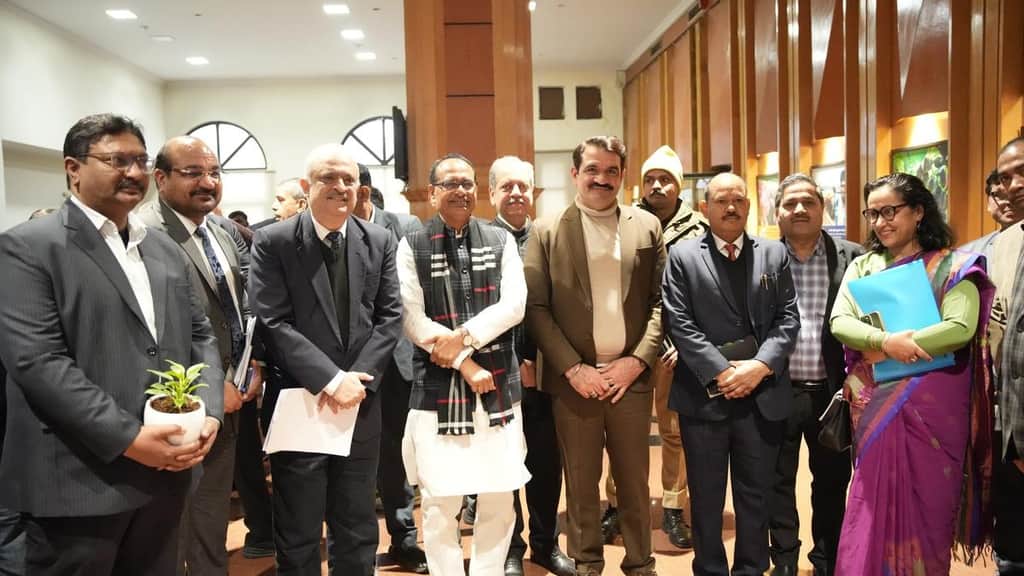
The Central government on Sunday (January 4, 2026) unveiled 184 high-yielding and climate-resilient seed varieties of 25 crops that will help farmers increase productivity, reduce costs, and cope with climate change, soil salinity, drought, and other biotic and abiotic stresses.
The new varieties – developed by the Indian Council of Agricultural Research (ICAR), various universities, and private entities – include 122 cereals, six pulses, 13 oilseeds, 11 fodder crops, six sugarcane varieties, 24 cotton (including 22 BT cotton), and one each of jute and tobacco, the government said.
Union Agriculture Minister Shivraj Singh Chouhan said the country has become the world’s largest rice producer, surpassing China. “India’s rice production has reached 150.18 million tons, compared to China’s 145.28 million tons, ensuring national food security and strengthening India’s role as a global food supplier,” he said, adding that the new seed varieties will boost crop production and enhance income of farmers.
Mr. Chouhan said that since 2014 the Narendra Modi government has approved 3,236 high-yielding varieties of seeds as compared to 3,969 varieties notified between 1969 and 2014.
ICAR director general M.L. Jat highlighted the importance of breeding programmes focused on acid soils, organic and natural farming systems, and regenerative agriculture. Union Agriculture Secretary Devesh Chaturvedi said the National Seeds Corporation played a significant role in seed multiplication, which has contributed to enhanced agricultural productivity and achieved a turnover of ₹200 crore.
Defending the recently passed Viksit Bharat Guarantee for Rozgar and Ajeevika Mission (Gramin) Bill, Mr. Chouhan said the Congress was spreading misinformation about the new scheme. He said Leader of Opposition in the Lok Sabha Rahul Gandhi was not present in the House when the Bill was taken up for debate. He said the Opposition did not want to listen to the details of the Bill.
“The Congress has announced an MGNREGA Bachao Sangram. It is actually a ‘save corruption’ campaign. MGNREGA had become synonymous with corruption. Under social audits done by gram sabhas, there were more than 10,51,000 complaints. The same work was repeated, work was done by machines, money was siphoned off in the name of cleaning canals and roads, 30% workers were above the age of 60,” he said.
The Minister said an amount of more than ₹8.48 lakh crore has been allocated to the scheme by the government, while the UPA had spent just over ₹2 lakh crore on it. “The Congress is a factory of lies. It is now saying that workers will not get work,” he said, adding that the new Bill offers a better scheme than MGNREGA.
Editorial Context & Insight
Original analysis & verification
Methodology
This article includes original analysis and synthesis from our editorial team, cross-referenced with primary sources to ensure depth and accuracy.