Big Tech’s 2026 AI Spending: Why the Meta, Alphabet, Microsoft and Amazon Capex Numbers Don’t Add Up
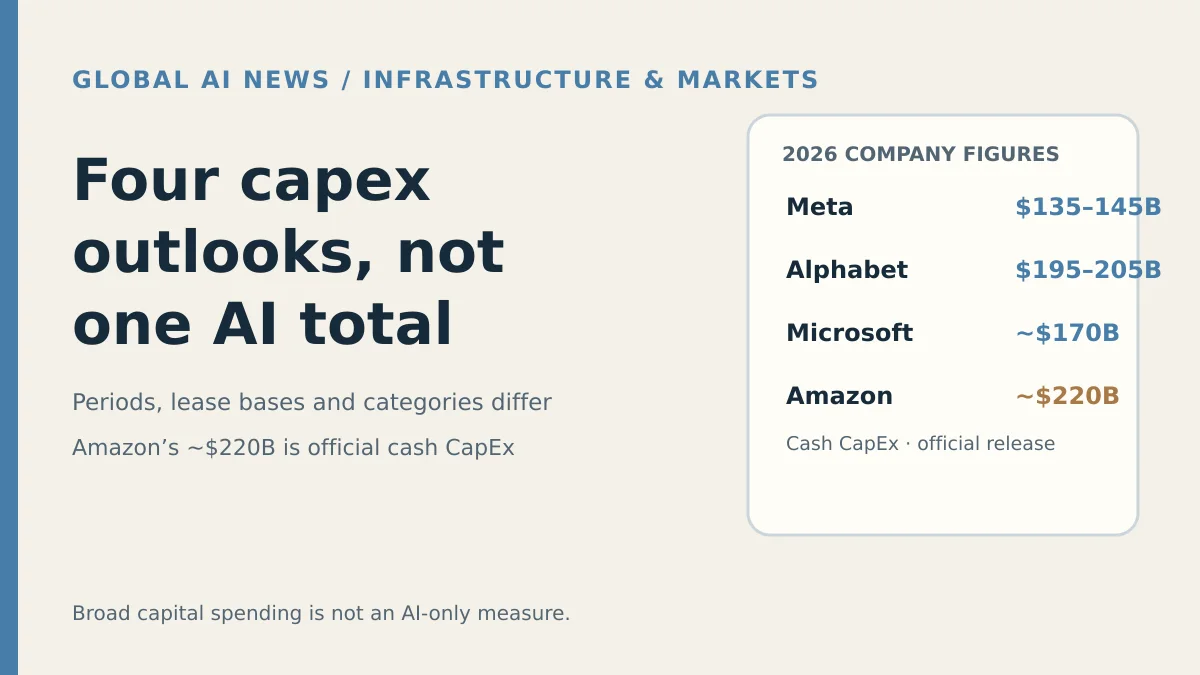
Meta guides $135–145B, Alphabet $195–205B, Microsoft about $170B and Amazon about $220B. Different periods and lease treatments make a single $700B+ “AI capex” total misleading.
Key takeaways
- Meta’s $135–145 billion guidance includes finance-lease principal payments; Alphabet’s outlook is $195–205 billion.
- Microsoft’s roughly $170 billion estimate is for calendar 2026; Amazon expects about $220 billion of 2026 cash capex, mostly for AWS.
- The figures differ in period, accounting basis and category, and none is an audited AI-only number, so a combined $700–745 billion headline does not hold up.
In this article
The bottom line
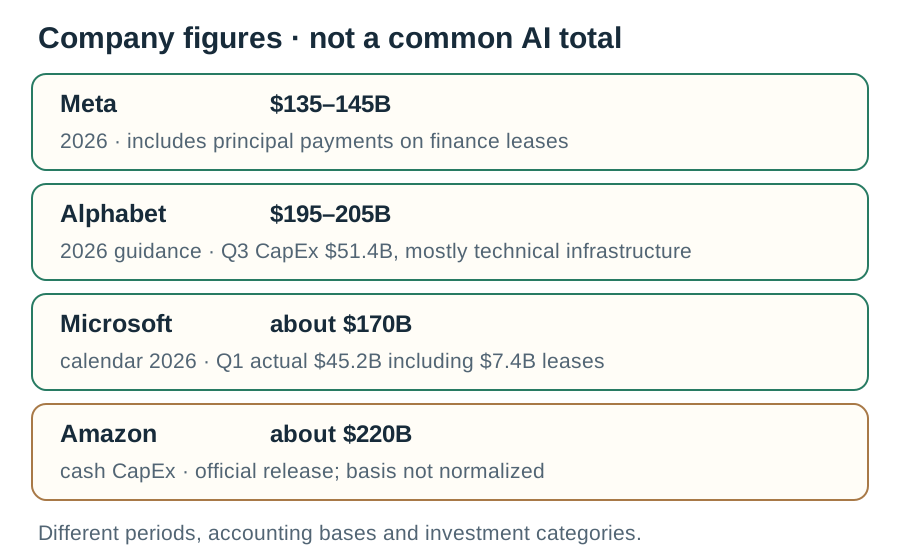
The latest company disclosures do not support one verified four-company “AI capex” figure for 2026. Meta’s $135–145 billion guidance includes principal payments on finance leases. Alphabet’s $195–205 billion outlook is a company capital-expenditure forecast, with $51.4 billion reported for Q3 and most spending tied to technical infrastructure. Microsoft’s roughly $170 billion estimate is for calendar 2026, while its fiscal Q1 reported $45.2 billion of CapEx, including $7.4 billion in finance leases. Amazon’s 29 October Q3 release confirms approximately $220 billion in 2026 cash capital expenditures, with the majority expected to go to AWS. These figures still differ in period, accounting basis and category. None is an audited measure of AI-only investment. A combined $700–745 billion headline should therefore be withheld until the underlying rows are reconciled.
The more useful question is not “How large is the total?” but “What does each company mean by capital spending, for which period, and for what kind of infrastructure?” Company filings and calls answer parts of that question. They do not supply a consistent four-company table of AI-only cash outlays.
What each company has actually said
View data
| Company | Latest figure found | Period and basis | Verification status |
|---|---|---|---|
| Meta | $135–145B | 2026; includes principal payments on finance leases | Official Q3 release |
| Alphabet | $195–205B | 2026 guidance; Q3 CapEx was $51.4B | Official call transcript |
| Microsoft | About $170B | Calendar 2026 estimate; FY2027 Q1 CapEx was $45.2B, including $7.4B in finance leases | Official call transcript |
| Amazon | About $220B cash CapEx | 2026; majority for AWS | Official Q3 release; cash basis differs from other rows |
The amounts are not yet on a common basis and are not AI-only totals. [1–8]
Meta’s 21 October Q3 release reports $34.91 billion in quarterly capital expenditures, including principal payments on finance leases, and maintains a $135–145 billion 2026 range on that same stated basis. That definition is unusually explicit and should travel with the number every time it is repeated. [1]
Alphabet’s 28 October earnings-call transcript keeps 2026 capital-expenditure guidance at $195–205 billion. It reports $51.4 billion in Q3, with most spending directed to technical infrastructure. The transcript does not make that entire category synonymous with AI, and the basis should not be silently converted into Meta’s lease-inclusive definition. [2]
Microsoft’s FY2027 Q1 call gives an estimate of approximately $170 billion for calendar 2026. The company also reports $45.2 billion of CapEx in the quarter ended 30 September, including $7.4 billion in finance leases. Its explanation for the calendar estimate points to third-party capacity deliveries delayed into the second half. That is a timing explanation, not a claim that the annual estimate fell because of lease accounting. [3]
Amazon’s official 29 October Q3 release says the company continues to expect approximately $220 billion in 2026 cash capital expenditures, the majority for AWS, and expects to spend meaningfully more in 2027. This verifies the annual estimate from a primary company source; third-party call transcripts also carry similar wording. The figure is still a cash-CapEx measure, so it is not automatically comparable with Meta’s lease-inclusive range or the other companies’ capital-expenditure presentations. [4–8]
Why the numbers do not add cleanly
View data
| Reconciliation check | Why it matters in this comparison |
|---|---|
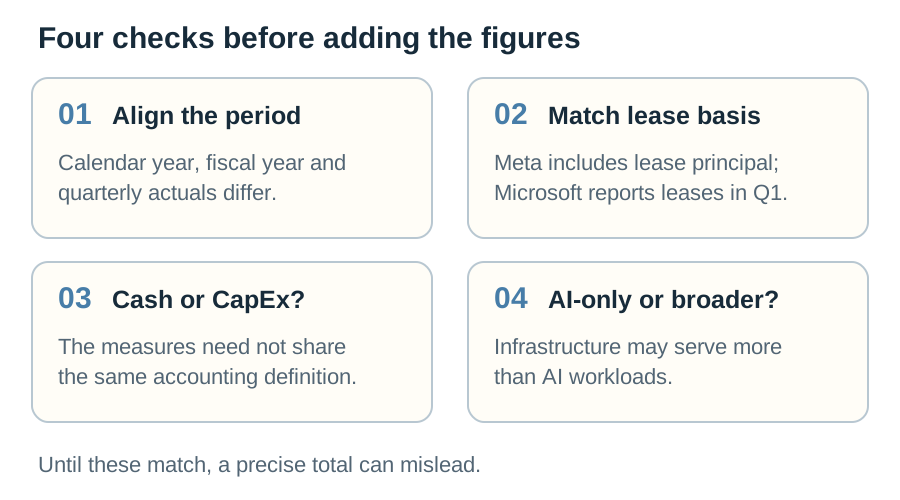
| Period | Calendar 2026 is not the same as a fiscal quarter or a fiscal-year outlook. |
| Lease accounting | Meta includes finance-lease principal in its stated range; Microsoft identifies leases in its quarterly figure. |
| Cash versus CapEx | Amazon’s annual figure is confirmed as cash CapEx in its official release; it is not normalized to other companies. |
| Investment category | Technical infrastructure and total capital expenditures include equipment and facilities that may support more than AI. |
Period alignment: An annual forecast and a single quarter’s actual spending answer different questions. A quarter is useful as a run-rate signal, but multiplying it by four assumes a steady pace that the companies have not promised. Microsoft’s fiscal first quarter is also not the first quarter of calendar 2026. Its calendar-year estimate is a separate forward-looking statement. [2][3]
Lease treatment: Meta explicitly includes finance-lease principal in its 2026 guidance. Microsoft’s Q1 figure includes $7.4 billion in finance leases. A cash-only estimate, a CapEx measure including finance leases and a CapEx line presented under another company’s reporting convention are not automatically equivalent. A comparison needs to state which treatment it uses and whether every company reported enough detail to normalize the others. [1][3]
CapEx versus cash CapEx: Amazon’s official release calls its $220 billion figure “cash capital expenditures.” That primary wording resolves the source question, but not the comparison question: cash CapEx should not be treated as interchangeable with another company’s reported capital-expenditure guidance without checking the underlying definition. The estimate can be reported as Amazon’s guidance while still being excluded from a normalized four-company total. [4–8]
AI spending versus infrastructure: The company figures are not a common measure of investment solely in AI. Meta’s range covers capital spending, not a disclosed AI-only bucket. Alphabet describes most Q3 spending as technical infrastructure, which can support several services and workloads. Microsoft and Amazon discuss cloud and data-center capacity alongside AI demand, but those broad categories do not isolate an AI-only amount. A label such as “AI CapEx” would require a company-provided allocation or a carefully disclosed estimate; the current figures do not provide one. [1–4]
The difference between guidance and a market estimate
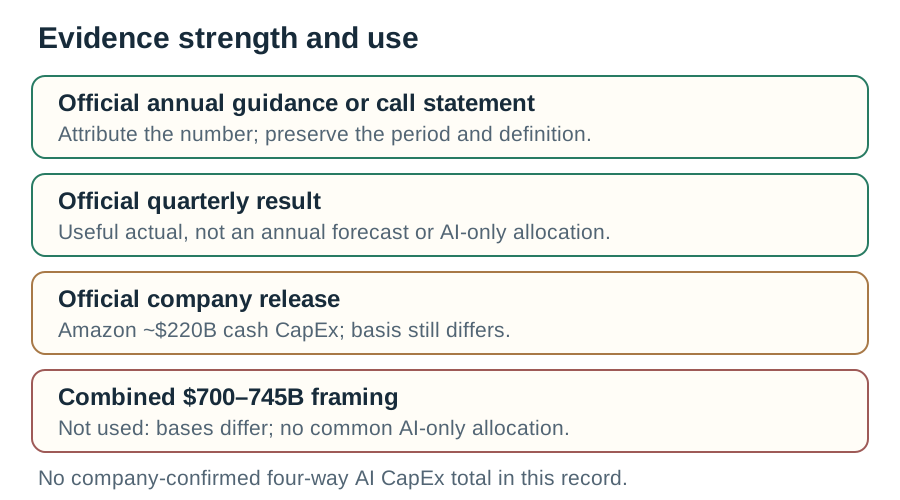
View data
| Evidence type | Example in this report | Use |
|---|---|---|
| Official annual guidance | Meta $135–145B; Alphabet $195–205B | Attribute to issuer and preserve basis |
| Official call estimate | Microsoft about $170B calendar 2026 | Preserve period and stated reason |
| Official quarterly actual | Meta $34.91B; Alphabet $51.4B; Microsoft $45.2B | Do not treat as annual guidance |
| Official company release | Amazon about $220B cash CapEx | Primary-confirmed; preserve cash basis and do not treat as AI-only |
| Secondary transcript/reporting | Amazon Q3 call | Corroborating context; not the primary basis for the figure |
| Analyst or press aggregation | $700–745B combined framing | Do not repeat as AI-only or fully reconciled |
There is a practical difference between a statement in a company release, a manager’s estimate on a call, a third-party transcript of that call and an analyst’s combined number. Each can be useful. They answer different evidentiary questions. A secondary transcript may preserve a sentence accurately, but an earnings release, filed transcript or primary recording is the stronger basis for a definitive company attribution. [1–8]
The $700–745 billion combined framing is not used here. Amazon’s estimate is confirmed in its official release, but the four figures still mix different periods, accounting bases and categories. Even if every individual estimate is confirmed, the sum would remain total capital spending, not necessarily AI spending. A precise total can conceal a weak definition. [1–8]
The companies’ own financial materials also caution that forward-looking guidance is uncertain and subject to changing conditions. This report records what management said as of the cited dates, not a forecast of final 2026 spending. Later quarterly results may revise the outlook or explain additional changes in investment timing. [1–4]
A reporting table that preserves the gaps
| Company | Official evidence available by 31 October | What this report can say | What remains open |
|---|---|---|---|
| Meta | Q3 release and 2026 guidance | $135–145B for 2026, including finance-lease principal; Q3 was $34.91B on that basis | Which portion supports AI specifically |
| Alphabet | Q3 call transcript and results | $195–205B for 2026; Q3 CapEx $51.4B; most Q3 spend was technical infrastructure | A company-reported AI-only allocation and a fully normalized lease basis |
| Microsoft | FY2027 Q1 call transcript and results | About $170B calendar-year 2026 estimate; Q1 $45.2B including $7.4B leases; capacity deliveries were delayed into H2 | A common cash/accrual and category basis for the four-company comparison |
| Amazon | Q3 release and call-page audio | Official release confirms about $220B 2026 cash CapEx, majority for AWS | A definition aligned to the other companies and an AI-only allocation remain unavailable |
This is a reconciliation table, not a company ranking. The gaps are visible because hiding them would make the comparison less useful. A reader who wants to build a total can do so only after choosing a definition—cash spending or accounting CapEx, calendar or fiscal year, lease-inclusive or lease-exclusive—and confirming each company’s row under that definition.
Quarterly actuals can help explain the pace of investment, but they cannot fill missing annual definitions. Meta’s Q3 number is reported on the same lease-inclusive basis as its annual range; the other quarterly figures still have to be read alongside each company’s own forecast and fiscal calendar. Multiplying a quarter by four would assume a steady spending pattern, ignore delivery timing, and turn an actual into an unsupported forecast. The available company sources do not justify that step. [1–3]
What this means for…
Data-center operators: The figures show that large infrastructure commitments are still planned across the biggest cloud and social platforms, but they do not tell a supplier which category of capacity will be purchased, where it will be deployed or how much is contracted. Avoid using the aggregate as a proxy for a specific customer pipeline.
Investors and analysts: Compare the company’s own period and definition before treating a headline as an increase or decrease. Calendar-year estimates, fiscal-year guidance, cash CapEx and lease-inclusive CapEx can move in different directions. This article does not assess valuation, returns or whether any company is spending too much.
Technology buyers: Broader infrastructure growth can affect cloud availability and product investment, but these public figures do not determine an individual customer’s pricing, performance or service capacity. Company-level CapEx is not an availability guarantee.
Journalists: Use “capital spending” or “CapEx” when that is what the cited source reports. Use “AI spending” only when the source reports an AI-specific amount or when the estimate method and assumptions are disclosed. Keep the company, date, period and lease treatment next to the figure.
What we don’t know yet
- What specific spending categories and lease treatment sit inside Amazon’s cash-CapEx definition?
- Will any company publish a comparable AI-only allocation or a normalized cross-company basis?
- What share of each company’s 2026 spending is attributable exclusively to AI infrastructure?
- Can the four companies’ estimates be normalized to the same lease, cash/accrual and calendar-year basis?
- How will subsequent earnings updates change these 2026 guidance ranges?
What to watch next
- Amazon’s next filing or call: check for further detail on cash CapEx, lease treatment and the AWS share.
- Amended guidance: record new ranges with the date and the measure each company uses.
- Quarterly filings: compare reported CapEx, finance leases and cash-flow statements without treating one as a substitute for another.
- AI-specific disclosures: only calculate an AI-only total if companies publish an allocation or the estimate method can be independently documented.
- 2027 planning: keep future-year estimates separate from calendar-2026 guidance and actuals.
FAQ
How much will the four companies spend on AI in 2026?
The checked sources do not provide a consistent AI-only total. Meta, Alphabet and Microsoft report broad capital-spending guidance on different bases. Amazon’s official Q3 release confirms about $220 billion in 2026 cash CapEx, most for AWS. But that does not align the four bases or identify AI-only spending. The article therefore does not add the figures or label a sum as AI spending.
Why is Meta’s $135–145 billion range not directly comparable with Microsoft’s estimate?
Meta says its 2026 range includes principal payments on finance leases. Microsoft’s roughly $170 billion figure is an estimate for calendar 2026, while its fiscal Q1 CapEx was $45.2 billion including $7.4 billion in finance leases. The annual periods and reporting details differ, and the sources do not establish a fully normalized basis.
What does Alphabet’s $195–205 billion guidance include?
Alphabet’s Q3 call maintained a 2026 capital-expenditure range of $195–205 billion and reported $51.4 billion in Q3, with most spending directed to technical infrastructure. That company description is broader than an AI-only allocation. The available sources do not support relabeling the full range as AI spending.
Is Amazon’s approximately $220 billion figure confirmed?
Yes. Amazon’s official Q3 release says it expects approximately $220 billion in 2026 cash capital expenditures, with most going to AWS. That confirms Amazon’s own estimate. It does not make the figure directly comparable with the other companies’ accounting bases or turn the amount into an AI-only allocation, so the article still excludes a combined total.
Why not report the combined $700–745 billion estimate?
The sum mixes different periods, accounting bases and investment categories. It also combines broad capital spending, not company-reported AI-only investment. Reporting the aggregate as a verified AI total would imply a consistent definition that the checked sources do not provide.
Sources
Tier 1 — primary / official
- Meta Platforms, Q3 2026 Results, 21 October 2026. https://investor.atmeta.com/investor-news/press-release-details/2026/Meta-Reports-Third-Quarter-2026-Results/default.aspx
- Alphabet Investor Relations, 2026 Q3 Earnings Call, 28 October 2026. https://abc.xyz/investor/events/event-details/2026/2026-Q3-Earnings-Call-2026-Ujou16CTw9/default.aspx
- Microsoft Investor Relations, FY2027 Q1 Earnings Conference Call, 28 October 2026. https://www.microsoft.com/en-us/Investor/events/fy-2027/earnings-fy-2027-q1
- Amazon, Q3 2026 Results, 29 October 2026. https://www.aboutamazon.com/news/company-news/amazon-earnings-q3-2026-report
- Amazon Investor Relations, Q3 2026 Amazon.com, Inc. Earnings Conference Call, 29 October 2026; official page links audio. https://ir.aboutamazon.com/events/event-details/2026/Q3-2026-Amazoncom-Inc-Earnings-Conference-Call/default.aspx
Tier 2 — secondary transcript/reporting
- CNBC, Amazon holds 2026 capex unchanged at $220 billion, 29 October 2026. https://www.cnbc.com/2026/10/29/amazon-amzn-q3-earnings-report-2026.html
- The Motley Fool, Amazon Q3 2026 earnings call transcript, 30 October 2026. https://www.fool.com/earnings/call-transcripts/2026/10/30/amazon-amzn-q3-2026-earnings-call-transcript
- Stock Analysis, Amazon Q3 2026 earnings call transcript, 29 October 2026. https://stockanalysis.com/stocks/amzn/transcripts/720308-q3-2026/
Methodology note
Research and drafting for this article were AI-assisted; the text was reviewed against the cited sources before publication. Company guidance is attributed to the dated company release or call transcript. Amazon’s approximately $220 billion cash-CapEx figure is verified from its official Q3 release; its cash basis is kept distinct from the other rows. No combined four-company amount is calculated because periods, accounting bases and investment categories are not normalized. The article does not make market-causation claims or provide investment advice. Companies named in this article are subjects of our reporting. See our editorial standards for how we handle conflicts of interest.

Aman Mishra, Chief Editor (reviewer). Aman Mishra is Chief Editor of Global AI News. He is responsible for the publication’s editorial standards and reviews articles against their cited primary sources before publication.
Global AI News Desk explains AI news using primary sources: filings, official documents, papers and company announcements. Claims made by companies are attributed to them. Spotted an error? Tell us — we correct mistakes openly under our editorial policy.