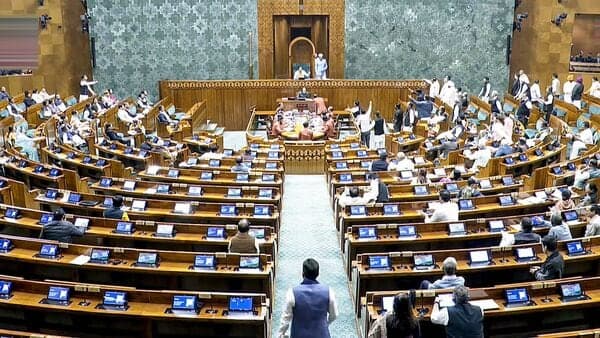
The Union government will table the Sustainable Harnessing and Advancement of Nuclear Energy for Transforming India bill, 2025 (SHANTI) in the last week of Winter Session of Parliament. The bill allows any company or joint ventures to build, own, operate or decommission a nuclear power plant or reactor.
On Friday, the government approved the Bill that seeks to open up the tightly-controlled civil nuclear power sector for private participation as India eyes 100 GW atomic energy capacity by 2047.
The bill elaborates that the operator shall be liable for damages except those caused by “a grave natural disaster of an exceptional character, an act of armed conflict, hostility, civil war, and insurrection or terrorism.”
The operator, however, won’t be liable for damages in “under construction nuclear installation itself and any other nuclear installation including a nuclear installation under construction, on the site where such installation is located, any property on the same site which is used or to be used in connection with any such installation; or the means of transport upon which the nuclear material involved was carried at the time of nuclear incident.”
“The maximum amount of liability in respect of each nuclear incident shall be the rupee equivalent of three hundred million Special Drawing Rights or such higher amount as the Central Government,” the legislation adds.
The Bill also allows “the import, export, acquisition, or possession of nuclear fuel or prescribed substance, the import or export of any technology or software, that may be used for the development, production or use of prescribed substance or prescribed equipment,” according to a report in Hindustan Times.
At a meeting chaired by Prime Minister Narendra Modi, the Union Cabinet is learnt to have approved the Sustainable Harnessing and Advancement of Nuclear Energy for Transforming India (SHANTI) Bill.
In her Budget speech in February, Finance Minister Nirmala Sitharaman had announced plans of opening up the nuclear power sector for private sector participation.
Sitharaman also announced the Nuclear Energy Mission for research and development of small modular reactors or SMRs with an outlay of ₹20,000 crore, and to operationalise five indigenously developed SMRs by 2033.
1-Ends Monopoly: Nuclear power generation and related activities in India are largely restricted to government entities like Nuclear Power Corporation of India Limited (NPCIL) under the Atomic Energy Act of 1962 until now.
The SHANTI Bill, however, proposes to change that by legally permitting private sector participation in the nuclear value chain.
2- Expanding Private roles: Private firms can now engage in fuel cycle activities, equipment manufacturing, power generation, and potentially plant operations—subject to safety oversight.
3-Better Regulation: The legislation proposes a unified legal framework for nuclear energy, including modern safety regulation, a dedicated nuclear tribunal for disputes, and reforms to the nuclear liability regime to cap risks and attract investment.
4- The FDI push: The Bill allows up to 49 per cent foreign direct investment (FDI) in certain nuclear activities, helping bring technology and capital into the sector.
5- Larger Goal: This large goal of the bill is to help India achieve its target of 100 GW of nuclear power capacity by 2047 and strengthen energy security and clean-energy transition goals.

