China Nears First Investment Decline in 3 Decades After Sharp Monthly Drop
A broad measure of investment fell more than 10 percent in November, continuing a recent reversal and signaling the depth of China’s property crisis.

Investment in China slowed drastically in November, propelling the country closer toward its first annual decline in more than three decades.
Investment for housing, public infrastructure and manufacturing fell 2.6 percent from January through November, marking another month of sharp decline in so-called fixed-asset investment, China’s National Bureau of Statistics announced on Monday. The research firm Capital Economics estimated that investment fell 11.1 percent in November from a year earlier, a second straight month of double-digit declines over 2024.
The November drop puts China on the brink of a historic slowdown in investment. For more than 30 years, as China’s economy grew by leaps and bounds, investment in buildings, public works and factories had increased every year since the late 1980s.
The pullback, which began in the second half of this year, signals growing caution about the Chinese economy.
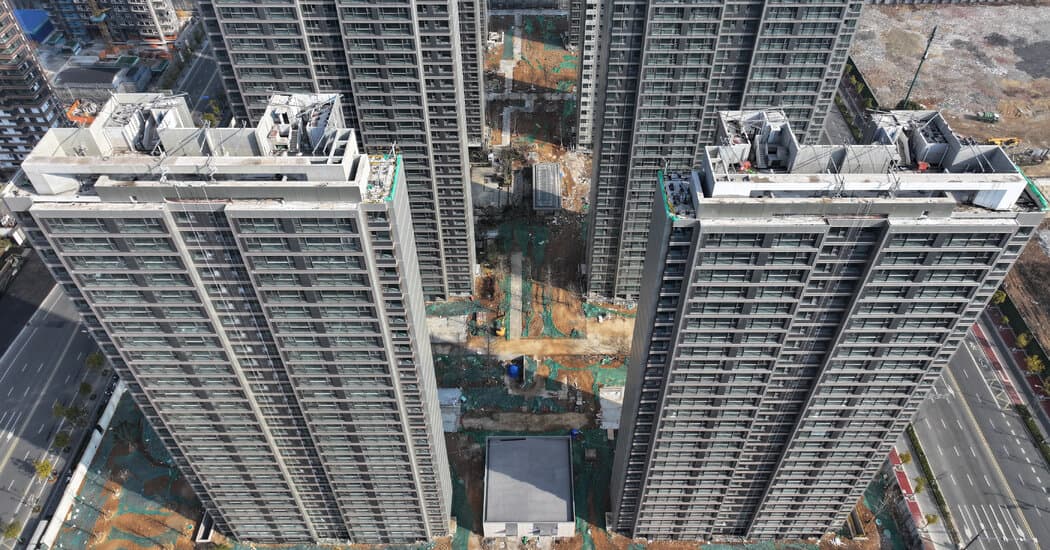
Investment in real estate, once considered a pillar of China’s growth, continued to drop precipitously last month. Investment in public infrastructure and manufacturing also fell, as all three main components of fixed-asset investment declined.
It is unusual for investment to decline across all three segments, indicating the confluence of problems affecting the Chinese economy. China is dealing with an entrenched real estate crisis that has shaken confidence. Because of the property slump, local governments lack the funds to plow money into public works projects. And Beijing’s efforts to curb excessive competition, which is harming even China’s fast-growing industries, have slowed investment in new factories.
In a news conference on Monday, Fu Linghui, the spokesman and chief economist of China’s National Bureau of Statistics, said that while the overall figure was down, investment in key areas such as clean energy technology continued to grow, laying the foundation for medium- to long-term growth.
Chinese officials have signaled that stabilizing investment and reversing the downturn are policy priorities for the coming year.
“Policy support should help drive a partial recovery in the coming months, but this probably won’t prevent China’s growth from remaining weak across 2026 as a whole,” Zichun Huang, China economist at Capital Economics, wrote in a note on Monday.
In addition to investment, China reported other indicators pointing to continued economic sluggishness. Retail sales, a measure of consumer spending, rose 1.3 percent, the slowest pace in almost three years.
The property sector continued to receive worrying news, reinforcing the view that the real estate collapse shows no signs of abating. China Vanke, one of the country’s largest property developers, failed to win approval of a plan to delay repaying a bond that was due on Monday, moving the company closer to default.
In a Monday filing with the Hong Kong Stock Exchange, Vanke stated that it has a “grace period” of five working days after failing to make a payment on time. It said it plans to convene another meeting of bondholders during that time.
Siyi Zhao contributed research.

