

Key takeaways
- Top robotics researchers and founders explain how robot autonomy is evolving.
- In a world where self-driving robotaxis glide through major city streets without drivers behind the wheel and delivery drones autonomously…
- But that future hinges on developing increasingly autonomous robots powered by modern artificial intelligence—an ambitious vision that has…
What happened
In a world where self-driving robotaxis glide through major city streets without drivers behind the wheel and delivery drones autonomously fly through the skies to drop off orders at customers’ homes, the idea of general-purpose robots helping humans with various tasks in workplaces or even homes may not seem far-fetched.
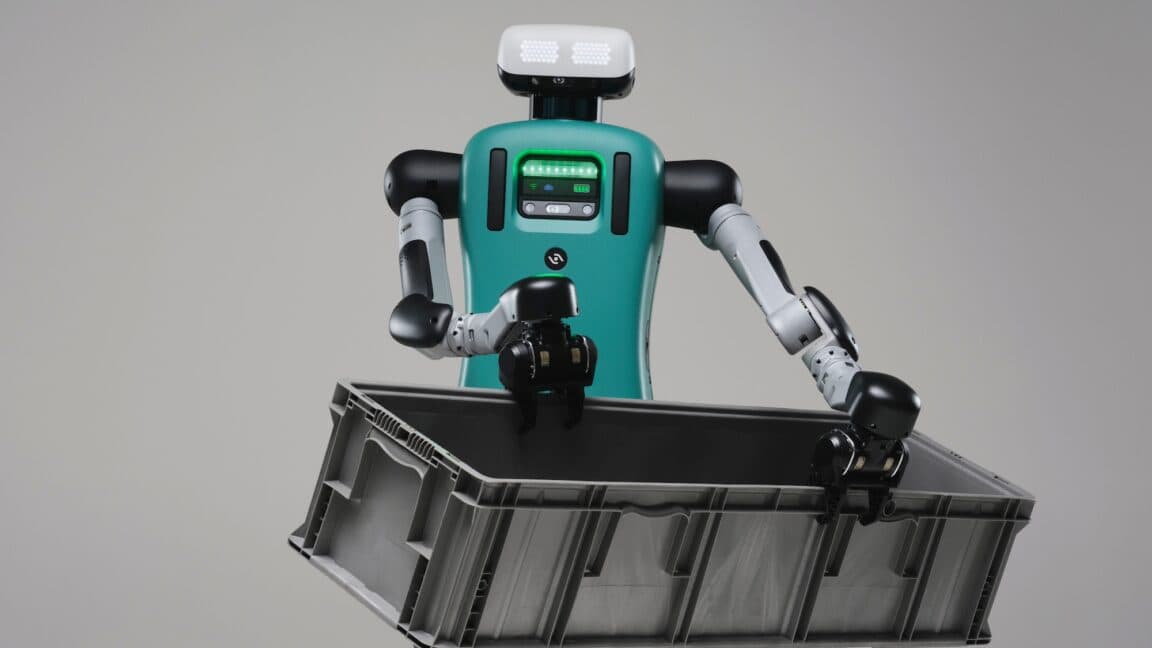
Inside the warehouse, Digit robots crouch to lift and move totes filled with products from order-picking areas to conveyors.
Agility has since deployed more humanoid robots to work on the automotive production lines of Toyota Motor Manufacturing Canada and the South Carolina factory of German automotive manufacturer Schaeffler. It has another commercial agreement to integrate Digit robots into a facility of the e-commerce company Mercado Libre in San Antonio, Texas. The robots have even done testing in Amazon warehouses.
On June 24, Agility announced plans to become the first “pure-play humanoid company” publicly listed on a major North American exchange. The company says its robots have already accumulated more than 65,000 hours of operations through the initial commercial deployments and pilot programs.
Digit’s workplace duties have mostly focused on picking up and handling totes and bins. But the next step could be picking up items and putting them into bins, then handling cardboard boxes of many different sizes and shapes, Hurst said.
That could eventually lead to work opportunities in the back rooms of retail and grocery stores, which would be less structured environments and potentially more chaotic than factory assembly lines or warehouses.
Further down the road, humanoid robots such as Digit may start riding around in autonomous vehicles to deliver packages to people’s front doors. The very last stop might involve directly helping people in their homes. But Hurst cautioned that robotic development is still several decades away from creating robots smart enough to operate safely around children or help with household chores.
“Eventually, autonomy is going to mean how your robot reacts when someone hands a baby to the robot,” Hurst said. “If it’s going to be actually unsupervised in human environments, you’re going to have to deal with really wonky corner cases like that and how the robot is going to be intelligent enough to make good choices there.”
For now, though, companies that claim their humanoid robots will be safely working inside homes alongside humans “are either lying or wrong, one of those two,” Hurst said.
Before autonomous robots can roam around inside workplaces and homes, they must first prove they can operate safely around humans. The physical danger from robot coworkers has been made clear since January 25, 1979, when 25-year-old Robert Nicholas Williams was crushed and killed by a 1-ton robotic vehicle’s arm inside a Ford Motor Company factory in Flat Rock, Michigan.
Such lessons have not been lost on Agility Robotics, the Oregon-based company that was first to land a long-term commercial contract for deploying its Digit humanoid robots at a GXO logistics warehouse in Atlanta, Georgia. The robots move totes filled with products from order-picking areas to conveyors and have been working in isolation without human workers in their immediate vicinity.
“The reason we have still deployed a relatively small number of robots is safety as the blocker,” Hurst said. ”
For safety reasons, Agility’s Digit robots have been deployed inside “work cells” separate from human workers. But within the next 12 months, Agility plans to commercially launch its Digit v5 robot as the “first AI-enabled, cooperatively safe humanoid robot,” Hurst said.
“[The robot] can identify people around it, stop moving and sit on the ground before a person can touch it,” Hurst said. “That’s how you ensure that it’s not going to fall on somebody’s foot or swing an arm into somebody’s face.”
Both Agility and Boston Dynamics joined a working group to develop an international safety standard for industrial mobile robots through the International Organization for Standardization (ISO). The draft version of the standard, ISO 25785-1, is currently being considered by a technical committee that oversees robotics. Once the committee signs off, the draft international standard will be put to a vote by the 89 voting nations of the ISO.
Some robots that already work very closely with human bodies have limited autonomy for safety reasons. “Surgical robots don’t perform surgery automatically with full autonomy,” said Bhushan Patel, principal technical program manager and an engineering leader at Intuitive, a surgical robotics company based in Sunnyvale, California, in an interview with Ars. Instead, he described such robotic devices as “still overwhelmingly human-driven systems with varying levels of intelligent assistance.”
The first robotic telesurgery concepts in the 1980s were intended to help astronauts in space, Bhushan wrote in an article for IEEE Transmitter. But the idea soon led to robotic surgery procedures for patients on Earth, such as robotic-assisted radical prostatectomy, which involves human surgeons controlling robot arms to remove part or all of the prostate gland.
Such surgical robots equipped with tiny tools allow surgeons to do minimally invasive operations with superhuman precision in the confined spaces of the human body, like performing extremely delicate repairs on blood vessels or making precise incisions while avoiding collateral damage to neighboring nerve bundles.
From the late 1980s through the early 2000s, human surgeons still did everything from planning to executing surgeries while controlling the robotic tools.
That only began to change as robotic systems gained level one autonomy by providing assistive capabilities such as automatically stabilizing motions to allow for more precise actions by human surgeons controlling robotic tools, enforcing safe movement boundaries to avoid hurting patients or staff, and providing AI-powered computer vision to help surgeons visually differentiate between different anatomical structures inside the body.
“The question is not whether the robot is autonomous or not,” said Bhushan, who is also a senior member of the Institute of Electrical and Electronics Engineers (IEEE). “The question is how much decision-making and action execution we are delegating to machine versus human.”
Surgical robots with more autonomous capabilities could potentially deliver greater consistency and precision across multiple operations than even the most experienced and skilled human surgeons, according to a Science Robotics review article by Johns Hopkins University researchers. That could help to ensure faster surgeries with lower complication rates for patients.
In the most extreme scenarios, such surgical robots could provide medical care in remote regions on Earth or during space missions that lack human surgeons.
Most commercial robotic surgery systems are still at the first level of autonomy, Bhushan said. But some systems have reached level two autonomy by performing specific, preprogrammed tasks assigned by human surgeons: automated suturing, camera tracking, bone milling, and predefined cutting trajectories.
Next up is level three autonomy, where robots can analyze imaging, generate procedural plans, adapt movement trajectories, and dynamically respond to human tissue movement during surgeries—all actions requiring mandatory surgeon approval. “Companies are spending billions right now to reach that… but only a very small number of FDA-cleared systems today approach level three capability,” Bhushan explained.
Only level four autonomy with “real-time reasoning” and “continuous environment understanding” would allow the robot to “theoretically perform major portions of a surgery independently while the surgeon acts more like a supervisor,” Bhushan said. But he cautioned that such autonomy is “still very ambitious” as a research lab goal, especially because the robot would need to handle unexpected complications such as bleeding, tissue deformation, and variations in patient anatomy.
Finally, a robot with level five autonomy would be capable of independently doing nearly everything a surgeon can do. But “no clinically deployed system is anywhere near this today,” Bhushan said.
Clinicians and patients are much less likely to tolerate robot mistakes that might be shrugged off for consumer robotics, Bhushan said. Each step forward in autonomy for surgical robotics must also deliver improved operating room efficiency and clinical outcomes that justify the complexity and costs of purchasing and maintaining the robotic systems.
The same practical test of economics awaits any company seeking to deploy more autonomous, general-purpose robots in human workplaces and homes.
Even if robotics is unlikely to have its own ChatGPT moment like the one sparked by the rapid rise of large AI models, Hurst at Agility suggested that the current AI boom has still broadly benefited robotics research and development. By making some robotics challenges appear more solvable, the latest AI techniques have also inspired many more people to dedicate their professional careers to robotics.
“When I got my PhD in robotics, fewer than 100 people on the planet had a PhD in robotics, and Carnegie Mellon and Georgia Tech were the only robotics programs in the country,” Hurst said. “Now we have one in Oregon State that I cofounded, and now there’s like 30 others, and there are thousands of graduate students going into robotics and AI and billions of dollars going into this.”
This could create a “self-fulfilling prophecy” for enabling more autonomous robots to enter the world, Hurst said, because so many “really motivated, excited, and capable engineers throwing their whole life’s efforts into this professionally is going to make it happen.”
One such person is Dipam Patel, who is pursuing his PhD in computer science at Purdue University in Indiana while also testing robots at the US Army DevCom Army Research Lab.
His Army Research Lab work has focused on training robots to traverse unfamiliar landscapes filled with obstacles during search-and-rescue scenarios, such as the aftermath of an earthquake disaster. He has even tested how four-legged robots with a robot arm on top can perform “interactive navigation” by grabbing obstacles to move them out of the way.
Scrambling through earthquake debris and moving objects out of the way is second nature to human rescue workers. But robots face challenges in reliably performing multi-step tasks with longer time horizons, including “catastrophic forgetting” when a robot’s AI model trained through reinforcement learning may overwrite a previously learned capability as it starts to learn new tasks.
The robots also need to pack enough onboard computing hardware and sensors to perform as needed in new environments without necessarily relying on external cameras and sensors or having the luxury of offloading computing tasks to cloud servers. “The robot should be able to do everything on its own without any external dependencies,” Patel told Ars. “Only then can we push towards general-purpose robots.”
Patel, who is also a graduate student member at IEEE, has done broader work on developing whole-body control schemes for both quadruped “robot dogs” and the humanoid robots that have generated so much excitement among investors and the general public. But like Levine at Physical Intelligence, he takes a pragmatic approach in his view of what robotic form makes the most sense.
Why it matters
But that future hinges on developing increasingly autonomous robots powered by modern artificial intelligence—an ambitious vision that has motivated many researchers to become startup founders while also attracting billions of dollars in investment.
“When I started maybe about 15 years ago, I led a project team that was focused on autonomy, but in that era, the goal of that team was to just get a robot to navigate from point A to point B,” said Matt Malchano, vice president of software at the robotics company Boston Dynamics based in Waltham, Massachusetts. ”
It was previously difficult to imagine a practical path for creating general-purpose, autonomous robots like housekeeper Rosie from The Jetsons or the various droids like C-3PO from Star Wars, especially when robotics labs and companies were still struggling to solve autonomous navigation and even self-balancing, in the case of walking robots.
In 1979, the experimental autonomous vehicle known as the Stanford Cart required five hours to successfully move 20 meters through an obstacle-filled room. The first bipedal robot capable of walking on its own without losing its balance was developed in 1996.
But robot autonomy has always been a “moving target,” with the goal of reaching a point where robots can do an increasingly larger subset of things that humans can already do, ideally without direct human supervision, Malchano told Ars. The International Standards Organization defines autonomy in robotics as the “ability to perform intended tasks based on current state and sensing, without human intervention.”
More recent advances in AI—such as reinforcement learning in the 2010s and large foundation models trained on huge amounts of data in the 2020s—have “unlocked” the ability to “imagine a world where the robot can do sequences of activities and really understand the tasks, and that’s very exciting,” Malchano said.
Now, multiple research labs and companies are racing to develop general-purpose robots capable of handling a wide variety of tasks independently in more complex, unpredictable environments.
Such robots will not necessarily be humanoid in appearance and function despite the substantial amounts of investor money going into humanoid robots. But whatever their form, they could represent a significant step beyond the millions of industrial robots and service robots that already perform specific tasks within the relatively controlled environments of factories and warehouses.
“There’s an assembly line, the robot is supposed to do a particular motion, and if you do that motion reliably and repeatedly, that’s a basic factory level of autonomy,” said Sergey Levine, a computer scientist at the University of California Berkeley and cofounder of the AI and robotics company Physical Intelligence. ”
Ars interviewed robotic researchers and founders about how AI has supercharged interest in robotics, the challenges of making general-purpose robots, how safety is a make-or-break issue for robot workers, why surgical robots still have limited autonomy, and when to expect robot helpers in people’s homes.
Levine’s startup, called Physical Intelligence, is working toward achieving practical robotic intelligence that can empower many different types of robots operating autonomously in open-world environments. “I don’t think it will be the one ultimate robot, like a super advanced humanoid that can do everything,” Levine told Ars. “I think it will be a general AI model that can power lots of different robots that are well-suited for their job.”
For example, a small robotic arm hanging from the ceiling might prove more suitable for a tiny New York City apartment, whereas a “hulking giant robot” that moves heavy objects could be more handy on a farm, Levine suggested. “I’m sure we’ll also have good humanoids, but there will be other stuff, too,” he said. “There will be whatever makes the most sense for the job.”
But developing autonomous robots that can operate more independently in the open world involves “step changes in technological complexity,” Levine said. He described such robots as needing to handle complex environmental perception, requiring robust motor skills and the ability to overcome basic mistakes and process instructions from humans. In addition, such robots will need to learn how to generalize their behaviors to handle new situations.
Many researchers are trying to make this happen through a combination of AI techniques involving reinforcement learning and large pre-trained models, Levine said. Reinforcement learning involves training robots to perform specific tasks through trial-and-error, whether using physical robots interacting with the real world or computer simulations.
At the same time, foundation models pre-trained on huge amounts of data—such as visual-language models trained on images and text—can provide some basic prior knowledge of the world to help robots react more appropriately and avoid unnecessary mistakes in various situations.
“Reinforcement learning is like how, after you practice your tennis swing many, many times, you can get really good at it,” Levine explained. “But to get there, you first need to have a kind of basic common sense to even get started.”
That combination of AI techniques and the gradual expansion of accessible training data—such as humans teleoperating robots to show how to perform specific tasks—has enabled “encouraging” progress in training robots to perform many different tasks reliably under various conditions, Levine said. “The key to making modern machine learning systems work is to get enough of a critical mass of data so that we see generalization,” he said.
But there is still a widely recognized data gap when it comes to collecting enough of the right data for training robots to perform physical tasks. The more costly and time-consuming methods involve humans wearing teleoperation rigs to directly guide a robot’s physical motions in training or running many experimental trials with robots in labs or other environments.
Manually coded simulations grounded in physics can help train robots more cheaply in virtual environments but can fail to capture many real-world complexities and uncertainties.
Robotics researchers have also been developing world models to help robots predict the consequences of their actions in the physical world and plan accordingly. Some implementations of such AI models are trained on primarily visual data to learn how physical environments work, with some companies even collecting first-person videos for training data by hiring gig workers to wear head-mounted cameras as they do household chores or other tasks.
This approach to robot training is cheaper than running real-world experiments with robots, but world model development remains computationally expensive and may also struggle to accurately replicate real-world physical interactions.
For now, general-purpose robots remain on the horizon. Current training methods, such as reinforcement learning, can produce robots that are very good at consistently performing a specific task under very specific conditions—but such robots may falter on the same task under different conditions. 99 percent level of robustness,” Levine said.
“You can either have something that is kind of OK but not amazing at everything or something that’s extremely good at one thing,” he said. “We really want something that’s extremely good at all things, and that’s still at the frontier of research.”
Fortunately, the world won’t need to wait for the development of general-purpose robotic capabilities to find practical uses for robots. Many companies have already been developing and selling specialized industrial and service robots for decades—and both newer startups and more established robotics companies are already applying the latest levels of robot autonomy toward handling a growing array of tasks.
One of the most well-known contenders is Boston Dynamics, which originally spun out of an MIT lab in 1992. The robotics company is popularly known for its viral video demonstrations of quadruped and biped robots, with the most recent examples including its Atlas humanoid robot learning various soccer moves during the 2026 World Cup.
But for several years, Boston Dynamics’ four-legged Spot robot has been conducting autonomous inspections of facilities that are more hazardous for humans, including Massachusetts converter stations operated by the electricity and gas utility company National Grid and culvert pipes running beneath California highways.
Such robotic autonomy is “really about the ability for that robot to navigate through an environment and perform actions on its own, taking photos and sensor measurements of that environment,” Malchano said. ”
One particular challenge for Spot involved learning to walk on slippery floors in customer facilities, which required additional training through reinforcement learning. “We retrained how that robot chooses to walk and its ability to recognize that it’s on a slippery floor and then take actions to stay stable and be able to navigate across that in a similar way to how a human might walk across ice,” Malchano explained.
At the same time, the company’s wheeled Stretch robots with large robotic arms have been handling large boxes and packages in warehouses operated by logistics companies such as DHL. “We’ve continually adapted it to different forms of packages, the ways that trucks are loaded, and the structures of the trucks themselves that we’ve encountered by interacting with the real world,” Malchano told Ars.
Boston Dynamics is also currently ramping up manufacturing of the all-electric Atlas humanoid robot. The humanoid robot is undergoing training and testing at the Robot Metaplant Application Center run by its South Korean parent company, Hyundai Motor Group. The goal is to have trained Atlas robots performing tasks at the Hyundai Motor Group Metaplant America—a huge electric vehicle factory located in Ellabell, Georgia—by 2028.
“I think we’re very lucky to be affiliated with Hyundai, which obviously produces fantastic cars that are produced at scale,” Malchano said. “Being able to leverage that capability to get to scale is really important for building robots.”
The Hyundai and Boston Dynamics effort aims to have the capacity to produce 30,000 humanoid robots annually by 2028. Whether the world can find a use for so many humanoid robots depends on how useful and cost-effective they can be in traditionally human workplaces.
There are also initial signs of pushback from Hyundai’s own human workforce—the Hyundai Motor labor union approved a potential strike on June 25 as it negotiated with the South Korean automaker about job protections related to the upcoming Atlas robot deployment.
But for now, general-purpose robots that approach human levels of flexibility and adaptiveness remain many years away. “We’ve come to expect that if you ask a person to do a task, they’ll do it right with some training almost all the time,” Malchano said. “I think we’re still understanding what it takes to achieve that level of reliability for general-purpose, AI-driven tasks.”
Future progress in robotics probably won’t look like a “ChatGPT moment,” in which robots trained on enough data suddenly become capable, said Jonathan Hurst, cofounder of Agility Robotics and a robotics researcher at Oregon State University.
He said collecting training data for robots isn’t as straightforward as scraping Internet text, images, and videos—it requires collecting much more real-world data related to controlling and coordinating all the robot’s joints and limbs as it interacts with the physical world.
“It’s dramatically harder to have an embodied AI; it’s 10 times harder to have an embodied AI,” Hurst told Ars. “The data that enabled large language models doesn’t exist and never will exist for embodied AI.”
Hurst anticipates robots making gradual progress over the next several decades that allows them to enter more generalized environments and situations. His company, Agility Robotics, was the first to earn a long-term commercial contract for humanoid robots by deploying its Digit robots at a GXO logistics warehouse in Atlanta, Georgia, starting in 2024.
What to watch
“People are like, ‘we need a human-like robot,’ but we don’t really need that,” Patel said. “We just need a robot that can do stuff.”
This story was updated on July 7, 2026 to provide additional information about how Agility’s Digit robot would operate around human workers.