


Key takeaways
- Google Research introduces SensorFM, a foundation model that processes diverse wearable sensor data to provide a unified health…
- Google Research has unveiled SensorFM, a foundation model that learns a general representation of human physiology and behavior from…
- Most health features on wearables today are built for a single purpose.
What happened
Google Research has unveiled SensorFM, a foundation model that learns a general representation of human physiology and behavior from wearable sensor data collected from five million people. The model can be applied to 35 different health and behavioral tasks.
The authors believe scaled pretraining could be especially useful for hard-to-measure traits that vary widely between individuals, such as depression and anxiety symptoms.
To adapt SensorFM's learned representations to new tasks, the researchers set up a "classroom" of competing and collaborating LLM agents. These agents repeatedly generated, tested, and refined code for downstream prediction models, running more than 30,000 experiments in the process. The models they found outperformed simple linear head models based on the same SensorFM representations on 28 of 35 prediction tasks.
The researchers also integrated SensorFM into a personal health agent and compared three variants. All three received demographic information and daily summaries computed from wearable data, covering things like activity, sleep, blood oxygen, and skin temperature.
One variant also received SensorFM predictions for various health markers, a second received the actual known values for those same markers, and the third got none of this extra information and served as the baseline.
Four clinicians evaluated 93 health summaries for 31 real participant profiles, spending more than 40 hours and producing 1,860 individual ratings. The result: summaries augmented with SensorFM predictions scored significantly higher than the baseline across all five dimensions the team measured, which were context, personalization, justifiability, relevance, and safety. There was no statistically significant difference overall between summaries that used SensorFM predictions and those that used actual known health data. That said, this doesn't mean SensorFM can replace clinical measurements or diagnoses.
The researchers point to several limitations. SensorFM was trained and tested only on data from Fitbit and Pixel Watch devices. Whether the results transfer to other wearables is an open question. The model also doesn't work with high-resolution raw signals but with data aggregated at the minute level, which means very short or fine-grained patterns can get lost.
Many of the health markers the team studied are based on self-reports, medication records, or questionnaires rather than clinically confirmed findings. The study population also doesn't fully represent the general population. And the health agent was only evaluated in a static setup with single responses, not in longer conversations with follow-up questions.
Why it matters
Most health features on wearables today are built for a single purpose. One model detects sleep stages, another estimates cardiovascular risk, and yet another analyzes stress or metabolic markers.
Google wants to replace these siloed approaches with a shared AI foundation that can make sense of continuous, often gappy sensor data across many health questions, cut the need for expensive labeled training data, and eventually feed personalized context into AI health assistants.
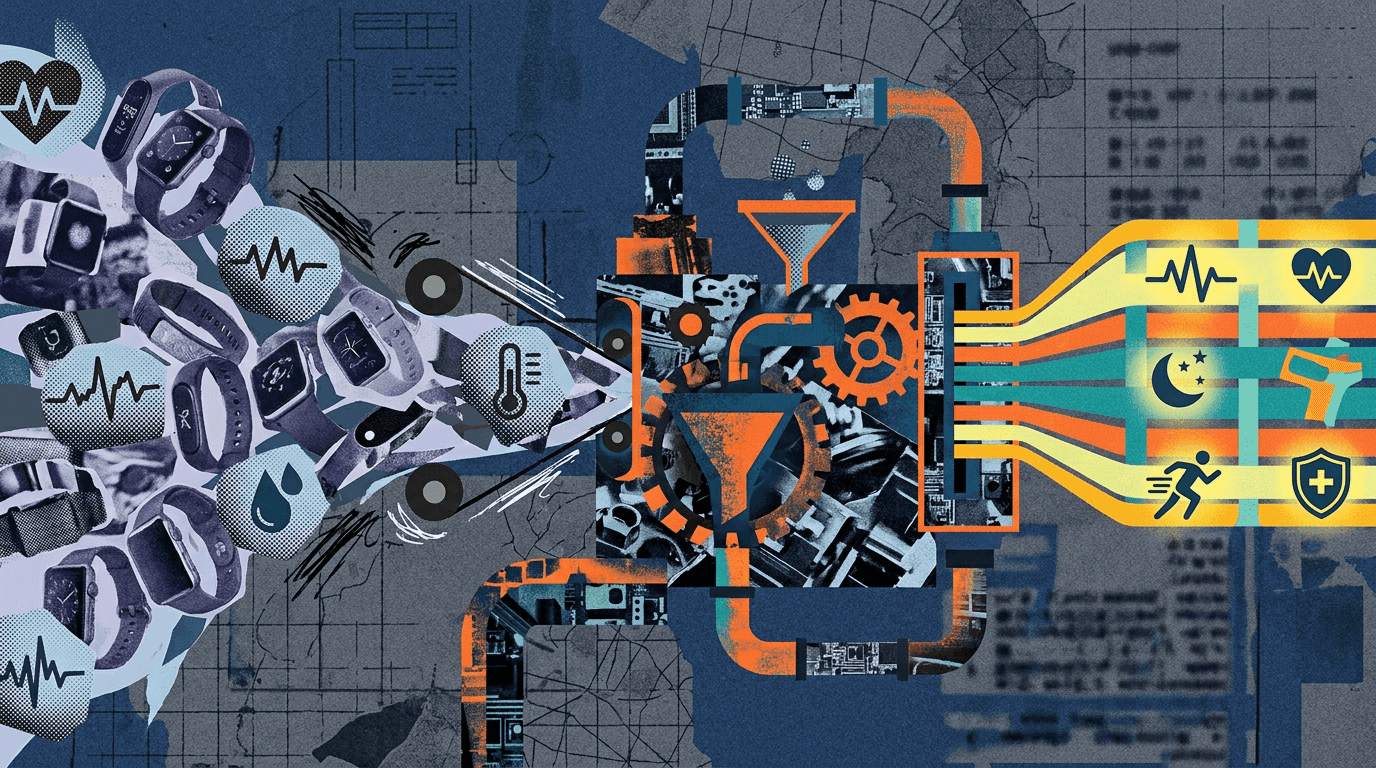
Google Research has now introduced SensorFM in a blog post and an accompanying paper. The foundation model learns a general, reusable representation of physiological and behavioral patterns from large volumes of unlabeled wearable data. The researchers used more than a trillion minutes of multimodal sensor data from five million Fitbit and Pixel Watch users for pretraining.
The data came from over 100 countries and was collected with more than 20 different Fitbit and Pixel Watch models. According to the authors, this is the largest and most diverse wearable dataset ever used to train a model of this kind.
SensorFM processes 34 features drawn from five types of sensor data: optical heart rate monitoring (photoplethysmography, or PPG), acceleration, skin conductance, skin temperature, and barometric altitude. The features include heart rate, heart rate variability, blood oxygen saturation, sleep stages, and motion data, among others. The model is trained in a self-supervised way by reconstructing deliberately masked data segments.
The technique, called "Adaptive and Inherited Masking" (AIM), flags both genuinely missing values and values that were artificially hidden during training, so SensorFM learns to handle both types of data gaps.
The researchers report that performance improves systematically when model size and data volume grow together. The four model variants they tested range from about 100,000 to 100 million parameters, and the training datasets span from 5,000 to five million people. On the largest training dataset, the biggest model's reconstruction error was 31 percent lower than the smallest model's. The largest configuration also performed best on most downstream prediction tasks.
The researchers then tested SensorFM on data from three separate studies with a total of 13,985 participants. The model had never seen this data during pretraining. They evaluated SensorFM on 35 prediction tasks covering cardiovascular and metabolic health, mental health, sleep, demographics, and lifestyle.
Even simple task-specific head models built on top of SensorFM's learned representations outperformed supervised baselines with hand-crafted wearable features on 34 of 35 tasks, according to the paper. Scaled pretraining also made SensorFM more label-efficient compared to the supervised baselines. The model could adapt to new tasks with relatively few labeled examples, and as it grew larger, it relied less on extra demographic information.
What to watch
SensorFM is purely a research model for now. Google already offers the Gemini-based Google Health Coach, which provides personalized tips on fitness, sleep, recovery, and other health topics. SensorFM could eventually serve as a technical foundation for features like these, but Google hasn't announced any concrete plans to integrate it into Fitbit, Pixel Watch, or the AI coach.
More details on SensorFM are available in the Google Research blog post and the open-access paper on arXiv.