India’s 10,000 AI Compute Unit Tender: What C-DAC Is Actually Buying
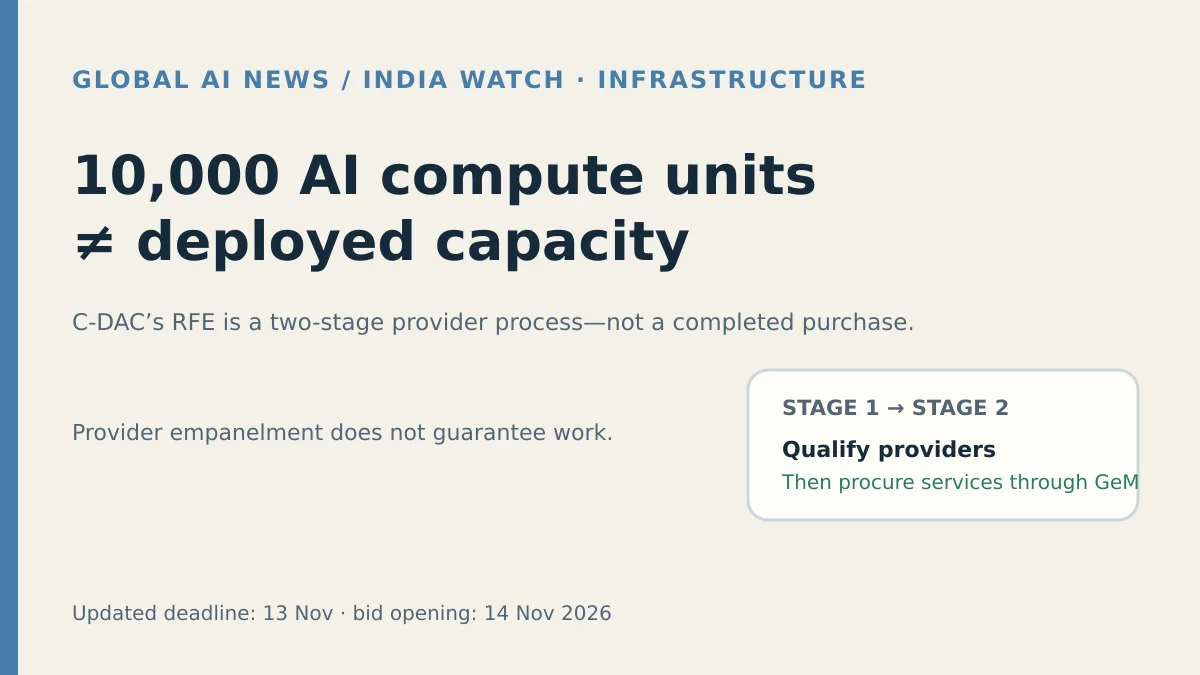
C-DAC’s request for empanelment seeks up to 10,000 AI compute units in two stages. It is a tender requirement, not deployed capacity. Bids are now due 13 November 2026.
Key takeaways
- C-DAC seeks providers for an initial requirement of up to 10,000 AI compute units, a term that covers GPUs, TPUs and other accelerators.
- Stage 1 is technical qualification. Actual procurement happens in Stage 2 through the Government e-Marketplace, and empanelment does not guarantee an award.
- A 27 October corrigendum moved the bid deadline to 13 November 2026 at 3:30 p.m. IST, with bids opening on 14 November.
In this article
- The bottom line
- What the RFE actually asks for
- “10,000 AI compute units” is not a count of deployed GPUs
- A tender number has several different meanings
- The revised calendar
- The operational questions come after empanelment
- Do not combine this with every other GPU headline
- What this means for…
- What we don’t know yet
- What to watch next
The bottom line
The Centre for Development of Advanced Computing (C-DAC) has issued an RFE to empanel providers of AI compute services. The request describes an initial requirement of up to 10,000 AI compute units, arranged in clusters, and permits C-DAC to scale capacity beyond that in response to demand. The RFE defines an AI compute unit as a hardware device and includes GPUs, accelerators, TPUs and similar components. It does not say that 10,000 individual GPUs have already been bought, installed, allocated to users or switched on.
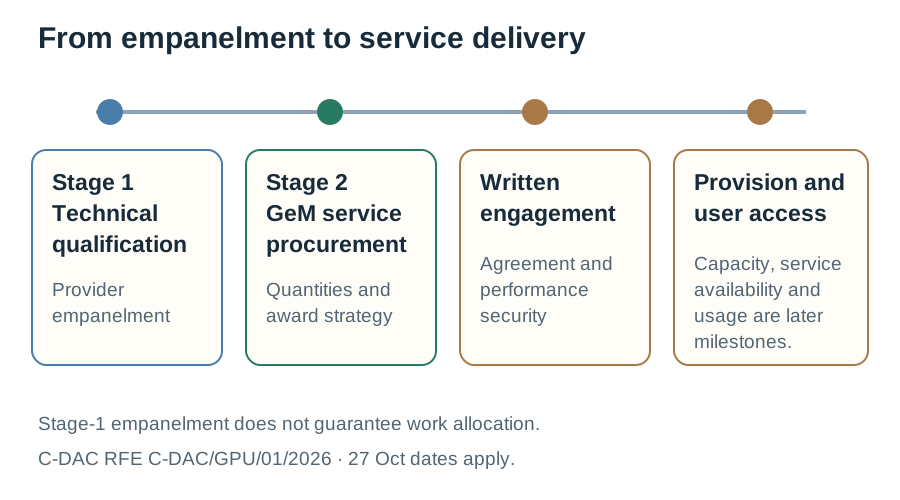
The distinction is procedural as much as numerical. Stage 1 is technical qualification and empanelment. Stage 2 is where C-DAC will procure services through the Government e-Marketplace (GeM), decide the engagement model and determine how much work each selected provider receives. Stage-1 empanelment does not guarantee an award. The five-year service period is part of the requested arrangement; it is not proof that all requested capacity will be operational for five years. [1]
The bid timetable has also changed. A 27 October corrigendum moved the submission deadline to 13 November 2026 at 3:30 p.m. IST and the opening of bids to 14 November at 4 p.m. IST. The earlier 29–30 October dates in the first version of the RFE are superseded. [2]
What the RFE actually asks for
View data
| Stage | What the RFE describes | What is not established yet |
|---|---|---|
| Stage 1 | Providers submit eligibility and technical information for qualification and empanelment | Final award, quantity per provider or revenue |
| Stage 2 | Procurement of AI compute services through GeM from empanelled providers | Final quantity, award split, pricing and start date |
| Engagement | Written agreement, performance security and later provisioning | Live capacity or end-user utilization |
Source: C-DAC RFE C-DAC/GPU/01/2026. [1]
An RFE—request for empanelment—is not the same instrument as a purchase order for a fixed number of GPUs. C-DAC’s document asks service providers to qualify for a potential role in provisioning AI compute services. It describes the process as two stages: Stage 1 evaluates technical qualifications, while Stage 2 conducts procurement among the empanelled providers through GeM. [1]
The RFE says no service-level requirements or financial bids are sought at Stage 1. A company can therefore clear the initial technical process without having a final price or service award at that point. The RFE also states that C-DAC may engage one or more empanelled agencies and decide the quantum of work allocated to each. That clause leaves the eventual award strategy open; it does not promise work to every company that qualifies. [1]
This sequence matters for readers trying to translate a headline into available capacity. Technical qualification is a gate. Empanelment creates a pool of providers. Stage-2 procurement and a signed engagement determine whether a provider is selected and what it must deliver. Provisioning and service availability come later still. Those are separate milestones, and a headline about Stage 1 should not collapse them into a single “deployment.” [1]
“10,000 AI compute units” is not a count of deployed GPUs
View data
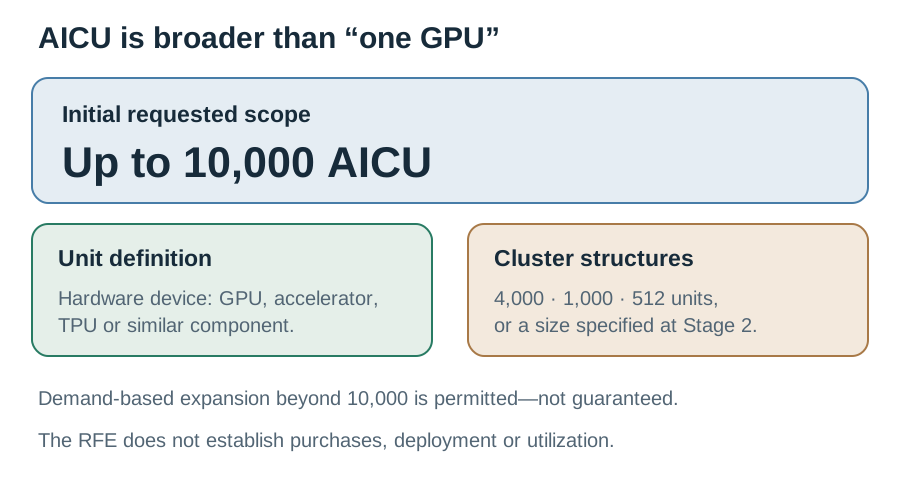
| RFE detail | Careful reading |
|---|---|
| Unit | A hardware device; examples include GPUs, accelerators, TPUs and similar components |
| Initial scope | Up to 10,000 AI compute units |
| Clustering | Clusters of 4,000, 1,000 or 512 units, or another size specified during Stage 2 |
| Expansion | C-DAC may scale beyond 10,000 according to demand during the empanelment validity |
| Work period | AI compute services are sought for five years |
These are tender terms, not an inventory of installed or operating devices. [1]
“GPU” is an understandable shorthand for AI compute, but the RFE’s own term is AI compute unit (AICU). Its definition covers hardware devices and lists GPUs, accelerators, TPUs and similar components. AICU is therefore broader than a count of one specific chip type. A headline that turns the number into “10,000 GPUs” may be easier to parse, but it narrows the official definition. [1]
The document organizes the units into clusters of 4,000, 1,000 or 512, or another arrangement that can be specified at Stage 2. The cluster sizes describe the tender’s requested capacity structure. They are not a report that those exact clusters already exist in a data centre. Stage-2 terms, provider capacity, technical suitability and the eventual procurement determine what can actually be supplied. [1]
The RFE also allows C-DAC to scale total capacity beyond 10,000 AICU during the empanelment period if demand warrants. That is an expansion option, not a forecast that the final deployment will exceed 10,000. The number is best read as an initial requirement with a possible demand-led increase—not as a hard maximum, a guaranteed purchase or an active-capacity figure. [1]
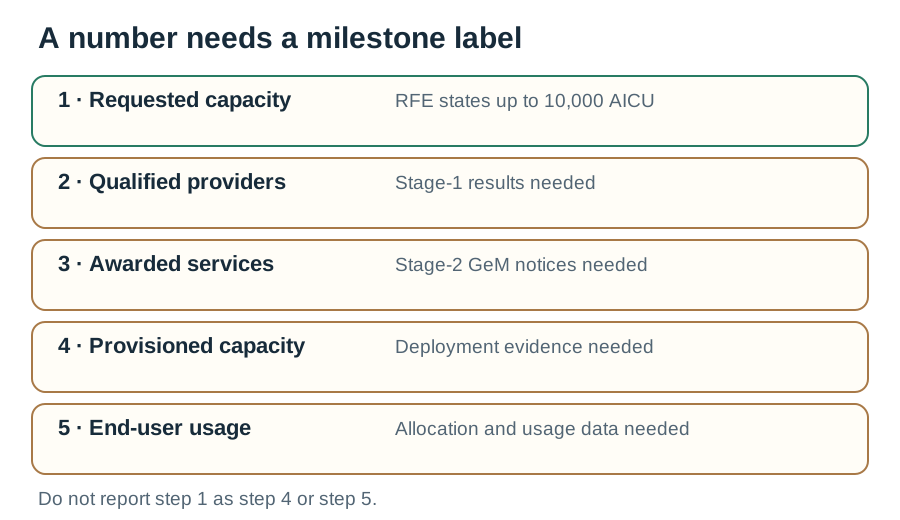
A tender number has several different meanings
View data
| Milestone | Evidence needed to report it |
|---|---|
| Requested capacity | The RFE’s stated requirement |
| Qualified provider pool | Stage-1 result and empanelment list |
| Awarded services | Stage-2 GeM notice, selected provider and quantities |
| Provisioned capacity | Contract performance, site or deployment record |
| Available service | Operational status, service levels and access terms |
| Utilization | Requests, allocations and usage data |
The RFE establishes the first row, not the later rows. [1]
The public-facing IndiaAI Compute Portal provides a separate view of how end users interact with compute services: users can register, submit eligibility information and request compute, with a draft bill based on the rate list and an application process for subsidy. Its eligibility page and price calculator are separate from the provider RFE. That portal illustrates why procurement and access are different questions. Provider empanelment is upstream; user eligibility, an available service, allocation and actual usage are downstream. The portal alone does not establish that this particular RFE has produced a new amount of live capacity. [4][6][7]
To report a deployment number responsibly, a newsroom would need a later record identifying what was awarded and to whom, then evidence that capacity was provisioned. To report user access, it would need availability and allocation terms. To report utilization, it would need usage data. The RFE itself is evidence of a procurement process and an intended capacity requirement. It is not an inventory database. [1][3][4]
The government eProcurement record says “Show Tender Value in Public Domain: No”; its tender-value field displays ₹0.00. That is a non-disclosure field, not evidence that the service procurement costs nothing. The RFE is a process for finding qualified providers and setting up later procurement, not a disclosed rupee commitment for a completed 10,000-unit purchase. The available source does not support estimating the budget by multiplying the unit count by a market GPU price; hardware types, configuration, service scope, time period and commercial terms are not yet fixed in a comparable public award. [1][3]
The revised calendar
The C-DAC RFE was published on 7 October. C-DAC’s 13 October corrigendum changed the pre-bid meeting and submission-start dates. The 27 October corrigendum then changed the submission deadline and bid-opening date. The latest amendment checked for this report supersedes the original timetable: bids are due 13 November at 3:30 p.m. IST, and opening is scheduled for 14 November at 4 p.m. IST. [1][2][5]
That distinction is important because a tender can have multiple amendments. Reporting the first deadline after a later corrigendum has changed it would describe an expired window as current. A date should be attributed to the relevant amendment, not copied from the initial RFE or an older news story. The 27 October document says all other terms and conditions remain the same; it changes the timetable rather than the scope of the capacity request. [2][5]
As of 31 October, the revised submission deadline is still in the future. This article does not claim that bids have closed, that any provider has qualified, or that the bid-opening outcome is known. Those developments would require a later official notice. [2][3]
The operational questions come after empanelment
An AI compute service is more than a chip count. The RFE contemplates end-to-end services over five years and describes workloads that include model training, fine-tuning, inference and high-performance computing. A user-facing service also depends on site readiness, power, networking, storage, software, security, maintenance, scheduling and support. The tender’s scope establishes that the procurement is for services, not merely a shipment of bare devices. It does not prove that every provider will deliver the same configuration or that every workload will be served in the same way. [1]
Stage 2 is where more of those details become concrete. The RFE says procurement will occur among empanelled providers through GeM and that the final engagement model, quantity allocation and award strategy will be determined at that stage. C-DAC may award work to one provider or distribute it across several lots or agencies. Until those notices appear, the RFE cannot answer which locations will host the service, how many units will be assigned to a provider, what prices will apply or when users can request capacity. [1]
The five-year service term also needs careful handling. It describes the period for which services are sought under the project, subject to the RFE’s process and later agreements. It does not mean that every requested unit is already contracted for the whole period. A service term and a capacity commitment answer different questions: the first gives a framework for duration; the second requires an award and a quantity. [1]
Do not combine this with every other GPU headline
The RFE’s 10,000-AICU figure should not be added to earlier counts of GPUs in India without checking their definitions, dates and status. A count of chips already available through an earlier programme is different from a tender requirement for providers to offer services; a shortlisted provider is different from a commissioned cluster; and an eligible user’s request is different from a delivered allocation. The public sources we checked do not establish a like-for-like series connecting the new RFE to previous counts.
This also limits comparisons with other national compute initiatives. The tender names ministries and departments, academia, research institutions, startups and industry among potential demand groups, but it does not disclose a final allocation for any one group. The figure should not be presented as a per-startup quota, a guarantee of compute for every applicant or a measure of the country’s full AI capacity. [1][4]
What this means for…
Startups and researchers: The RFE signals a planned provider-empanelment process, not immediate access to 10,000 units. Check the official user portal for current registration and application conditions, and wait for the relevant procurement and service notices before assuming capacity, price or eligibility.
Potential providers: Stage-1 technical qualification is only the first step. Read the full RFE, amendments and later GeM documents; the final quantity, award strategy and service terms are determined later.
Data-centre operators: The cluster structure points to the scale and organization the RFE is considering, but it does not tell an operator which sites will be selected or how much power or networking will be contracted. Those questions depend on provider proposals, technical evaluation and Stage-2 awards.
Policy makers: Report procurement milestones separately from commissioned hardware and end-user service. The distinction makes it possible to track where delays or constraints occur instead of treating an announcement as an outcome.
Journalists: Use “AI compute units” when describing the RFE’s number. Attribute the 10,000 figure to the tender, note its scale-up provision, and do not convert it into deployed GPUs, a budget or active user capacity.
What we don’t know yet
- Which providers will pass Stage-1 technical qualification?
- How many providers, locations and units will be selected at Stage 2?
- What prices, service levels and contract start dates will apply?
- How much capacity will be provisioned and when will it become usable?
- How will allocations and utilization be reported across user groups?
What to watch next
- The revised bid dates: C-DAC’s corrigendum sets 13 November for submission and 14 November for opening.
- Stage-1 results: look for the official empanelment list and qualification status.
- Stage-2 GeM notices: check award quantities, lot structure, providers and commercial terms.
- Deployment evidence: distinguish a contract from a provisioned cluster and a service that is accepting users.
- Usage reporting: look for allocations and utilization, not just announced capacity.
FAQ
Is C-DAC buying 10,000 GPUs?
The RFE seeks services using up to 10,000 AI compute units, and defines a unit as a hardware device that can include GPUs, accelerators, TPUs and similar equipment. It is an empanelment followed by Stage-2 procurement, not proof that 10,000 GPUs have been purchased or deployed. C-DAC may also scale capacity above 10,000 based on demand.
What is the difference between Stage 1 and Stage 2?
Stage 1 is technical qualification and empanelment. The RFE says it does not seek service-level requirements or financial bids at that stage. Stage 2 is procurement of AI compute services through GeM from empanelled providers, when C-DAC will determine the engagement model, quantities and award strategy. Passing Stage 1 does not guarantee work.
When are bids due and when will they open?
The 27 October 2026 C-DAC corrigendum changes the dates in the original RFE. Bid submission now ends on 13 November 2026 at 3:30 p.m. IST, and bid opening is scheduled for 14 November at 4 p.m. IST. This report uses the amended dates and does not repeat the superseded 29–30 October timetable.
Does the tender promise five years of service for 10,000 units?
The RFE describes AI compute services for five years and an initial requirement of up to 10,000 AI compute units, with potential demand-based expansion. Those terms do not amount to a confirmed five-year award for every unit. Provider selection, quantities, start dates and final service terms depend on Stage-2 procurement and later agreements.
Is 10,000 the maximum capacity?
No. The RFE describes an initial requirement of up to 10,000 units but also says C-DAC may scale total capacity beyond 10,000 during the empanelment validity according to demand. That is permission to expand, not a forecast or guarantee that the final capacity will exceed the initial request.
Sources
Tier 1 — primary / official
- C-DAC, RFE for Empanelment of AI Service Providers for provisioning of AI Compute Services, C-DAC/GPU/01/2026, 7 October 2026. https://cdac.in/index.aspx?id=tenders_ASP-RFE
- C-DAC, Date change corrigendum, 27 October 2026, Tender ID 2026_DIT_929273_1. https://www.cdac.in/index.aspx?id=tenders_Date-change-corrigendum_13.11.2026
- Government of India eProcurement System, tender record 2026_DIT_929273_1. https://eprocure.gov.in/eprocure/app?component=%24DirectLink_10&page=FrontEndTenderDetails&service=direct&sp=S%2BIdfKJWM8eaSytNrGF1SYA%3D%3D
- IndiaAI Compute Portal, end-user registration and compute request information. https://compute.indiaai.gov.in/login
- C-DAC, Date change corrigendum, 13 October 2026. https://cdac.in/index.aspx?id=tenders_Date_Change_Corrigendum
- IndiaAI Compute Portal, Eligibility criteria. https://compute.indiaai.gov.in/eligibilitycriteria
- IndiaAI Compute Portal, Price calculator. https://compute.indiaai.gov.in/indiaaipricecalculator
Tier 2 — secondary reporting
- MediaNama, MeitY invites AI compute providers to supply 10,000 GPUs under IndiaAI Mission, October 2026. https://www.medianama.com/2026/10/223-meity-ai-compute-providers-gpus-indiaai-mission
Methodology note
Research and drafting for this article were AI-assisted; the text was reviewed against the cited sources before publication. Tender terms are attributed to C-DAC’s RFE and corrigendum; the IndiaAI portal is cited only for the downstream end-user request process. Secondary reporting is not used to establish award, deployment or usage. The 10,000-unit figure is not converted into a GPU inventory or budget. Companies named in this article are subjects of our reporting. See our editorial standards for how we handle conflicts of interest.

Aman Mishra, Chief Editor (reviewer). Aman Mishra is Chief Editor of Global AI News. He is responsible for the publication’s editorial standards and reviews articles against their cited primary sources before publication.
Global AI News Desk explains AI news using primary sources: filings, official documents, papers and company announcements. Claims made by companies are attributed to them. Spotted an error? Tell us — we correct mistakes openly under our editorial policy.