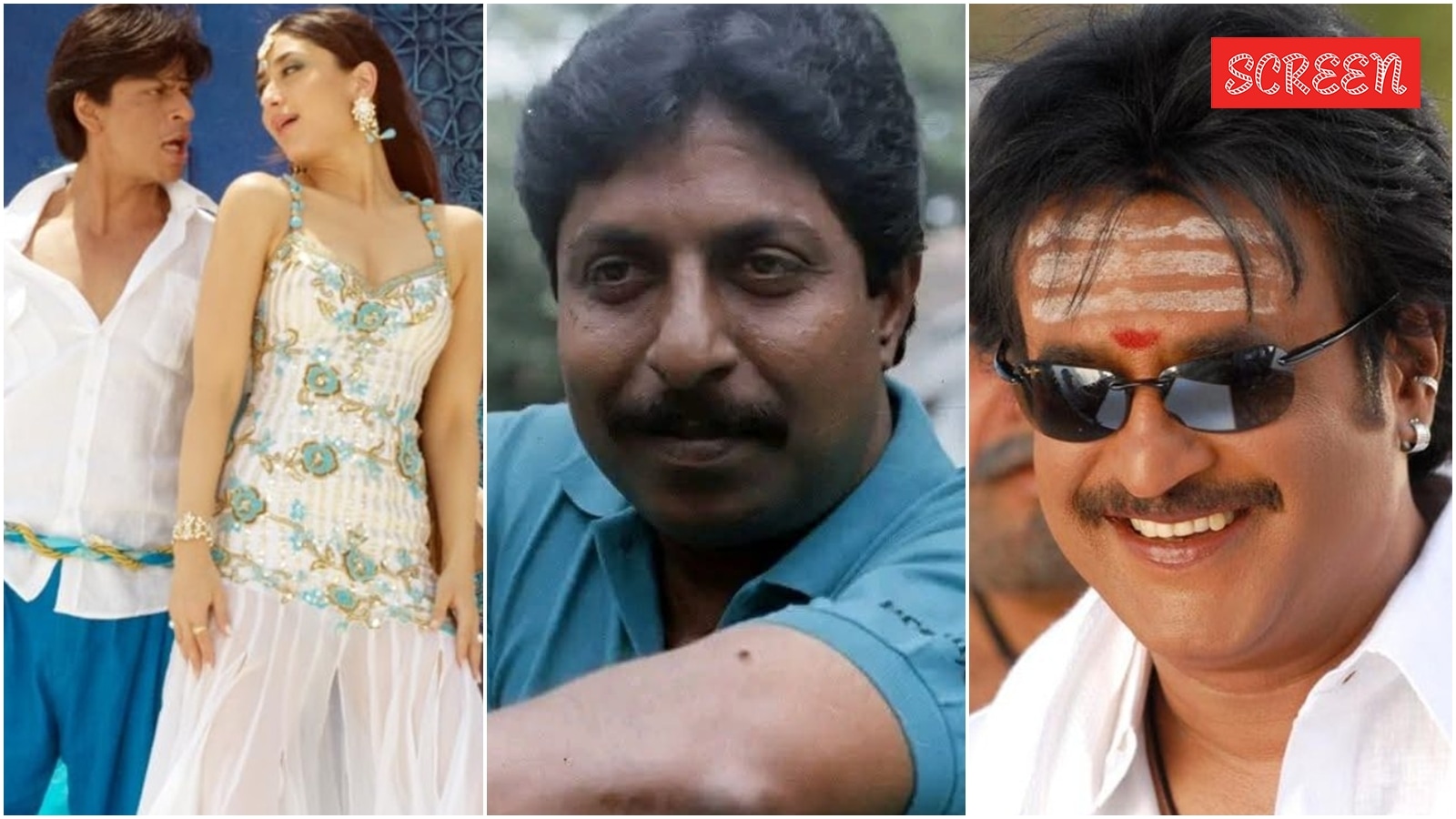
Rajinikanth and Shah Rukh Khan couldn't recreate the magic that Sreenivasan achieved once when they remade one of his films in their respective languages. (Credit: IMDb, Facebook/@theManjuWarrier)
It’s not easy to explain through words what Sreenivasan’s brilliance was, either as a screenwriter-filmmaker or as an actor. One can only understand its true extent by experiencing his work. However, it can definitely be said that one of the factors that made his movies and performances dear to Malayalees was their ordinariness. Much like the man himself, his characters were also raw and unfiltered. If any of his characters appeared to be wearing a mask, he ensured they were unmasked before the silver screen went blank. He popped the bubbles surrounding people, provoked the egos that defined them, and exposed their affectations like nothing else. Yet, there was an extreme sincerity at the core of his words and works.
In fact, even Rajinikanth and Shah Rukh Khan couldn’t recreate the magic that Sreenivasan achieved once when they remade one of his films in their respective languages. Even though these movies were helmed by the most prolific filmmakers in both industries, they failed to replicate the success of the Malayalam original.
After years of continuous work, the 2000s saw Sreenivasan slow down and take on only a few projects each year. However, when his brother-in-law, M Mohanan, was planning to make his directorial debut after years as an AD, Sreenivasan took his pen once again and wrote Kadha Parayumbol (2007). Interestingly, Sreenivasan and his actor friend Mukesh bankrolled the movie under their newly established banner, Lumiere Film Company. It was one of the only two films they produced, the other being Vineeth Sreenivasan’s Thattathin Marayathu (2012).
Revolving around a barber named Balan (played by Sreenivasan himself), who lives in a village with his family, and his long-lost friendship with film superstar Ashok Raj (Mammootty), the movie emerged as a massive success upon release. The story of Balan, who purposefully distances himself from all the clamour when Ashok Raj reaches his village for a film shoot — assuming that the latter may have forgotten him — and the superstar, who still silently harbours sweet memories of his lost childhood friend, stole the hearts of the audience.
Following the film’s massive success, it was remade in Tamil (Kuselan, 2008), Telugu (Kathanayakudu, 2008), and Hindi (Billu, 2009). While ace filmmaker P Vasu helmed the Tamil and Telugu versions, which were shot simultaneously, blockbuster director Priyadarshan remade Kadha Parayumbol in Hindi. ‘Superstar’Rajinikanth reprised Mammootty’s role in Tamil and Telugu, and ‘Bollywood’s Baadshah’ Shah Rukh Khan did it in Hindi. Irrfan Khan took on the role of Balan in Hindi, while it was played by Pasupathi in Tamil and Jagapathi Babu in Telugu, highlighting that all the films had the necessary ingredients to soar, with the extra benefit of bigger budgets.
Although Kuselan and Kathanayakudu marked Rajinikanth and P Vasu’s first collaboration since the all-time blockbuster Chandramukhi (2005), both movies underperformed and even earned negative reviews compared to the Malayalam film. The fate was similar for Billu as well. Although the Hindi movie grossed Rs 47.45 crore worldwide against a budget of Rs 27 crore, according to Box Office India, it didn’t reach the lofty heights everyone expected. Despite Shah Rukh Khan riding a success wave at that point, with back-to-back hits such as Don (2006), Chak De! India (2007), Om Shanti Om (2007), and Rab Ne Bana Di Jodi (2008), Billu’s performance didn’t match that of his recent works. Even Priyadarshan, known as an expert in remaking movies, couldn’t recreate the Sreenivasan magic.
But why? One of the major reasons could be that while Kadha Parayumbol was the story of Balan, the barber, Kuselan and Billu revolved mostly around Ashok Kumar (Rajinikanth) and Sahir Khan (SRK), respectively. Despite the superstars having only limited screen time in their respective films, Kuselan and Billu went above and beyond to satiate their star images, stripping the narratives of their naturalness. While one could easily imagine Ashok Raj (Mammootty) shedding his glittering robes to rekindle with Balan (Sreenivasan) at the end, the manner in which Kuselan and Billu presented Ashok Kumar and Sahir Khan — from the opening moments to the climax — made it almost impossible to believe that they would step into the homes of Balakrishnan (Pasupathy), Balakrishna (Jagapathi Babu) or Bilas Rao Pardesi (Irrfan Khan) so easily. The inclusion of numerous unnecessary subplots and item songs for commercialisation further backfired in both films.
Thus, it could be said that even the most prominent names and talents in the Tamil, Telugu, and Hindi industries failed to recreate the magic that Sreenivasan once achieved with Mammootty. The main strength Sreenivasan had here was his deep understanding of the hearts and lives of the average audience, something one can achieve only by living at the grassroots level and maintaining one’s roots even after gaining success.