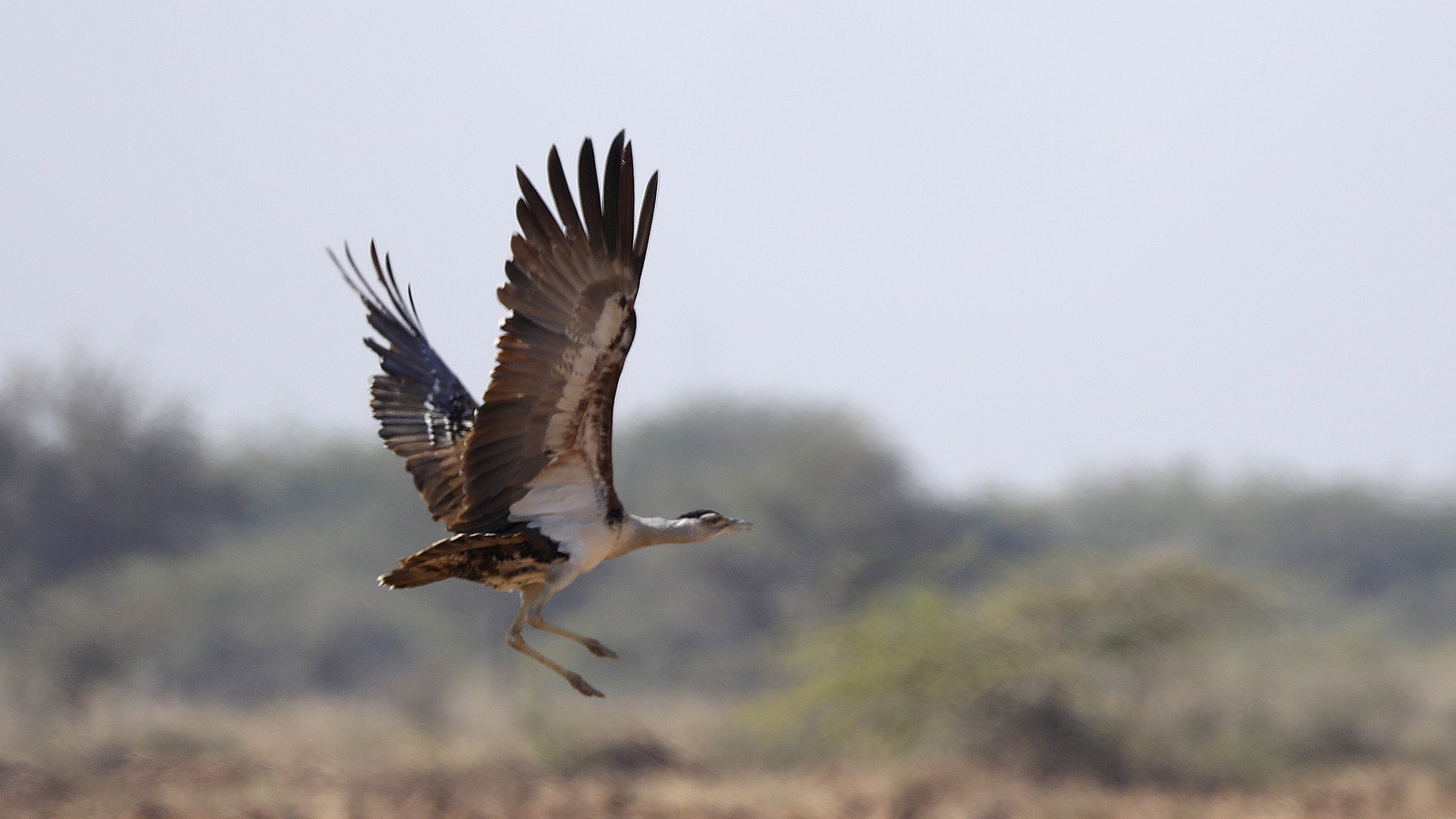
The Supreme Court has said that the protection of the critically endangered Great Indian Bustard bird was “non-negotiable” as it examined the recommendations of a expert panel on the conservation and protection of the species.
A bench of Justices P S Narasimha and A S Chandurka was hearing a plea filed in 2019 that highlighted the declining numbers of the species and sought the intervention of the top court.
The bird is a flagship species of the Thar Desert, locally known as “Godawan”– as critically endangered.
The court appointed an expert committee in 2024 to find a “delicate balance” between practical and environmental challenges in the conservation and protection of the species.
While accepting the recommendations of the committee, the bench formally designated 14,013 square kilometer in Rajasthan and 740 square kilometer in Gujarat as “revised priority areas”. These zones are considered essential for the GIB.
Notably, the court paid homage to the Bishnoi community and late Radheshyam Bishnoi, known as the “godawan man”, underscoring their tradition of eco-veneration was a classic example of harmony with nature that modern development must now emulate.
The bench went ahead to quote “My Head for a Tree” authored by Martin J Goodman as saying, “Luckily for one giant bird, they have such eyes. For millions of years, way before primates evolved into humans, they used this lateral vision to thrive in desert lands. This is the Great Indian Bustard, the State bird of Rajasthan. It’s over three foot tall and weighs forty pounds, about as big as a bird can be and still be able to take wing. A bird that big should be easy to find. Then people came and built wind turbines, and cables between tall pylons to ferry to the city electricity garnered from desert winds. Now the species is almost extinct.”
The top court also referred to folklore, saying the survival of the bird was a” shared cultural responsibility” for it represents not just a species but the unique natural heritage and resilience of the arid landscapes.
The court quoted the folklore text, when translated, says, “The pearl of the desert land, my dear Godawan; It walks with a slow, graceful gait, my stylish Godawan; On the land of the sand dunes, my Godawan wanders tallest among all the birds, my beloved Godawan.”
The plea filed by M K Ranjitsinh in 2019 had sought immediate directions for the conservation of the bird species, besides the Lesser Florican (LF) species.
In 2021, the top court had initially issued a blanket ban on overhead electricity lines across 99,000 *square kilometer to preserve the species, ordering them to be placed underground within a year
The government challenged the order in 2024, arguing that undergrounding of high-voltage lines was technically impossible in the desert sands and would release massive carbon emissions if renewable goals were not met.
The court subsequently modified its order and appointed an expert committee to find a “delicate balance”. Later, the expert committee submitted its recommendation report to the court.