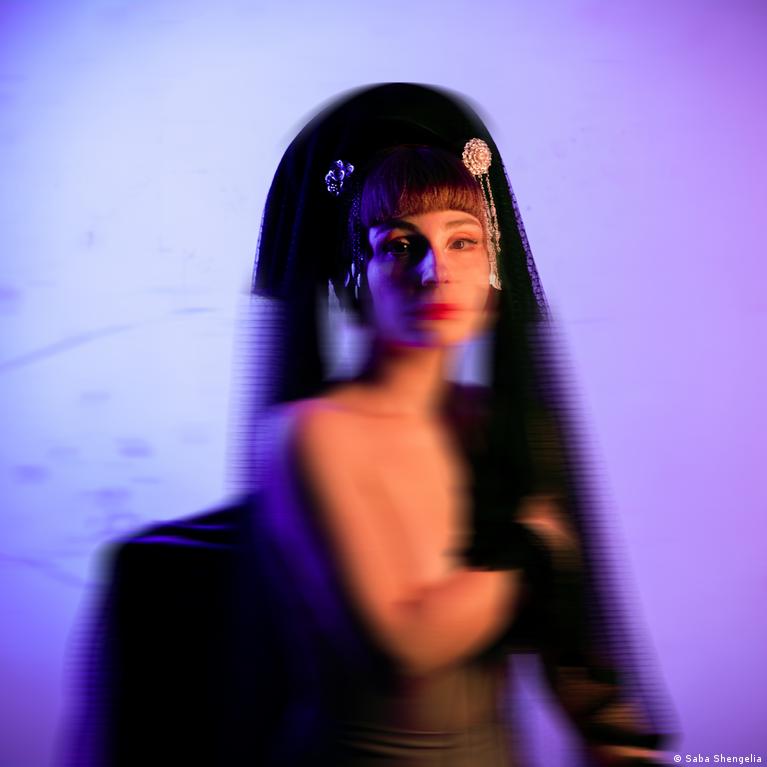
Her guitar has been sitting unused in the corner for a month. "I don't feel like it," says 35-year-old Georgian musician and composer Natuka Natsvlishvili. "I'm depressed and I don't think I have the right to sit at home and work on my music."
Natsvlishvili has been a musician since the age of 15 and has recorded an album. But now her focus has shifted. "My feeling is that we just have to fight now," she told DW, explaining that she believes Georgia's government threatens not only her freedom as an artist, but the freedom of the country itself.
For the last year and a half, the Black Sea nation has seen waves of protest, starting in May 2024 against the so-called foreign agent law, which allows authorities to take action against foundations, independent organizations and media outlets.
This was followed by uproar over the increasingly authoritarian ruling Georgian Dream party's contested victory in the October 2024 parliamentary elections, and the new government's decision to suspend European Union accession talks just a few weeks later.
The populist, socially conservative government has met protesters with violence, arrests and imprisonment. Human rights organization Amnesty International describes the approach as "systemic abuse of the justice system to silence dissent and sustain a climate of impunity for human rights violations."
In September, for example, well-known actor Andro Chichnadze and 18 others were convicted of "group mass disturbance" for participating in the pro-European demonstrations and sentenced to two years in prison.
Musician Natsvlishvili often takes part in protests outside the parliament building in Tbilisi. She says that it feels like the government is constantly passing repressive new laws.
"They can already put us in prison just for standing on the sidewalk," Natsvlishvili says, adding that fear and the daily struggle for basic rights are stifling creativity. "In the near future, there will be no place for art in this country. Free expression is no longer welcome."
David Apakidze, a visual artist from Tbilisi, says: "Art is taking a back seat right now." The 27-year-old is also referring to the financial pressure now felt by Georgian artists.
Many depend on support from abroad, but since the foreign agent law came into force, there has been great uncertainty among patrons and recipients. The law requires all media outlets and NGOs that receive more than 20 percent of their funding from abroad to register and identify themselves as "representing the interests of foreign powers.”
"It has become complicated to pursue one's work as an artist and still make ends meet," Apakidze says.
He also creates objects made of colorful glass that combine elements of Orthodox Christianity with queer identity — and thus finds himself doubly targeted by the Georgian government, which has long been committed to fighting what it calls "LGBTQ propaganda."
In 2024, it passed a law that severely restricts the rights of sexual minorities and aims to end "propaganda of same-sex relationships." For Apakidze, this meant that Project Fungus, a queer artist collective he cofounded in 2020, had to be shut down. "With all these new laws, it was too dangerous to continue operating — both for us and for our financial backers,” he says.
Apakidze has also been the target of hostile parliamentarians, with one describing the book he wrote for Project Fungus, which looks back on 100 years of queer art in Georgia, as "disinformation and LGBTQ+ propaganda."
Shortly afterwards, Apakidze and his colleagues were told that the venue for the planned book presentation had been canceled. "It was a very frightening situation,” Apakidze recalls. "But we went ahead with the book presentation at another location anyway, because we knew that if we didn't do it now, we would never do it.”
Mariam Megvinyte also has firsthand experience of this narrowing public discourse. The screenwriter runs a theater collective in Tbilisi with colleagues. A photo from a performance in which two women scantily clad as cats fight each other sparked hateful comments about the theater on social media.
"There were vicious insults below the belt. Another post said we weren't real Georgians, that we were influenced by the West. So now I don't share anything on social media that could be considered provocative. But I don't even know what's provocative anymore. It could be anything these days," she says.
Megvinyte also describes seeing unknown men come to the theater to look around. Since then, she says she wonders at every performance whether there are people in the audience who are there to monitor what is happening in the theater.
Megvinyte recently spent some time at Munich's Residenztheater and is now returning to Georgia. Her theater in Tbilisi is still open, but she suspects that the authorities will make life more difficult for her and her colleagues.
Could she imagine emigrating? It's an option, she says, because she can't imagine the situation in Georgia improving in the foreseeable future. "On the other hand, it would be strange to leave," Megvinyte says. "We have all these political prisoners, you can't just abandon them. They're in prison purely by chance, but it could just as easily have been me."
This article was originally written in German.