Last month, when the Bihar government issued a notice asking former Chief Minister Rabri Devi to relocate from her current government bungalow that she had occupied for two decades, her refusal quickly escalated into a political controversy.
The episode once again highlighted how government housing in Bihar has long been intertwined with legacy, power, and entitlement. That debate unfolded in public amid a quieter but far more consequential shift in Patna.
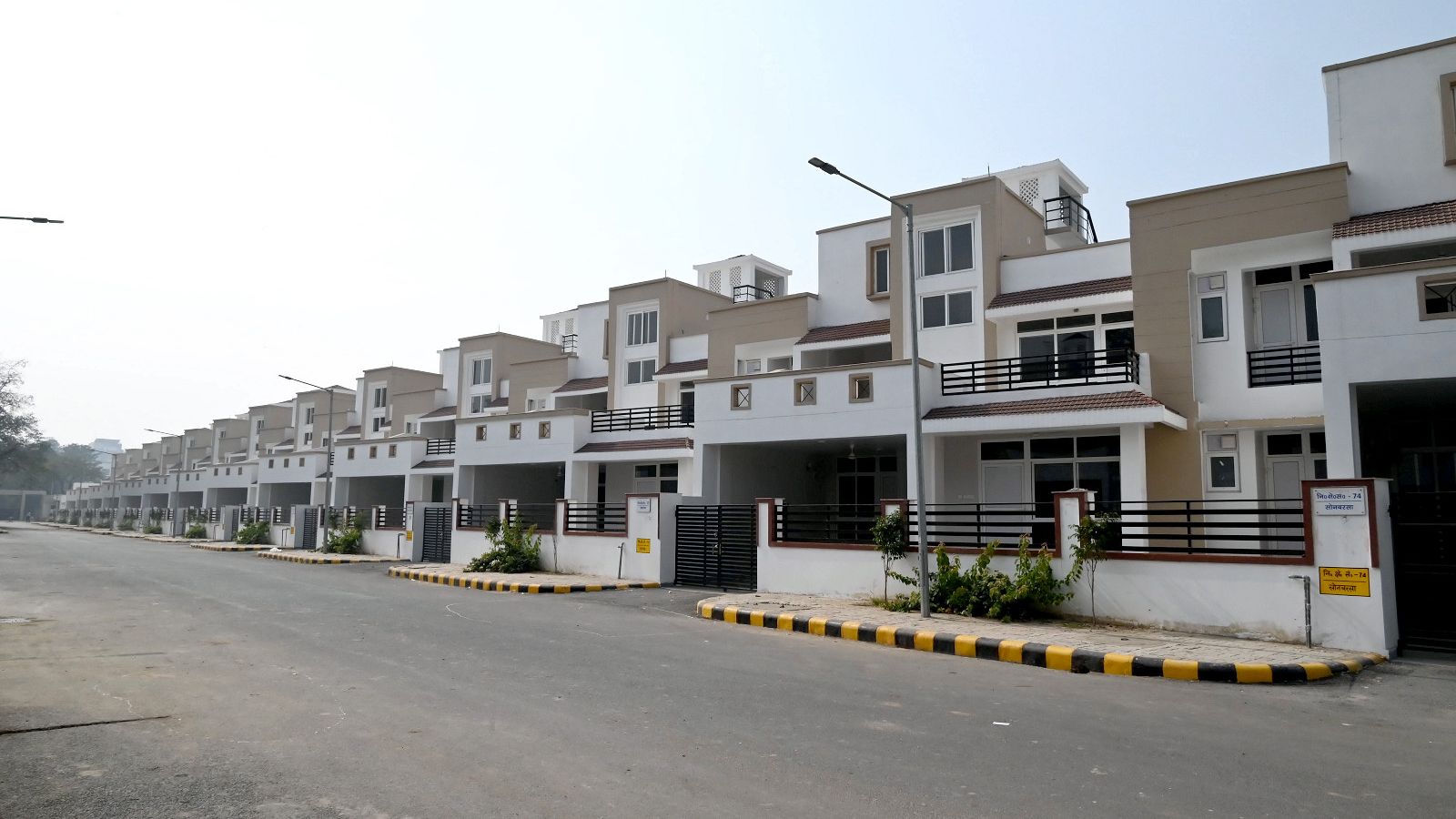
After more than a decade of delays, re-tendering and stalled construction, Bihar’s long-pending MLA bungalow project has finally materialised in the capital. First envisioned in 2013, stalled due to technical and administrative hurdles, revived in 2018, allotted in 2020, and construction happening in 2021–22, the project today stands as a cluster of 158 newly built, identical G+2 bungalows on the Beer Chand Patel road near the JD(U) office in Patna. Several MLAs have already performed housewarming rituals and moved in, ending years of uncertainty around official housing.
First envisioned in 2013, stalled due to technical and administrative hurdles, revived in 2018, allotted in 2020, and construction happening in 2021–22, the project today stands as a cluster of 158 newly built, identical G+2 bungalows on the Beer Chand Patel road near the JD(U) office in Patna. (Express Photo by Rahul Sharma)
For decades, dating back to the 1930s and continuing well into the post-Independence period, there was no uniform residential area for public representatives in Patna. While CMs and senior leaders occupied sprawling legacy bungalows, most legislators lived in rented houses, scattered flats, or temporary government quarters. During Assembly sessions, many had to stay in hotels or short-term accommodation, shifting frequently based on availability. The absence of stable housing was felt most acutely by first-time legislators and those from modest or marginalised backgrounds.
Each bungalow follows a standardised design to avoid hierarchy among legislators. Spread over 4,300 square feet with a built-up area of around 3,600 square feet, the three-storey residences include three bedrooms, a drawing room, a guest room and an office chamber. Basic furnishings have been provided, including air conditioners, beds, dining furniture, and essential fittings.
Beyond the bungalows, the complex also houses a dedicated MLA hostel with 83 suites, primarily intended for use during Assembly sessions. Spread over nearly 1.9 acres, the hostel includes service and staff dining facilities in the basement, reception and dining areas on the ground floor, 83 suites from the first to fifth floors, and pantry and service spaces on the sixth floor. Officials say the hostel is meant to accommodate visiting legislators and reduce dependence on hotels during legislative sittings.
For several MLAs, particularly those from marginalised communities, rural regions, and with no political lineage, the allotment represents their first permanent residence in the city. This was visible during the key-handover ceremony itself, when Ram Chandra Sada, an SC MLA from Alauli constituency in Khagaria district, broke down in tears as Chief Minister Nitish Kumar handed him the keys last week.
Subash Singh, the BJP MLA from Gopalganj, said the new bungalows were for people and not MLAs. “If someone from our constituency comes to Patna for treatment or official work, they will have a place to stay, eat, and meet us.”
Manoj Bishwas, the Congress MLA from Forbesganj, pointed out that the complex was conveniently located close to the Assembly, railway station, airport and the Indira Gandhi Institute of Medical Sciences.
Vishnu Deo Paswan, LJP (RV) MLA from Darauli, said, “The old MLA flats had very limited amenities. These bungalows have more rooms and better safety. All MLAs from the eight Assembly seats in our district have been allotted bungalows next to each other. If someone comes seeking help and I am unavailable, another MLA from the same district will be present. No one will return empty-handed.”
Not all legislators, however, see the development purely through the lens of convenience. Bhism Pratap Singh Kushwaha, JD(U) MLA from Ziradei, struck a note of caution. “Solutions come from the constituency. The bungalow in Patna is meant for Assembly sessions. MLAs should come here when the House is in session and stay only as long as necessary,” he said. However, he said housing MLAs from the same district in proximity to each other was “helpful for coordination and collective problem-solving”.
The complex has centralised utilities, including individual water tanks for each bungalow, a water treatment plant, and a 240 KLD sewage treatment plant. While security currently relies more on guards than on electronic surveillance, officials said the Assembly Secretariat would soon float tenders for landscaping, maintenance, and security.
According to engineer Sunny Singh, the sewage treatment plant operates for nearly 12 hours a day, with recycled water used for landscaping. Solar lighting provisions have been included in the budget, while streetlights cover internal roads. Solid waste will be managed through a dedicated housekeeping system, ensuring door-to-door garbage collection.
Unlike routine residential projects that rely solely on concrete roofing, the bungalows feature a seven-layer waterproofing system involving chemical treatment, damp-proof courses, multiple protective layers, finishing tiles and epoxy coating.
Alongside the MLA residences, the state has also constructed 75 official houses for MLCs, another first in Bihar’s legislative history. Officials say the twin housing projects are intended to bring legislators into a single institutional space and reduce the ad hoc arrangements that have long defined political life in the capital.
RJD national spokesperson Subodh Kumar Mehta welcomed the move but urged clearer demarcation. “While it is good that every MLA now has an official house in Patna, bungalows should be earmarked for those holding key Constitutional and political positions, such as ministers and Leaders of the Opposition, to avoid future disputes,” he said.
“Many MLAs come from very modest backgrounds. Having an official bungalow helps them discharge their administrative and legislative responsibilities more effectively, while also giving them adequate space to meet people from their constituencies,” said JD(U) chief spokesperson Neeraj Kumar.