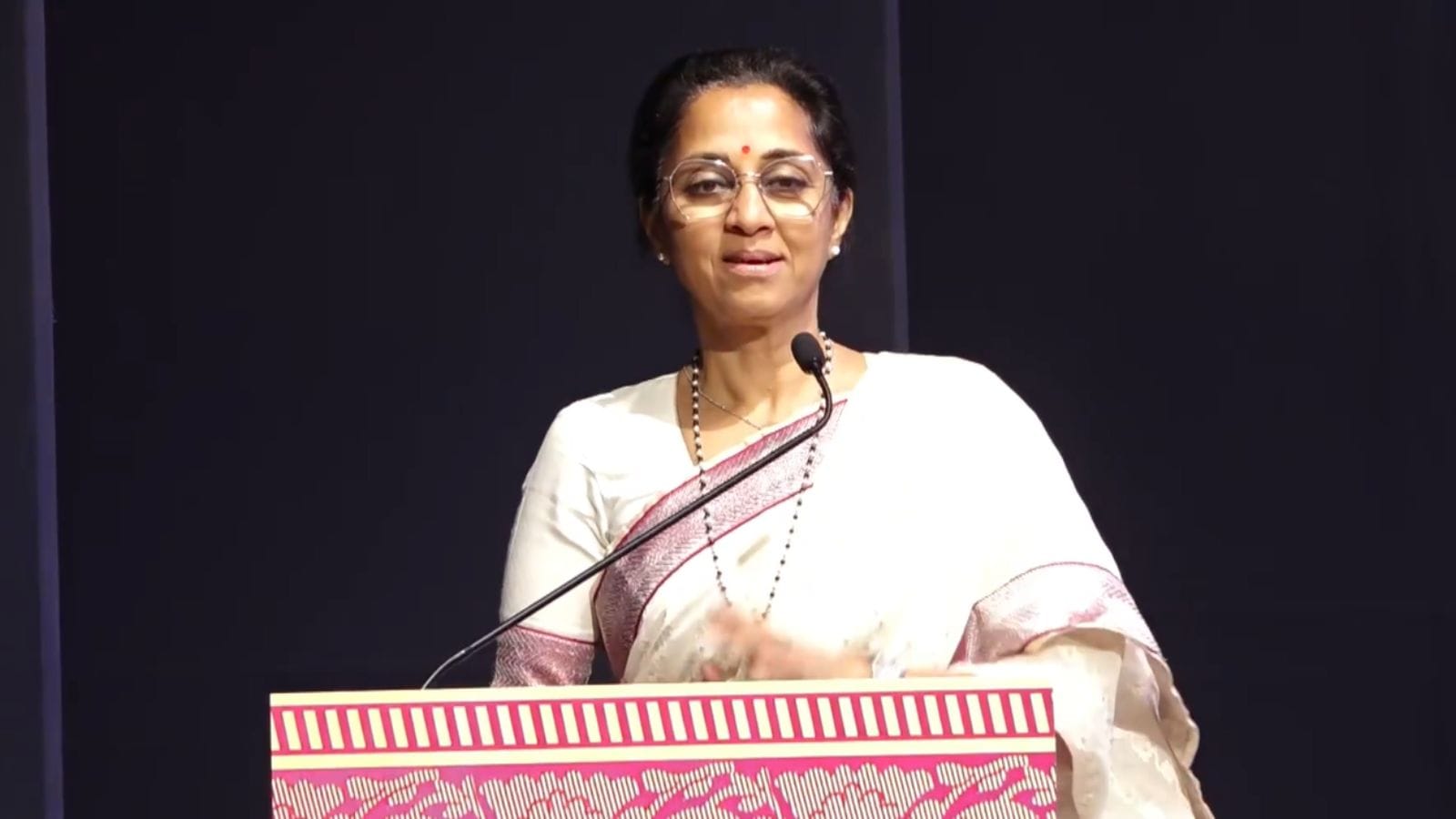
As per the tradition of the Stree Mukti Movement, the conference began with the presentation of songs on women’s liberation. (Image: @supriya_sule)
NCP (SP)’s Lok Sabha MP from Baramati Supriya Sule inaugurated a three-day state-level conference in Mumbai on Saturday to commemorate 50 years of Stree Mukti Movement.
Eminent personalities such as advocate Indira Jaising, Dr. Saeeda Hameed, and Sharada Sathe, president of the Maharashtra Stree Mukti Parishad, were the chief guests. Also present were Dr. Chhaya Datar, Dr. Pradnya Daya Pawar, advocate Nisha Shiurkar, Dr. Chayanika Shah, Lata Bhise Sonawane, Hasina Khan, Amol Kerkar, Sunita Bagal, Shubhada Deshmukh, Sangeeta Joshi, and several other dignitaries.
Speaking on the occasion, MP Supriya Sule briefly reminisced about the five decades of the women’s liberation movement. She said she grew up in an environment of gender equality. Even today, though many women enter politics and become sarpanches, the actual administration often lies in the hands of their “SP,” that is, the Sarpanch pati (husband). “Dowry-related suicides among women continue even today. Metro services have begun, but travel is still not safe. True liberation for women will be achieved only when they receive genuine respect at home and in schools,” said Sule.
Chief guest advocate Indira Jaising said, “Mahatma Gandhi and Dr. Babasaheb Ambedkar brought true women’s liberation to the country. One taught people to take to the streets and protest, while Dr. Babasaheb Ambedkar taught them to fight for their fundamental rights.” She expressed concern that while people often ask who the father of the Constitution is, no one ever asks who the mother of the Constitution is.
“There was a time when women like Mrinaltai Gore and Ahilyabai Rangnekar took to the streets with “latane morchas” to fight for basic rights such as access to water. Pramila Dandavate initiated and spread the anti-dowry movement across villages. Nira Desai upheld the importance of educational traditions, while Nirmala Deshpande helped people realize that although countries like Pakistan, Nepal, Bangladesh, Sri Lanka, and India are different, the problems faced by women everywhere are largely the same,” said Jaising.
“In 1975, the United Nations declared March 8 as International Women’s Day and acknowledged that women across the world still did not have equal rights. This marked the true beginning of the women’s liberation movement….Women’s liberation thrives on democracy, and only when democracy functions effectively can true women’s liberation be achieved,” said Jaising.
Guest of honour Dr. Saeeda Hameed said she was extremely happy to see such a large gathering of women representatives. During her tenure at the Planning Commission, she studied the conditions in Malegaon and Gadchiroli in Maharashtra and presented the ground realities before the nation. “Seeing the work of the Maharashtra Stree Mukti Parishad gives a true glimpse of its impact,” said Dr Hameed.