Anthropic’s IPO Filing Explained: Who Owns It, and Who Really Controls the Board?
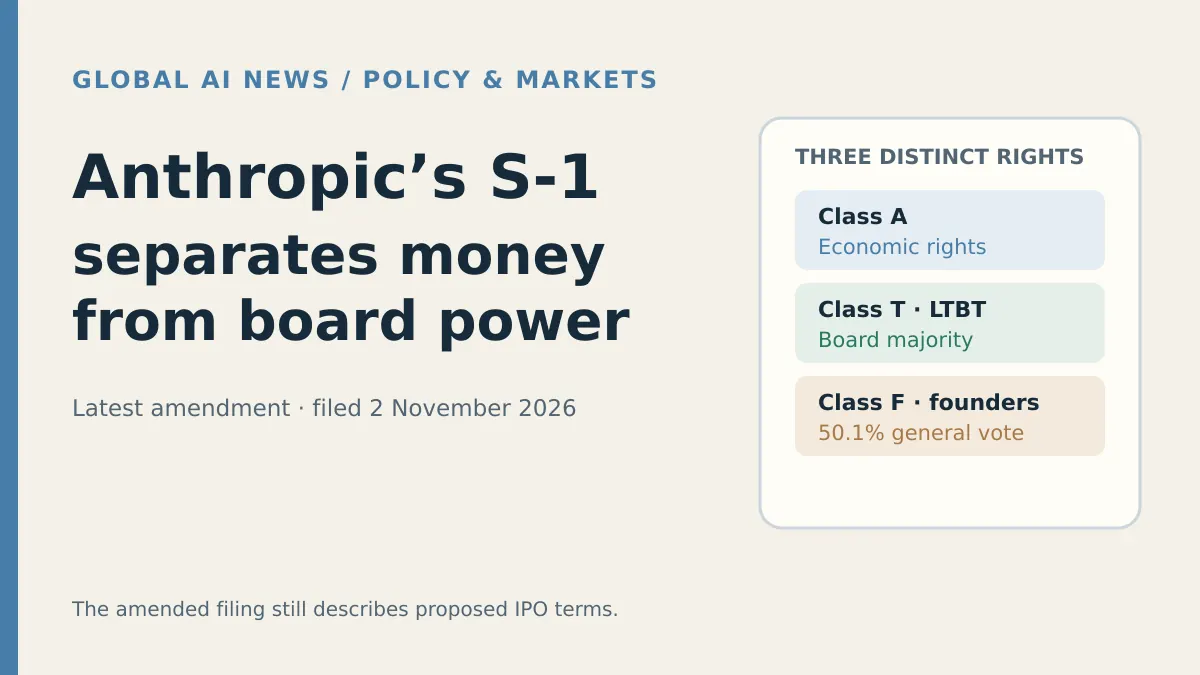
Anthropic’s S-1/A gives public investors economic rights, the founders 50.1% of shareholder votes and its Long-Term Benefit Trust a board majority. We break down the share classes.
Key takeaways
- Public Class A shareholders would receive economic rights, but not control of the board.
- A single Class F share held by the founders’ LLC would carry 50.1% of voting power on matters put to shareholders generally.
- The Long-Term Benefit Trust’s Class T share elects the Class T directors, who would form a board majority. Price, share count and offering date are still undetermined.
In this article
- The bottom line
- What the filing proposes
- Board selection and shareholder voting are different
- How the current filing compares with Anthropic’s 2023 explanation
- The financial figures are not one story about profitability
- What the filings support—and what they do not
- What this means for…
- What we don’t know yet
- What to watch next
The bottom line
The 2 November Amendment No. 1 to Anthropic’s 26 October Form S-1 describes a proposed listing in which public investors could buy Class A shares with economic rights without controlling the board. The latest filing proposes two separate governance levers: a single Class F share held by the founders’ LLC would carry 50.1% of voting power on matters submitted to shareholders generally, including the election of directors other than the Class T directors; and the Long-Term Benefit Trust (LTBT), through a Class T share, would generally elect and remove the Class T directors, who together would make up a majority of the authorized board. Both special classes have no economic rights, according to the filing. These terms are proposals in a registration statement, not a completed offering. The latest filing still leaves the offering price and share count undetermined; no offering date is stated. [1][2][9]
Filing update — 3 November 2026: The S-1/A filed on 2 November retains the governance terms summarized here and adds financial statements through 30 September. The financial figures below are deliberately labeled as H1 2026 figures from the original S-1; they are not the latest nine-month totals. [9]
The structure separates three questions that are often collapsed into “who owns the company?”: who receives economic value, who votes on ordinary shareholder matters, and who can choose the board. The latest S-1/A answers them differently. It does not establish how the structure will work in every future dispute, whether the Trust will exercise its powers in a particular way, or what public Class A shareholders will earn.
What the filing proposes
View data
| Class | Proposed holder or holders | Economic rights in the S-1 | Voting or board role described in the filing |
|---|---|---|---|
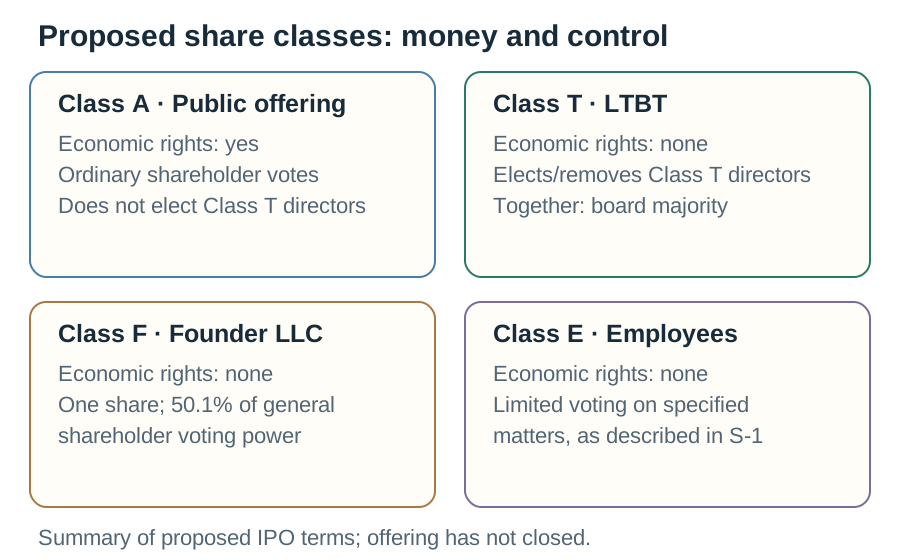
| A | Public investors and other eligible holders | Yes; the proposed IPO offers Class A common stock | Ordinary shareholder voting; does not elect the Class T directors |
| T | Long-Term Benefit Trust | None | Generally elects and removes Class T directors, who together are a majority of the authorized board; no general shareholder vote |
| F | Founder LLC | None | One share carries 50.1% of total voting power on matters submitted to shareholders generally, including election of directors other than Class T directors |
| E | Employees, excluding co-founders | None | Limited voting on specified matters |
This is a summary of proposed terms, not legal advice. See the latest S-1/A and original S-1 for the full terms, exceptions and conditions. [1][9]
The filing says the proposed offering is for Class A common stock. It also says Anthropic intends to list the shares on the Nasdaq Global Select Market under the symbol “ANT.” That is an intention, not a completed listing. The company’s own filing announcement says the number of shares and price range had not been determined. [1][2]
Class A is the economic class prospective public investors are being offered. The latest S-1/A retains the proposal that special Class T and Class F shares have no economic rights. This means the Class F share’s 50.1% vote is not a statement that the founders own 50.1% of Anthropic’s economic value. Nor does it mean that public shareholders receive 49.9% of every vote: Class T has no general shareholder vote, and the filing also describes limited voting rights for Class E. The safest description is the filing’s own: Class F would hold 50.1% of the total voting power on matters submitted to shareholders generally. [1][9]
Board selection and shareholder voting are different
View data
| Decision point | Proposed route in the S-1 | What it does not mean |
|---|---|---|
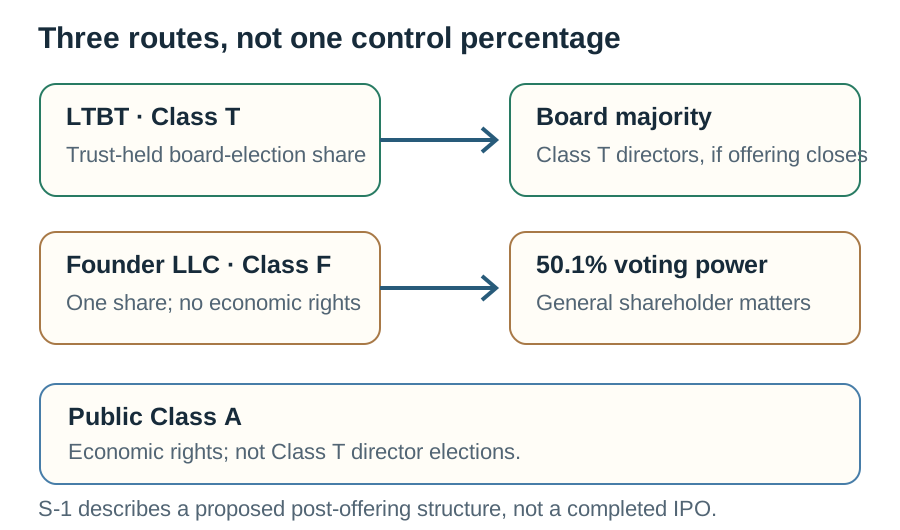
| Majority of board seats | LTBT generally elects and removes the Class T directors through Class T; those directors together constitute a majority of the authorized board | It does not give the Trust economic ownership of the company |
| Most shareholder matters | Founder LLC’s one Class F share carries 50.1% of voting power | It does not mean the founders’ LLC receives 50.1% of economic returns |
| Public investment | Class A common stock is the security offered | It does not give Class A holders the power to elect the Class T directors |
| Company management | The board appoints and oversees executives under the described governance structure | The S-1 does not predict the outcome of future board or shareholder disputes |
The filing describes the LTBT as an independent body of financially disinterested trustees with expertise in areas including AI safety, national security, public policy and social enterprise. Through Class T, the Trust generally has authority to elect and remove the Class T directors. The latest S-1/A retains the proposal that group will constitute a majority of the authorized board. In parallel, the single Class F share would be held by Founder LLC, whose initial members would be Anthropic’s seven co-founders. [1][9]
The latest S-1/A retains the proposal that Class F’s 50.1% voting power applies to matters submitted to shareholders generally, including election of directors other than the Class T directors. That wording is more precise than saying “the founders control every vote.” It specifies a large voting block and its stated scope, while the Trust’s Class T authority covers the separate process for selecting a majority of the board. Neither phrase alone tells readers how all future questions will be resolved. [1][9]
The latest S-1/A describes the relevant rights as part of a proposed post-offering structure. Class T and Class F are to be issued immediately before completion of the offering. Until the offering closes, readers should not write as if those proposed securities have already been issued under the IPO terms. The document is a registration statement: terms can be revised, and the company has not announced that the transaction is complete. [1][2][9]
How the current filing compares with Anthropic’s 2023 explanation
View data
| Date | Public document | What it says |
|---|---|---|
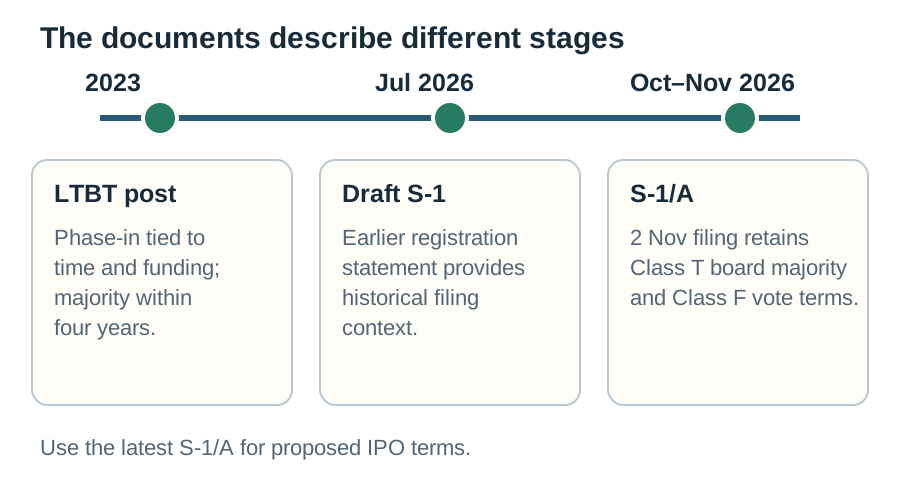
| 19 September 2023 | Anthropic’s LTBT announcement | Describes a trust-held Class T share and a phase-in of board appointment authority, with a majority within four years, plus an investor-elected board seat |
| 13 July 2026 | SEC draft registration statement | Describes the governance architecture before the October S-1 |
| 26 October 2026 | SEC Form S-1 | Proposes that Class T directors will constitute a majority of the authorized board after the offering |
| 2 November 2026 | SEC Form S-1/A | Retains the proposed Class T and Class F governance terms and adds financial statements through 30 September |
The 2023 explanation is historical context. For proposed IPO terms, the 2 November 2026 S-1/A is the latest filed source; the October S-1 remains the source for the H1 figures labeled below. [1][3][4][9]
Anthropic’s 2023 announcement presented the Trust as a governance structure that would phase in over time and funding milestones, reaching a board majority within four years. It also described an investor-elected board seat. The November 2026 S-1/A retains the IPO-era proposal: the Class T directors would together be a majority of the authorized board, while the Founder LLC’s Class F share would carry the specified general shareholder voting power. [1][3][9]
The difference is important, but it is not enough by itself to claim a contradiction. The documents were published at different stages, address different financing contexts and describe powers with different timing. The 2023 post explains the arrangement at its then-current stage; the S-1/A describes the latest structure proposed for the offering. The latest filing should be used for IPO terms, and the older announcement should be labeled as historical context—not silently combined with it. [1][3][4][9]
The S-1 also frames Anthropic’s public-benefit purpose as the responsible development and maintenance of advanced AI for the long-term benefit of humanity. Delaware’s public-benefit corporation statute requires directors to balance stockholders’ pecuniary interests, the interests of people materially affected by the corporation’s conduct, and the public benefit identified in the certificate. PBC status does not mean the company is a charity, that returns no longer matter, or that the public benefit automatically overrides every other consideration. [1][5]
The financial figures are not one story about profitability
View data
| Period or measure | Figure in the S-1 | Important boundary |
|---|---|---|
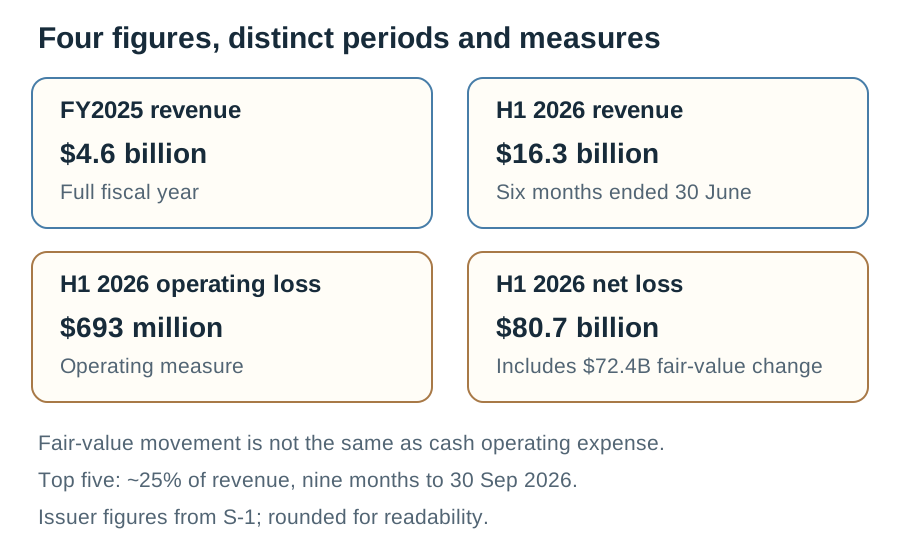
| FY2025 revenue | $4.6 billion | Full fiscal year |
| H1 2025 revenue | $1.2 billion | Six months ended 30 June 2025 |
| H1 2026 revenue | $16.3 billion | Six months ended 30 June 2026 |
| H1 2026 operating loss | $693 million | Operating result before non-operating items |
| H1 2026 net loss | $80.7 billion | Includes a $72.4 billion change in fair value of convertible notes, derivative liabilities and SAFEs |
| Top-five customer concentration | Approximately 25% of revenue | Nine months ended 30 September 2026, not H1 |
Issuer-reported amounts from the S-1; rounded for readability. [1]
The filing reports $4.6 billion in revenue for 2025 and $16.3 billion for the six months ended 30 June 2026, compared with $1.2 billion in the comparable 2025 half. It separately reports an operating loss of $693 million and a net loss of $80.7 billion for H1 2026. The gap between those two loss measures is material: the S-1 reports a $72.4 billion change in the fair value of convertible notes, derivative liabilities and SAFEs, with most of the change attributed to the increased fair value of convertible promissory notes as the company’s enterprise valuation increased. [1]
That is not the same as a $72.4 billion cash operating expense. It is a reported fair-value change in financing instruments. A headline that says simply “Anthropic lost $80.7 billion” is technically tied to the filing’s net-loss line but hides the accounting composition. A headline that removes the fair-value change and calls Anthropic profitable would also overreach: the filing reports an operating loss and additional financial statement items. The useful comparison states both figures, the period, and the reason the net figure diverges. [1][6]
Customer concentration needs the same period discipline. Anthropic says its top five customers represented approximately 25% of revenue for the nine months ended 30 September 2026. That is not a first-half figure. The filing also warns that a small number of customers account for significant revenue, a risk to monitor as the company moves toward a public offering. [1]
What the filings support—and what they do not
View data
| Claim | Filing status | Reporting treatment |
|---|---|---|
| Class F has 50.1% of general shareholder voting power | Stated in the S-1; retained in the S-1/A | Attribute to the proposed offering terms |
| Class T directors will be a majority of the authorized board | Stated in the S-1; retained in the S-1/A | Explain the Trust’s board role separately from ordinary votes |
| H1 2026 revenue was $16.3 billion | Stated in the S-1 | Preserve the six-month period |
| H1 2026 net loss was $80.7 billion | Stated in the S-1 | Pair with the $693 million operating loss and $72.4 billion fair-value change |
| IPO price, share count and date | Price and share count remained undetermined in the company announcement; no offering date is stated in the latest filing | Do not state an offering valuation or timetable |
| “The Trust will always act in the public interest” | Not established by the filing | Do not predict trustee decisions |
The company filed an S-1, which is a registration statement, not a final prospectus with a set price. Anthropic’s announcement said the share count and price range had not yet been determined. The company proposed the ticker ANT and Nasdaq listing venue; it did not set an offering date. No calculation from the financial tables can substitute for missing offering terms. [1][2][6]
The filings can describe formal powers, but they cannot prove how trustees, founders, directors or public investors will behave in a future conflict. They cannot show what the share price will be, whether the IPO will be completed, or whether future changes to the charter will alter the structure. Those are open questions, not gaps to fill with an estimate or an assumption. [1][9]
What this means for…
Prospective investors: Read the capital structure as three separate layers—economic rights, ordinary shareholder votes and board selection. The filing proposes Class A as the IPO security, but it does not offer a price range or share count yet. A ticker reservation and S-1 filing do not reveal what the shares will cost or whether the offering is suitable for an individual investor.
Employees: The S-1 also describes Class E shares for employees other than co-founders, with no economic rights and voting on limited matters. That class is distinct from Class A, T and F. The summary here does not replace the plan documents or employee disclosures that would govern a specific grant. [1]
AI governance researchers: The Trust is not an abstract mission statement; the S-1 attaches board-election and removal powers to a separate class of shares. Evaluate the charter’s actual rights, transition conditions, trustee independence and amendment provisions. Then distinguish those legal mechanisms from the company’s public explanation of why it created them.
Journalists: Keep the 2023 Trust explanation, the July draft registration statement, the October S-1 and the November S-1/A in their proper timeline. The current offering terms should be attributed to the latest filing, while earlier descriptions and H1 financial figures remain period-labeled. Do not merge figures or rights from documents filed at different dates without identifying the document.
What we don’t know yet
- What price range and number of Class A shares will Anthropic propose in a later amendment or final prospectus?
- When will the company seek to complete the offering, and will the proposed listing go ahead?
- How will the final prospectus describe any changes to Class T, Class F, Class E or the LTBT?
- How will the Trust and board use their powers in a real disagreement with founders or public shareholders?
- What will the post-offering economic ownership and voting percentages be after the final share count and any concurrent transactions?
What to watch next
- Amended registration statements: compare changes to the proposed share classes, board rights, financials and risk factors.
- Price range and share count: report them only after a filing or company announcement supplies the terms.
- Final prospectus: verify the exact class rights, exceptions, dilution and any changes to the Trust arrangement.
- Offering completion: distinguish filing, pricing and closing; they are separate milestones.
- Financial statements: keep fair-value changes, operating results and cash flows distinct, and preserve the stated reporting periods.
FAQ
Who controls Anthropic under the proposed S-1/A structure?
The 2 November S-1/A retains separate proposed powers. The Long-Term Benefit Trust would generally elect and remove the Class T directors, who together would be a majority of the authorized board. The founders’ LLC would hold one Class F share carrying 50.1% of voting power on matters submitted to shareholders generally. The filing does not reduce control to a single owner percentage. [9]
Do Anthropic’s founders own 50.1% of the company?
The latest S-1/A retains the proposal that one Class F share held by the Founder LLC would carry 50.1% of total voting power on matters submitted to shareholders generally. It also retains the proposal that Class F has no economic rights. That is a voting-power figure, not a statement that the founders own 50.1% of Anthropic’s economic value. [9]
Is Anthropic already publicly traded?
No. Anthropic filed a registration statement for a proposed initial public offering and said it intended to list Class A shares on Nasdaq under ANT. The company announcement said the share count and price range had not been set. A filing and intended ticker are not the same as an IPO closing or a public market listing.
Why is the reported net loss much larger than the operating loss?
The S-1 reports a $693 million operating loss and an $80.7 billion net loss for H1 2026. It includes a $72.4 billion fair-value change in convertible notes, derivative liabilities and SAFEs, primarily driven by an increase in the fair value of convertible promissory notes as enterprise valuation increased. A fair-value change is not the same as cash operating expense.
Does public-benefit corporation status mean Anthropic can ignore shareholder returns?
No. Delaware law requires a PBC’s directors to balance stockholders’ pecuniary interests, the interests of people materially affected by the corporation’s conduct and the public benefit identified in the certificate. The statute does not make the company a charity or say that one of those considerations automatically overrides every other one.
Sources
Tier 1 — primary / official
- U.S. Securities and Exchange Commission, Anthropic, PBC — Form S-1, filed 26 October 2026. https://www.sec.gov/Archives/edgar/data/2130357/000162828026067168/anthropicpbc-sx1.htm
- Anthropic, Anthropic files S-1 with the SEC for proposed initial public offering, 26 October 2026. https://www.anthropic.com/news/s1-sec
- U.S. Securities and Exchange Commission, Anthropic, PBC — Draft Registration Statement, filed 13 July 2026. https://www.sec.gov/Archives/edgar/data/2130357/000162827926000861/filename1.htm
- Anthropic, The Long-Term Benefit Trust, 19 September 2023. https://www.anthropic.com/news/the-long-term-benefit-trust
- Delaware Code, Title 8, Subchapter XV, Public Benefit Corporations, §§ 361–368. https://delcode.delaware.gov/title8/c001/sc15/
- Securities and Exchange Commission, Form S-1, Registration Statement under the Securities Act of 1933. https://www.sec.gov/files/forms-1.pdf
Tier 2 — independent reporting
- CNBC, Anthropic’s IPO puts power in the hands of founders, giving everyday shareholders little voice, 26 October 2026. https://www.cnbc.com/2026/10/26/anthropic-ipo-founder-voting-control.html
- Fortune, Anthropic’s S-1, 26 October 2026. https://fortune.com/2026/10/26/anthropics-s-1
Tier 1 — current amendment
- U.S. Securities and Exchange Commission, Anthropic, PBC — Amendment No. 1 to Form S-1, filed 2 November 2026. https://www.sec.gov/Archives/edgar/data/2130357/000162828026068676/anthropicpbc-sx1ax1.htm
Methodology note
Research and drafting for this article were AI-assisted; the text was reviewed against the cited sources before publication. The latest SEC filing is the primary source for proposed share rights; H1 financial figures are taken from the original S-1 and labeled by period. The company announcement is used for the intended listing. The 2023 Trust post and July 2026 draft registration statement are historical context, not substitutes for the latest S-1/A. No commercial relationship with Anthropic is reported by Global AI News. This is not investment advice.

Global AI News Desk explains AI news using primary sources: filings, official documents, papers and company announcements. Claims made by companies are attributed to them. Spotted an error? Tell us — we correct mistakes openly under our editorial policy.