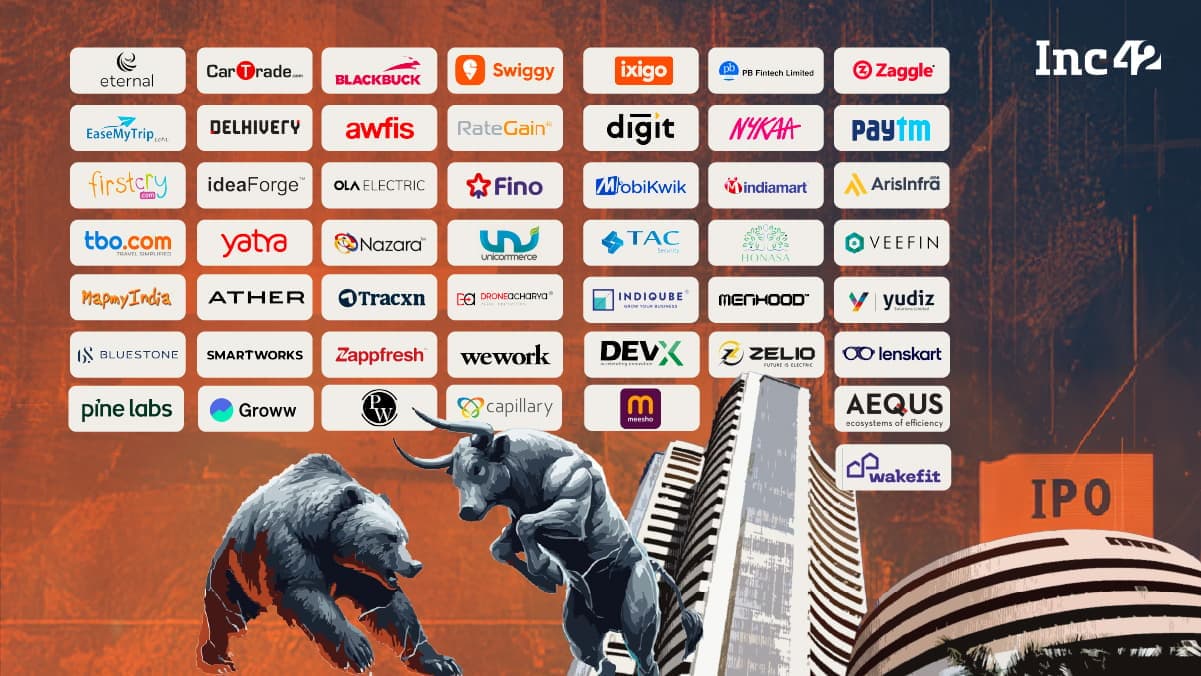
For years, we at Inc42 have tracked the Indian tech startup ecosystem and seen it grow from a kid to an adult. Among the clearest signs of evolution and maturity of this ecosystem is the growing number of startups eyeing a public listing now.
For Indian companies, achieving a public listing has for long symbolised operational progression, transparency, and long-term viability. For startups, it’s a relatively new but increasingly critical rite of passage, one that not only signals coming of age but also creates pathways for investor exits and wealth creation.
Currently, nearly 15 startups, including Turtlemint, Shadowfax, Meesho, among others, are in various stages of their IPO journey. Meanwhile, over 50 Indian new-age tech companies have already crossed the milestone and are now listed on the bourses.
The count includes the likes of Groww, Meesho, Lenskart, and Aequs, who made their much anticipated market debuts in 2025. The list, however, doesn’t include Indian companies like MakeMyTrip, Zoomcar and Freshworks, which are listed on Nasdaq in the US
While 13 startups went public in 2024, the number has already been overtaken this year, with 18 companies making their market debut this year. The list of new-age tech companies that have gone public in 2025 includes —Wakefit, Aequs, Meesho, BlueStone, Ather Energy, ArisInfra, IndiQube, Smartworks, Urban Company, DevX, WeWork India, Zappfresh, Zelio E-Mobility, Lenskart, Groww, Pine Labs, PhysicsWallah and Capillary Technologies.
Besides, startups like Shadowfax, Cure Foods, boAt and Shiprocket are expected to file their RHPs soon as their draft IPO papers have already been approved by the SEBI. The latest to get the regulatory approval for an IPO is insurtech soonicorn Turtlemint.
To consolidate all the information about listed startups, Inc42 has launched the Indian Listed New-Age Tech Company Tracker. From the movement in the shares of the companies since their listing to the financial performance of these companies, the tracker is your one-stop resource to know everything you need about the listed tech companies.
Indian startups had gained a reputation for being “loss making” by prioritising growth at all costs and market share over immediate profitability. The trend of putting scale ahead of the bottom line was at its peak amid the funding boom of 2020-22.
While prioritising growth is not wrong for startups, especially at early stages, the start of funding winter in 2022 gave a reality check to the Indian startup ecosystem. Subsequently, startups started pushing for profitability. Giving further wings to the aggressive profitability push was the ambition to list on the exchanges.
While new-age tech companies look to turn profitable before filing their draft IPO papers, those that cross the line manage to stay in the green, data shows. About 64% of the listed new-age tech companies, 41 to be precise, are currently profitable.
In terms of profits, Sanjeev Bikhchandani-led internet company Info Edge towers over the rest. It posted a net profit of INR 962 Cr in FY25. Prominent internet companies Justdial and IndiaMART trail Info Edge in terms of profitability, raking in profits of INR 584 Cr and INR 551 Cr in FY25, respectively.
It is pertinent to mention that these companies have been listed on the bourses for years now, with Info Edge making its public market debut in 2006. While these companies trace their origin back to the 90s, a large majority of the new-age tech stocks under Inc42’s purview are about a decade old.
From a broad perspective, Inc42 data reflects that the median time taken for a startup to get listed on the bourses is 12 years. While listing for 18-year-old ixigo and 19-year-old Fino Payments Bank came relatively much later, recently listed ArisInfra’s IPO materialised within four years of its operations.
Meanwhile, the new-age tech companies that have made their public market debuts this year generally turned profitable right before their public market debuts. For instance, eyewear major Lenskart reported a net profit of around INR 297 Cr , a significant turnaround from a INR 10 Cr loss in FY24. The company maintained profitability in the first quarters of FY26.
Urban Company also reported its first consolidated net profit of approximately INR 240 Cr for FY25, a major turnaround from losses in FY24. While it maintained profitability in Q1 FY26, the company plunged back in to the red in Q2, reporting a multifold rise in its net loss to INR 59.3 Cr.
On the bourses, investors have rewarded profitable new-age tech companies. In the case of the aforementioned two companies, Urban Company’s shares have crashed about 20% from their listing price while Lenskart is up 3%.
The median stock price increase for profitable companies has been 24% since their listing, while the loss-making ones have witnessed a decline of 6%.
The startup sectors producing the most number of listed companies is proportional to the private funding trends witnessed in the Indian startup ecosystem. For context, ecommerce segment, which has seen a capital infusion of about $350 Bn between 2014 and 2024, leads the charts in terms of listed startups. Fintech and enterprise tech segments, which have also seen a healthy capital infusion over the past few years, trail ecommerce in terms of startup IPOs.
The dominance of the fintech and ecommerce sectors on the bourses is expected to continue as the likes of PhonePe, boAt and Turtlemint would soon be making their public market debuts.
Meanwhile, the number of startups hailing from other sectors is also expected to surge. For instance, the number of listed real-estate tech startups may go up to seven from six currently, with Infra.Market having filed its IPO papers confidentially with the SEBI.
While Bengaluru continues to be the startup capital of India, Delhi and its neighbouring cities Gurugram and Noida account for the most number of listed new-age tech companies. Overall, the Delhi NCR region is home to 24 listed new-age tech companies, ahead of Bengaluru’s eleven and Mumbai’s eight.
While thirteen companies, including Eternal, Delhivery, and Lenskart, call Gurugram their home, Awfis, EaseMyTrip, MapmyIndia and E2E Networks are from Delhi. Noida on the other hand is home to four listed new-age tech companies, including Paytm and IndiQube.
The Indian Listed New-Age Tech Company Tracker will be updated periodically with fresh data.

