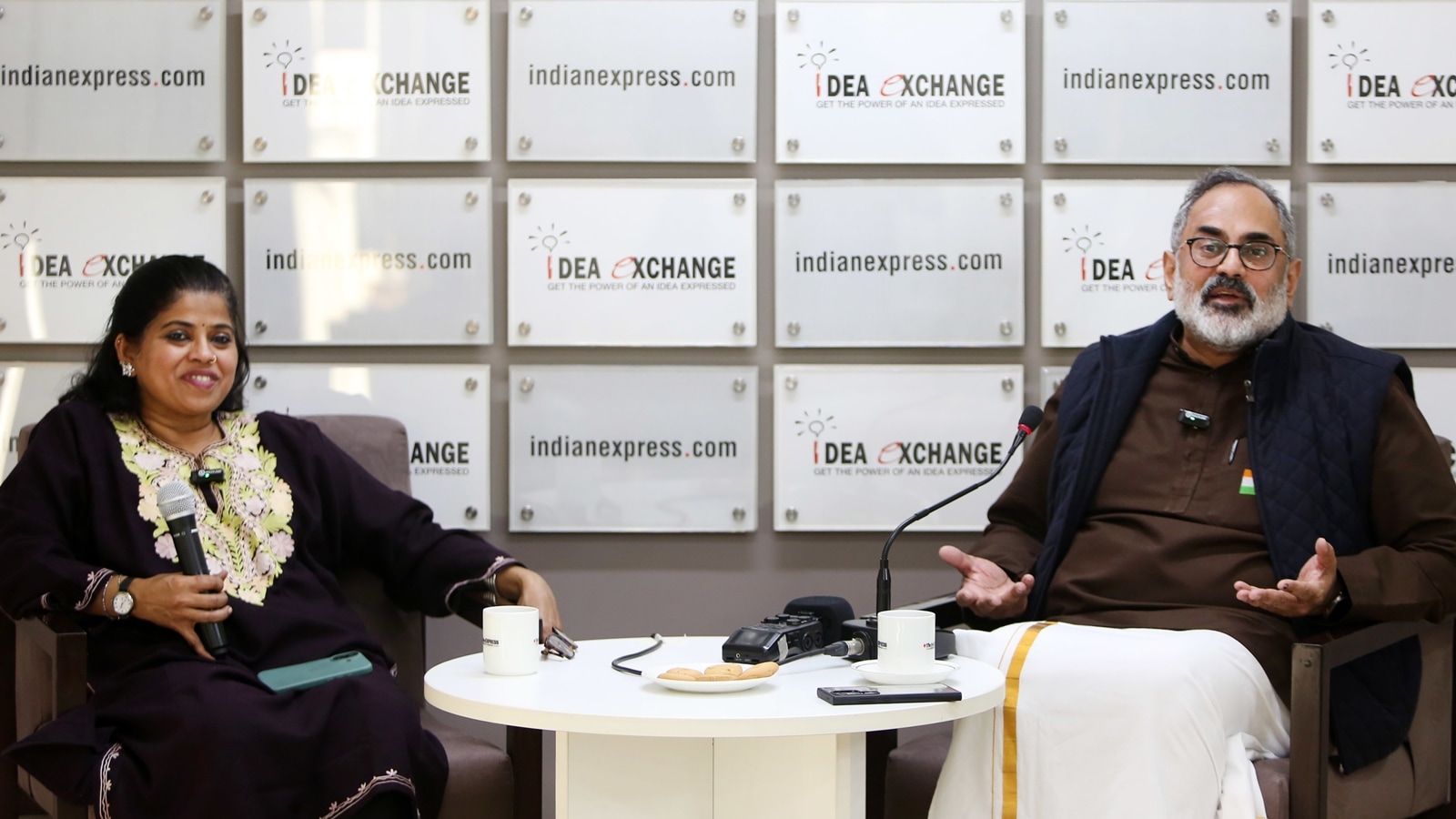
Rajeev Chandrasekhar, State President, BJP Kerala, on the economic and political challenges in Kerala, how politics in the state is changing and how the party is making a difference at the ward level. The session was moderated by Liz Mathew, Deputy Editor, The Indian Express
Liz Mathew: Winning Trivandrum Corporation is a big leap in your path to success. But it is confined to two municipalities, Tripunithura and Palakkad. When it comes to the district panchayat, you haven’t gained much.
Of course, there is the focus on Trivandrum Corporation and Palakkad and Tripunithura municipalities but the BJP-NDA flag is now planted across the state. We had set a target to win about 3,000 to 3,500 wards because we were contesting for the first time. We were number one in 2,000 wards and in over 500 wards, we were number two. So effectively, there is a huge jump compared to where we were in 2020 in terms of footprint across the state and electoral outcomes in terms of winning wards. So if you are (CPM-led) LDF or (Congress-led) UDF, the best description that you can give is that we didn’t win as much as them, which is correct. But, certainly you cannot deny that we are now a leading political force. We are the number two opposition in a large part of the local bodies. In the coming assembly, you will see a very different type of political debate and discourse in Kerala between the UDF and the NDA because it is clear that the LDF has been rejected and people don’t want to give them a third term.
Liz Mathew: While the BJP has succeeded in making inroads in many parts of the country, Kerala, barring this last election victory in Thrissur, has always been a very tough state. What is the main reason?
There are two fundamental issues that have held BJP NDA’s growth back in Kerala. Number one, there has been a narrative that has been carefully built and amplified that the BJP is a communal party, a communal organisation. This was carefully cultivated by the LDF and the UDF. This obviously posed a barrier given Kerala’s demography which has a huge non-Hindu minority Malayalis. The second is, and this is something less understood, that there is a tacit understanding between the LDF and the UDF to prevent BJP’s rise. If you look at the decline of the CPM vote in 2019 versus 2024, it is obvious that in many parts of Neyyattinkara, Kollam and Parassala assembly segments, the CPM transferred its vote to the Congress. In this local body election, you don’t have to go any further than Thrissur South and Kodungallur where, in booths, the Congress used to traditionally poll 300-400 votes, you suddenly find them having only 20 votes because they have en masse targeted three, four, five booths and moved those votes over to the LDF candidate. We now have our own strategies to defeat that. Nowhere else in the country do you see this type of an implicit partnership and cooperation between two parties that are supposed to be opponents.
Liz Mathew: So you don’t think it has anything to do with the culture of the state?
The so-called Kerala model that the CPM keeps putting forward or the UDF tries to push, that somehow the people of Kerala are different. It is not that. The politics of Kerala is different in the sense that the two parties that are supposed to be opposing parties come together every time, regularly, implicitly, clearly, to corner the BJP-NDA. And that is why our rise has been slow. But when that is not possible, when there is clear momentum, you saw (what happened) in the Lok Sabha. And the proof is in this. The first statement that the Chief Minister of Kerala says after the thrashing he got in the local body was not that ‘I’m sorry, LDF lost’. His statement was, ‘Secular parties must come together to prevent the rise of the BJP’. This is a signal obviously that they will want to come together.
On mandated installation of Sanchar Saathi | Governments will make mistakes. I think the app was unnecessary. There are much more nuanced, ways of doing that rather than using a hammer and saying, your phone shall have my app
Liz Mathew: What is the significance of the appointment of Nitin Nabin as the national working president of the BJP?
I think Nitin Nabin’s appointment is important because it signals an important transition in the party. Having a 45-year-old party president shows that this party is now going to work for the biggest stakeholders of ‘Viksit Bharat’ — the youth. Now it will be more about aspirations of young Indians and talking about jobs, education and entrepreneurship rather than the old politics of caste, division, religion that has been almost the accepted standard for the last 60-65 years. I see this as an important inflection point in the evolution of our party.
Liz Mathew: So there will be a new team? What about the old leadership?
In comparative politics, I don’t think age or how long you’ve been around matters, as much as what the challenges for the party are and who is best suited to address those challenges.
Manoj CG: There is a debate on the nomenclature of some of the Bills which were recently introduced including the VB-G RAM G Bill replacing MNREGA. The Opposition MPs from the south are calling it an imposition of Hindi. How do you counter it?
I think that’s essentially what we are trying to defeat, that if the political discourse is going to be around whether the name ought to have ‘Vikasitha Keralam’ as opposed to ‘Viksit Bharat’, if that’s all you have as an issue to debate, then I consider the battle already won. We should get into deeper discussions about why MNREGA is being reformed, what happened in the last 10-20 years and why are we doing an improved version of it. This is an ongoing struggle. We are not prepared to make it easy, be it for the DMK, the CPM or the Congress, when they say, ‘Oh, it is a Hindi word and therefore it is an assault on Malayalam or Tamil’. It is the laziest type of politics that we will not leave unchallenged.
Vikas Pathak: Last year too, there was controversy with the DMK saying that there is Hindi imposition. What is the need for that?
What is the alternative? That is just a choice that the government makes, you have two languages that are widely used all around the country, one is Hindi, one is English. Obviously, you can’t name it in Tamil, you can’t name it in Bhojpuri, you can’t name it in Kashmiri. So, you pick either English or Hindi. This government chooses to name it in Hindi.
Jatin Anand: As the chief of the party’s unit in Kerala, how are you taking forward organisational work in the state?
Kerala is a state where the youth is extremely frustrated. Nearly 30 per cent of our colleges are vacant. Children have to go outside now for not just jobs but also for studies. Today, people are saying, don’t make long speeches. Tell me what you will do for my child, for my career. So, organisationally, we are moving away towards more digital first and micro-meetings. In the last six months, we have had about 100-200 new, young faces. If you see the candidates in our local body election, they are superb inspiring youngsters who have come away from jobs and wanted to get into this. So, all of that is part of what we are trying to do there, which is to make it more modern, more contemporary.
Shahid Pervez: In the 2024 Lok Sabha elections, you lost to Shashi Tharoor by a narrow margin of 8,000 votes. Now with Thiruvananthapuram Municipal Corporation under the BJP’s belt, do you think that if there is a rematch, then you can get the better of Tharoor?
Tharoor has campaigned for the Congress from Trivandrum for 16 years now and they still haven’t won the Trivandrum Corporation. I was airdropped into Thiruvananthapuram, I had 35 days. If I had got 8,000 more votes, I would have won. But that is history, I can’t change that. But after the recent victory, it is clear that the politics in Kerala is going through a deep tectonic change. And that all of these barriers that were thrown at us, that we are not secular but communal, the fixed match between the Left and the UDF, is surely crumbling.
Rajeev Chandrasekhar, State President, BJP Kerala. (Express photo by Gajendra Yadav)
Pooja Pillai: This year in March, there was a controversy over the release of Empuraan and the makers went in for voluntary cuts. Issues were raised over the title of the movie JSK – Janaki V v/s State of Kerala. There were some cuts demanded from the movie Haal. There appears to be a sense of siege due to this among the artistic community in Kerala that the creative space has shrunk. Can you address this concern?
First of all, there is a communist government there, they are shrinking the creative space, you should ask them. Article 19 gives freedom of expression and everybody is allowed to do whatever they want. If I don’t like the movie, I won’t go see it. Personally, I am a fanboy of Mohanlal. I congratulated him but I didn’t particularly like the movie, so I didn’t go see it. But the party didn’t say or do anything against Empuraan. Our view is this: let it be, as long as it does not infringe on any law, does not violate 19 (2) or laws on defamation, everybody is free to do creative work. That’s the right guaranteed under the Constitution. And at the same time everybody has the right to challenge a creative piece of work if they believe it infringes on their rights and that is exactly what is playing out.
Soumyarendra Barik: It has been two years since you’ve left the office at the IT Ministry. When you look back at the regulatory policy action across ministries, including the recent Department of Telecommunication directive for mandatory installation of their own app, are you hopeful or disappointed with the regulatory direction the government is taking?
I’m 100 per cent hopeful, I’m not disappointed at all. Every democracy is struggling to deal with these issues. It is an extremely challenging situation where information and misinformation is being weaponised. Governments will make mistakes. I think the Sanchar Saathi app — I will be the first one to admit it, even though I’m in government — is completely unnecessary. There are much more nuanced, sophisticated ways of doing that rather than using a hammer and saying, your phone shall have my app. But I’m hopeful that eventually, we will find some sort of a steady state between innovation and the right of people to enjoy the Internet and use applications in a safe manner.
Anil Sasi: How difficult is it to be a BJP politician in Kerala where you have to juggle a lot of issues like beef and Hinduism?
I’ve taken on many challenges in my life. This is certainly the most difficult thing I’ve done. It is difficult because of the traditional legacy barriers that have been built up, like the LDF and the UDF calling the BJP communal. I got the first taste of that when I protested the Hamas vice-president addressing thousands of youth in Kozhikode in 2023. I was immediately attacked by the chief minister calling me a communal man. And I was scratching my head and trying to figure out why is he attacking me for saying Hamas should not radicalise my children. It is a little confusing in that sense. It is not as simple as saying I went and campaigned in Puducherry and won an election there or in Karnataka or Uttar Pradesh. This is certainly much more difficult for me.
Vineet Bhalla: What is your engagement strategy in Kerala for the Muslim and Christian populations considering that they form about 45 per cent of the population there and the fact that BJP continues to be seen as a Hindu nationalist party?
We have an outreach programme where we reach out to every household, to every citizen who is a voter and we communicate very clearly what we are about, what we intend to do if we are given an opportunity. For the Christian and the Muslim community, we have outreach teams and outreach leaders. We go out there and without being asked, address these myths, fallacies and falsehoods that have been built around us. We tell them that we are here for ‘Sabka Saath, Sabka Vikas’ (‘Ellavarude Oppam Ellavarkkum’). And there is much evidence in these election results. We don’t want any fancy, smart campaign. We will go to the two-and-a-half crore homes and tell people that this is what we are, this is what we intend to do if you give us an opportunity. We are doing this in Malappuram, which is a Muslim-dominated area. The rest is up to the people.
Unni Rajen Shanker: What are the big economic and governance challenges for whoever comes to power in 2026?
The biggest challenge is that Kerala today is a state with zero to negative development. The comparison between Kerala and Tamil Nadu is so important in the 2026 elections. Tamil Nadu today has 24 lakh industrial workers, Kerala has less than a lakh. These are the things that should be discussed politically. Instead they only want to talk about Karl Marx and secularism. The state today is exporting its only asset, the youth. Today, they are either going to another state or overseas.
This election is going to be about the economic future of Kerala. There is no such thing as the Kerala model, it is a CPM model or a Congress model. The Kerala model was when Kerala used to have food surplus and had lowest food inflation. Today, the highest food inflation in the country is in Kerala, highest unemployment is in Kerala. These are the things that need to be debated. Whoever wins or does not win in 2026, people will decide. But the politics of Kerala will certainly change in 2026 and we will leave this ideological peddling of imaginary fantasy issues and move to the real problems and real solutions.
There is a quote that I like using, that the Left does not deal with real problems or solve any real problems. That describes both the Left and the Congress in Kerala. They always end up creating imaginary problems that they become protectors of, because they are only protecting minorities; the minorities don’t need any protection, there is a Constitution, there are laws.
Soumyarendra Barik: Among the southern states, Kerala seems to be the only state where none of the investments in manufacturing semiconductors or assembly seem to be going. Is that something that you are going to take up with the Central leadership?
When entrepreneurship is booming in all southern states, Kerala is the only state from where there is a flight of talent. Investments go to where the talent is and talent goes to where the opportunities are. If there are no opportunities in Kerala, talent will flee. Why then would investments come? This is the reality that we are living in. Unfortunately, Kerala is not aligned to that reality. Kerala is still force-feeding people Karl Marx and Jawaharlal Nehru.