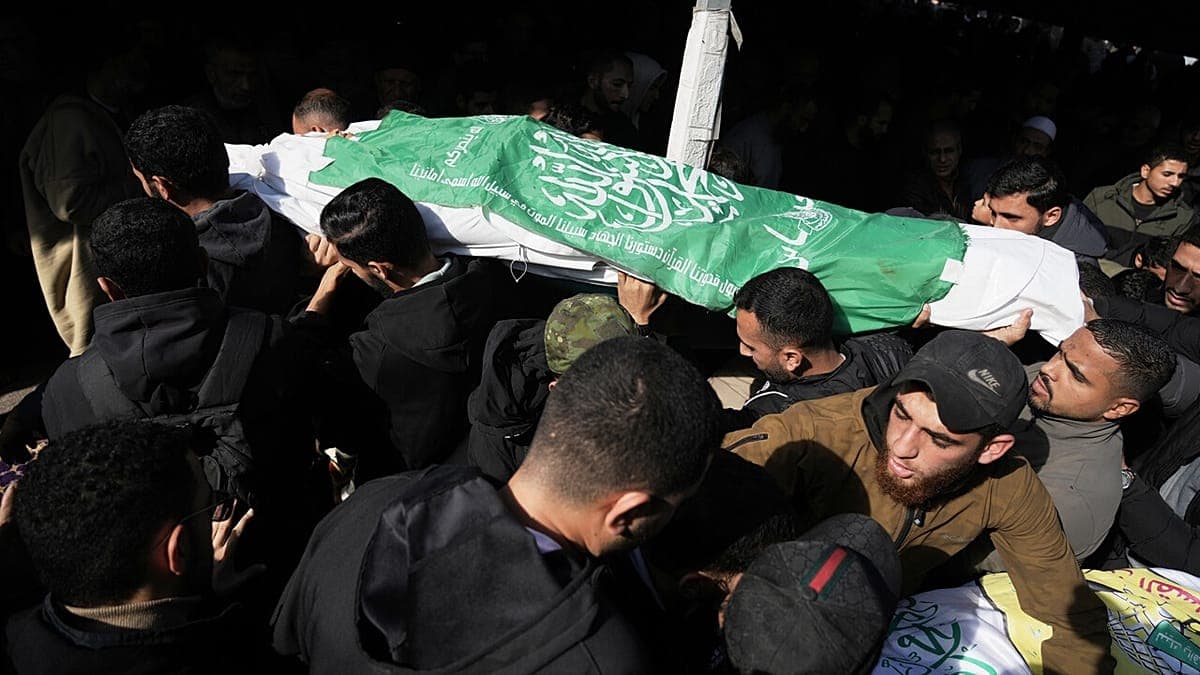
Hamas has confirmed the death of a top commander in Gaza, killed in an Israeli air strike on a car outside Gaza City on Saturday.
The death of Raed Saad, described in a Hamas statement as the commander of its military manufacturing unit, was the highest-profile assassination of a senior Hamas official since a ceasefire agreement came into effect in October.
The attack killed four people and wounded 25 others, according to hospital officials.
Hamas chief negotiator Khalil al-Hayya, who lives in exile, said the attack was one of a series of ceasefire violations committed by Israel since the start of the ceasefire.
In a televised address, al-Hayya said Israel's violations "threaten the viability of the agreement."
"We call on mediators, and especially the main guarantor, the US administration and President Donald Trump, to work on obliging Israel to respect the ceasefire and commit to it," he added.
Hamas also said it had named a new commander but did not give details, adding that it had the right to “respond to the occupation’s aggression.”
Israel had described Saad as an architect of the 7 October 2023 attack that sparked the war in Gaza, and claimed that he had been “engaged in rebuilding the terrorist organisation” in a violation of the ceasefire.
Israel said it killed Saad after an explosive device detonated and wounded two soldiers in the territory’s south.
Israel and Hamas have repeatedly accused each other of truce violations.
Israeli airstrikes and shootings in Gaza have killed at least 391 Palestinians since the ceasefire took hold, according to Palestinian health officials.
Israel has said recent strikes are in retaliation for militant attacks against its soldiers, and that troops have fired on Palestinians who approached the “Yellow Line” between the Israeli-controlled majority of Gaza and the rest of the territory. Israel says three of its soldiers have been killed since the ceasefire began.
On Sunday, Israel’s military said it had killed a “terrorist” who crossed the line and approached troops in northern Gaza.
Israel has demanded that Palestinian militants return the remains of the final hostage, Ran Gvili, from Gaza and called it a condition of moving to the second and more complicated phase of the ceasefire. That lays out a vision for ending Hamas’ rule and seeing the rebuilding of a demilitarised Gaza under international supervision.
Humanitarian crisis continues to spiral
When the ceasefire took hold , a surge of humanitarian aid was able to enter Gaza for the first time in months after Israel had blocked most of it from entering the territory.
But aid groups say not enough shelter materials are getting into Gaza during the truce. Figures recently released by Israel's military suggest it hasn't met the ceasefire stipulation of allowing 600 trucks of aid into Gaza a day, though Israel disputes that finding.
As winter storm Byron descended on the war-battered territory, rains and dropping temperatures have caused even more suffering to displaced Palestinians living in Gaza's tent camps.
“Cold, overcrowded, and unsanitary environments heighten the risk of illness and infection,” the UN agency for Palestinian refugees, UNRWA, said on X. “This suffering could be prevented by unhindered humanitarian aid, including medical support and proper shelter."
The ceasefire agreement specified that Israel let in a number of caravans and tents. No caravans have yet entered Gaza during the ceasefire, said Tania Hary, executive director of Gisha, an Israeli group advocating for Palestinians’ right to freedom of movement.
The Israeli military body in charge of coordinating aid to Gaza, called COGAT, said on 9 December it had “lately" let 260,000 tents and tarpaulins into Gaza and more than 1,500 trucks of blankets and warm clothing.
Shelter Cluster, an international coalition of aid providers led by the Norwegian Refugee Council, sets the number lower. It says the UN and international nongovernmental organisations have gotten 15,590 tents into Gaza since the truce began, and other countries have sent about 48,000. Many of the tents aren't properly insulated, it says.
Scenes of flooding in Gaza have shown how profoundly the Israel-Hamas war has damaged the territory, destroying the majority of homes. Gaza’s population of around 2 million is almost entirely displaced, and most people live in vast tent camps stretching along the coast, or set up among the shells of damaged buildings without adequate flooding infrastructure and with cesspits dug near tents as toilets.
At least three buildings in Gaza City already damaged by Israeli bombardment during the war partially collapsed under the rain, Palestinian Civil Defence said. It warned people not to stay inside damaged buildings, saying they too could fall down on top of them.
The agency also said that since the storm began, they have received more than 2,500 distress calls from people across Gaza whose tents and shelters were damaged.

