Do you share our anxiety about the state of the planet? As green journalists, we are all too familiar with what climate anxiety, climate doom, and even environmental existential dread feel like.
These terms all describe the same thing: the negative feelings, such as stress, fear, anger and grief, that come up when we are confronted with the reality of a warming Earth. With almost daily stories of lives lost or ruined by extreme weather, it’s hard to escape the consequences of climate change.
It’s easy to feel helpless and dejected. But as many experts agree, we can use some of those feelings of despair and turn them into action.
At Euronews Green, we know we play a key role in combatting climate doom. While it’s our job to be truthful and accurate in our reporting and not downplay or greenwash the situation, we also want to highlight that there is always hope.
This is why, for the past three years, we’ve kept track of all the positive environmental news stories throughout the year. Every year we write hundreds of good news stories, from eco-innovations and green breakthroughs to climate wins and feel-good reports on nature.
We hope to continue our efforts and keep doubling our numbers each year - because surely that’s a good sign of momentum.
As climate activist Tori Tsui says, "I think the beautiful thing about climate action is that everyone has a role, whatever that looks like to you".
Here are this year's top positive stories so far - including the small and local, the silly that made us smile - and the enormous and potentially world-changing.
If you came across a great, positive story that we haven't covered, please reach out to us on Instagram or X to share your ideas.
The Nobel Committee is under pressure to recognise the “greatest crisis of our time” by creating a Prize dedicated to climate change.
Tree-planting search engine Ecosia has deposited €1 million with a notary in Berlin, which is being reserved solely to help create the endowment for the prize.
After years of failed searches, one of the planet’s rarest whales has finally been spotted in the wild.
The race to encounter the elusive ginkgo-toothed beaked whales began back in 2020 after scientists recorded high-pitched sounds off the northwestern Baja California in Mexico.
A concept called ‘imagination activism’, coined by Phoebe Tickell, posits that the problem isn’t a lack of solutions to climate change, it’s the absence of a creative, collective vision for what a better future looks like.
Hamna Silima Nyange, like half of the 2 million people in Tanzania's semi-autonomous archipelago of Zanzibar, did not have a house connected to the electricity grid.
Then one day, a neighbour, Tatu Omary Hamad, installed solar panels and bulbs that lit her home with help from the strong sunlight along the Indian Ocean coast.
Tens of millions of red crabs are making their way to the ocean as part of their annual migration on Christmas Island, where a much smaller human population uses leaf blowers and garden rakes to help them on their way.
Russia’s full-scale invasion of Ukraine continues to devastate the country, with the civilian death toll passing 14,000 earlier this year, according to UN reports.
The conflict, which is nearing its fourth year, has also wreaked havoc on the country’s natural landscapes - risking irreversible damage and severe habitat destruction.
However, Ukraine has turned to conservation effortsto provide a “much-needed symbol of resilience” and help nature recover after the war is over.
The Salish Sea experiment turns undersea cables into giant whale microphones for research.
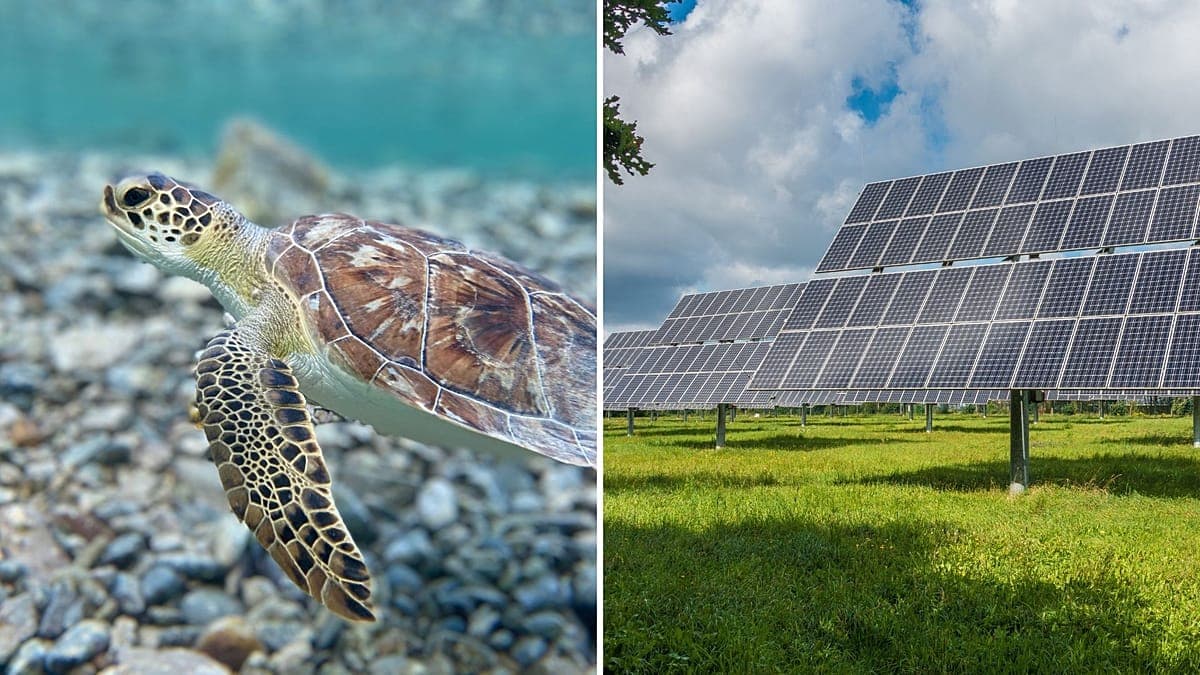
Green sea turtles have officially been reclassified from “endangered” to “least concern” thanks to decades of marine conservation.
After spending more than 40 years on the International Union for Conservation of Nature’s (IUCN) red list for endangered species, green sea turtles have made a dramatic comeback.
Bumblebees are crucial for ecosystems. They pollinate wild plants and crops, keeping habitats healthy. But many populations in Europe are declining because of climate change and habitat loss.
A new study, published in Global Change Biology, looks at how solar farms could help with bumblebee conservation in the UK.
Worldwide solar and wind power generation has outpaced electricity demand this year, according to a new analysis.
Plus, for the first time on record, renewable energies combined generated more power than coal.
Solar energy has been branded the “key driver” in the world’s transition to clean, renewable power due to its ultra-low cost.
A new study from the University of Surrey named solar energy the cheapest source of power, outranking other renewables such as wind, as well as coal and gas.
Europe’s greenest cities have been unveiled in a prestigious ceremony this month, securing a staggering €1 million in collective sustainability grants.
On 2 October, Heilbronn (Germany) was crowned the green capital at the European Green Cities Awards for 2027, hosted at the Lithuanian National Art Gallery in Vilnius.
With the need for natural food products constantly increasing, some Athenians decided to take matters into their own hands and in an original way.
Many residents of the Greek capital are now voluntarily looking after beehives on the rooftops of their apartment buildings in the centre of Athens.
A groundbreaking project has been launched to help protect one of the UK’s most spectacular insects.
Researchers from Anglia Ruskin University (ARU) have joined forces with Jimmy’s Farm & Wildlife Park and Nature's SAFE, a UK biobank specialising in conservation, to investigate if cryopreservation can come to the aid of Britain’s largest native butterfly.
In a huge victory for green energy, more than half of net electricity generated in the European Union came from renewable sources in the second quarter of 2025.
Data from Eurostat shows that renewable energy sources hit an impressive 54 per cent between April and June, marking a 1.3 per cent increase compared to the same period last year.
Marine forests off the north coast of Portugal play a major role in carbon capture and storage, scientists have discovered.
The pioneering research comes from Portugal's Interdisciplinary Centre of Marine and Environmental Research (CIIMAR) and Marine and Environmental Sciences Centre (MARE).
Researchers are developing bio-based fertilisers that reduce pollution, save energy and could curb Europe’s reliance on Russian imports. One promising solution: algae grown on wastewater.
The Vatican is inaugurating an ambitious educational centre inspired by Pope Francis’ ecological legacy. It is a 55-acre utopian experiment in sustainable farming, vocational training and environmental schooling for kids and CEOs alike on the grounds of the papal estate on Lake Albano.
Across twenty-six islands, 29 port stops and about 1000 nautical miles (185 kilometres), two low- to zero-emission sailing boats have sailed in the Aegean and Ionian Seas as part of the "Seal Greece" campaign.
The aim is to protect the Mediterranean monk seal, Monachus monachus, one of the world's most vulnerable marine mammals.
SMEY, a Paris-based biotech firm, is producing the world’s first lab-grown cocoa buter, palm and shea oils, with artificial intelligence (AI). They are hoping to provide beauty and food manufacturers with deforestation-free, sustainable oils.
Since the 1970s, the price of solar panels has dropped by more than 99 per cent. That has turned a once costly technology into a widely used power source for millions of homes, one that has reshaped energy markets worldwide.
Italy has agreed to a Vatican plan to turn a 430-hectare field north of Rome, once the source of controversy between the two, into a vast solar farm. The Holy See hopes it will generate enough electricity to meet its needs and turn Vatican City into the world’s first carbon-neutral state.
Along the canals of Amersfoort in the Netherlands are hundreds of little wooden staircases leading out of the water and onto the banks.
These special steps were installed as part of an initiative to protect wildlife that sometimes falls into the water and cannot climb out because of the high sides.
"Last month, at the UN Conference on Oceans on the Mediterranean coast of France, I made a promise - to honour this unique maritime heritage and protect it for future generations," says the Greek Prime Minister.
He says he is delivering on that promise by creating two new national marine parks - one in the Ionian Sea and one in the Southern Cyclades.
The global switch to renewable energy has passed a “positive tipping point”, according to two United Nations reports released on Tuesday.
Solar and wind are now almost always the least expensive and fastest option for new energy generation, according to the UN.
The Klamath River is newly navigable after a decades-long effort to remove its four hydropower dams to help restore the salmon run - an ancient source of life, food and culture for tribes who have lived alongside the river for millennia.
In June 2025, all renewable energy sources (RES) in Poland produced 44.1 per cent of electricity, while coal and lignite plants produced 43.7 per cent, according to preliminary estimates from the think tank Energy Forum.
This would mean that, for the first time ever, renewables provided more energy than coal.
Every night, around 25,000 cups are used in Lisbon's entertainment areas. Although many cups are sold as "reusable", until now there was no system in place to ensure the effective collection, cleaning and recirculation of these containers.
Through a new citywide reusable cup system, supported by a local deposit and return model, Lisbon has become the first European capital to implement an initiative that aims to combat plastic waste, reduce emissions and introduce a smart reuse model in the city's restaurant sector and bustling nightlife.
Europe’s offshore wind farms are being reimagined as multi-purpose sites. The first commercial-scale project has successfully harvested seaweed between turbines in the Dutch North Sea.
For just €8, researchers are turning old smartphones into devices capable of tracking marine life and buses.
“Innovation often begins not with something new, but with a new way of thinking about the old, re-imagining its role in shaping the future,” says Huber Flores, Associate Professor of Pervasive Computing at the University of Tartu in Estonia.
Half a century after its extinction, one of Europe’s rarest birds of prey – the Bearded Vulture – has been reintroduced to Bulgaria. This is seen as a stepping stone to reconnecting them across Europe, and to other continents.
Notpla, a company that makes seaweed-based packaging, has replaced more than 21 million items of single-use plastic across Europe, and is aiming to displace 1 billion units by 2030.
Its products are now used at major stadiums and venues in the UK, including the Kia Oval, The Principality, Tottenham Hotspurs, Aston Villa, The Aviva, Twickenham and the ExCel Centre.
UK-based company Colorifix is working on a fabric-dyeing process that uses the DNA codes for colours found in nature and teaches microbes to recreate them.
Founders Orr Yarkoni and Jim Ajioka were motivated by a research trip to Nepal in 2013, where they saw the toxic impact of chemically synthesised dyes on Kathmandu's rivers.
The EU is “well on track” to reach its 2030 climate targets, the European Commission said on Wednesday.
An assessment of updated National Climate and Energy Plans (NECPs) shows the EU is on course to achieve a 54 per cent emissions reduction by 2030 - just one per cent shy of its legally binding 55 per cent target.
The creative, cobblestoned Dutch city of Breda has officially become the first National Park City in the European Union.
Designated by the National Park City Foundation in May, Breda joins London, Adelaide and Chattanooga as the fourth member of a growing global movement to make urban areas greener, healthier and more connected to nature.
Antarctica’s number one cutest animal might be saving the planet with its number two.
A study published in Communications Earth & Environment finds that ammonia released from penguin guano – yes, their poo – may help form clouds that insulate the Earth and prevent sea ice from melting.
Scientists on board a deep-sea expedition to the South Sandwich Islands near Antarctica have returned with a treasure trove of photos of previously unseen marine life.
They found coral gardens, hydrothermal vents and many suspected new species while exploring around the island chain, including in the deepest trench in the Southern Ocean.
Indigenous women have surveyed and mapped out resources to show what is dwindling and what needs restoring. They have created what are known as dream maps, showing their villages in their ideal states. The most prominent of their bright colours is green.
Researchers who were dropped off by helicopter in a largely inaccessible and remote canyon in South Africa say they have discovered a type of gecko that hadn't been seen in more than 30 years and was thought to be extinct - or maybe to have never existed at all.
The spread of disinformation and anti-renewables rhetoric is hampering Europe’s transition to green energy, often with ambiguous motivations.
But a new approach based on community involvement in wind and solar projects could help to ease people's concerns.
The World Heritage Centre can treat around 70 seals at a time and has 12 intensive-care units for animals with serious injuries who are able to recover in special enclosures which offer a calm environment.
The new building, which cost over €40 million, with financing provided by local and regional governments as well as charitable organisations, tells more than just the story of the seas.
A ban on fossil fuel adverts in The Hague has been upheld by a Dutch court, in an “historic ruling” that campaigners hope will embolden other cities to take action.
In a decision last September, The Hague became the first city in the world to write into law a ban on ads that promote fossil fuels, including petrol cars, air travel and cruise ships.
Experts believe the research could help bolster climate laws and make polluters pay for their role in global warming.
It is part of an effort to make it easier for people and governments to hold companies financially accountable, like the tobacco giants have been.
The garden plays a pivotal role in protecting rare and endangered plant species globally.
Alongside protecting biodiversity, it promotes environmental sustainability by increasing carbon dioxide absorption rates.
Mazhar Botanic Garden surpasses the Orman Garden in its ability to absorb pollutants, removing the equivalent of four times the amount absorbed by Orman from Greater Cairo.
Rain could one day become a source of clean electricity, according to a group of scientists in Singapore.
Their experiments have been able to generate power from water droplets falling through a tube. They say this could be a model for harnessing larger amounts of electricity from falling rain in the future.
One hundred years after the colossal squid was identified, scientists have filmed a live specimen in the wild for the first time, marking a milestone in deep sea exploration.
During a research expedition in March, a team aboard the Schmidt Ocean Institute’s Falkor (too) vessel encountered the elusive creature near the South Sandwich Islands, in the frigid depths of the southern Atlantic Ocean.
At the Barcelona Zoo, a 40-year-old African elephant places her foot through the metal barrier where a zookeeper gently scrubs its sole. The beloved pachyderm gets her “pedicure,” along with apple slices every day.
The treatment is part of the zoo’s specialised geriatric care for ageing animals that cannot be reintroduced into the wild as zoos worldwide increasingly emphasise lifelong care.
Lego opened a $1 billion (€906 million) factory in Vietnam in April that it says will make toys without adding planet-warming gas to the atmosphere by relying entirely on clean energy.
The factory in the industrial area of Binh Duong, close to Ho Chi Minh City, is the first in Vietnam that aims to run entirely on clean energy. Lego says it will do that by early 2026.
The world generated more than 40 per cent of its electricity from low-carbon sources last year, according to analysis from clean energy think tank Ember. That’s a record not broken since the 1940s, when the global electricity system was 50 times smaller than it is today, and hydropower did the heavy lifting.
Now, it’s solar energy that is soaring in a targeted race to build an entirely clean electricity system
Two teenagers have been named as the European winners of The Earth Prize 2025 for their groundbreaking innovation that promises safer drinking water for all.
18-year-old Tomáš Čermák from Czechia and 19-year-old Anna Podmanická from Slovakia developed a unique filtration device they call PURA.
They are the first from either Czechia or Slovakia to win the Earth Prize.
The closure of a coal power plant in Finland today brings the country to the brink of a full coal phase-out - four years ahead of schedule.
Power utility company Helen officially decommissioned its Salmisaari plant in Helsinki on 1 April, dropping coal to a less than 1 per cent share of the country’s energy mix.
Last year, a concert by UK trip-hop collective Massive Attack made history - not for the music, but for its environmental footprint.
The group collaborated with climate researchers to stage the gig, and it broke the world record for the lowest carbon emissions ever produced by a music event.
Five traumatised lions rescued from the war zone in Ukraine settled into a new home in England after an international effort to bring them to safety.
Male African lion Rori and lionesses Amani, Lira and Vanda arrived in March at the Big Cat Sanctuary after a 12-hour journey by road and ferry from temporary homes at zoos and animal shelters in Belgium.
Record temperatures around the world contributed significantly to the annual 0.8 per cent rise in global CO2 emissions to 37.8 billion tonnes.
But the deployment of solar and wind energy, nuclear, electric cars and heat pumps since 2019 now prevents 2.6 billion tonnes of CO2 each year, according to the IEA. That’s equivalent to 7 per cent of global emissions.
More good news from the report includes how the expanding supply of low-emissions sources covered most of the increase in global electricity demand in 2024.
Giant sea spiders, ice fish and octopuses are among the surprisingly abundant creatures scientists have found in a stretch of sea that used to be covered by ice.
An international team onboard the Schmidt Ocean Institute’s Falkor (too) research vessel were on a trip around Antarctica earlier this year, studying “the interface between ice and sea” when a rare opportunity suddenly opened up.
On 13 January, an iceberg the size of Chicago named A-84 broke away from the George VI Ice Shelf, one of the massive floating glaciers attached to the Antarctic Peninsula ice sheet.
One in five new cars sold in the EU this year will have zero tailpipe emissions. How did we get here? A surge in the uptake of electric cars will save Europe 20 million tonnes of CO2 this year, according to analysis from campaign group Transport & Environment (T&E).
That’s equivalent to the emissions pumped out by eight coal power plants and represents one positive trend within a notoriously difficult to decarbonise sector.
‘Fish doorbell season’ officially began on 3 March for the fifth year in a row. This camera shows live footage, allowing viewers to let the lock keeper at the Weerdsluis lock know when fish are waiting to swim upstream so they can open the gate.
Linda Voortman, alderwoman for Utrecht, says each year the fish doorbell is received with enthusiasm by the people of the city and far beyond.
“In fact, last year there were almost three million unique visitors who together helped thousands of fish through the Weerdsluis gates in Utrecht,” Voortman says.
It’s well known that sea otters help make kelp forests more abundant, by eating the sea urchins that nibble away at the plant. But scientists were puzzled as to why the impact of otters on kelp – particularly along the coastlines of islands in Southern California and British Columbia – varied by location.
Now, new research has found that sea otters’ level of influence on how quickly kelp forests grow back depends on what other species the mammals interact with.
A family of beavers made global headlines earlier this year when they built a dam exactly where authorities had been planning one in Czechia, saving taxpayers around CZK 30 million (€1.2 million). The project had been held up by bureaucracy but they cut the red tape overnight.
These industrious animals are doing good work across Europe with England approving releases into the wild in February. But how do they know where to build their dams?
In a world that relies on plastic, the time it takes to break down is a major problem. But scientists at the University of Hawaii have found a possible solution - marine fungi.
Researchers at the University of Hawaii (UH) in Mānoa believe it is a “promising and largely untapped” solution to the removal of plastic waste from both on land and in our waters.
Dubbed the storm of the century, Storm Eowyn produced record-breaking gusts of 184 km/h and made headlines worldwide. At its peak, it left 750,000 homes without electricity. The west of Ireland was hit especially hard.
Tree surgeons came to the rescue, clearing fallen trunks, logs and branches to allow emergency crews who flew in from around Europe to help Ireland’s Electricity Supply Board (ESB) in restoring power.
Truphena Muthoni attempted a new world record with a tree-hugging marathon. The 21-year-old hugged a single tree in a public park in downtown Nairobi, Kenya for almost 48 hours.
The Kenyan revealed that she wants to set the record to help others understand the link between nature and good mental health.
Tree-hugging has been a protest activity by environmentalists for almost 300 years, and there are now even world championships in the pastime.
India doubled its tiger population in a little over a decade, a study found in early February. It has done so by protecting the big cats from poaching and habitat loss, ensuring they have enough prey, reducing human-wildlife conflict, and increasing living standards for communities near tiger areas.
In the early 2000s, experts were warning that tigers could soon go extinct. But over the last 25 years, India's national animal has seen a remarkable recovery.
Tucked beyond the Arctic Circle, the Svalbard Global Seed Vault sits proudly in a former coal mine and stores fruit and vegetable seeds from all over the world.
Holding over 6,297 crop species, last year saw the highest numbers of depositing genebanks and the highest number of newcomers in the history of the vault, proving that cooperation on conserving seeds is flourishing.
A love of the oceans inspired one man to create a sustainable alternative to Omega-3 supplements for both humans and farmed fish.
Previously, Omega-3 has relied on wild fish, which takes vital food from coastal communities. The solution also cleans up a problem within Scotland’s most popular industry.
Whisky wastewater usually ends up in the ocean, but the company MiAlgae uses nutrient-rich byproducts to create dried algae powder through a giant renewable-powered fermentation process. This is then used as aquafeed for farmed fish and pet food.
The Dutch have created a national sport out of tile-whipping to help make the Netherlands ‘climate-proof’.
Tile whipping - or ‘tegelwippen’ - sees residents try to remove the most paving slabs from their gardens, ensuring that urban spaces are greened and rewilded. This also eases pressure on drainage systems.
Winning communities receive a golden shovel with prizes going to the ‘whipper of the month’.
Researchers at the University of Edinburgh wanted to ensure a new generation could be part of climate conversations.
This was no mean feat, but British Sign Language has now expanded its vocabulary to include terms such as greenhouse gases, carbon footprint, and sustainability.
After being released from prison and into the care of the French government, Paul Watson, the founder of the Sea Shepherd Conservation Society, a direct action group focused on marine conservation activism, spoke to Euronews Green in early January.
Watson, who began protecting whales in 1974, highlighted that very few nations still hunt whales, with Norway, Iceland and Japan the only exceptions, and is increasingly confident about the future of these gentle giants.
And so Watson should be, as Euronews Green reported on multiple sightings of the magnificent humpback whale seen by people living along the UK coast - likely due to humpback whale populations having recovered extensively over the past half a century after whaling bans.
Scientists discovered a way to turn previously useless industrial waste into a vital material used in batteries that could power our future.
Discovered by scientists at America’s Northwestern University, the redox flow batteries use a chemical reaction to pump energy back and forth between electrolytes.
They could be an invaluable solution for energy storage on the scale of an electricity grid and help smooth out the current issue of troughs and peaks in wind and solar supply.
The island of St Helena in the British Overseas Territory has installed the world’s most remote public EV charger in its capital Jamestown.
In a trial supported by Norwegian charging company Easee and Japanese car brand Subaru, the hope is that by improving the infrastructure for electric vehicles, more people on the island will ditch their petrol and diesel-powered vehicles and adopt EVs.
Three countries signed a clean energy cooperation deal that means they will share wind and solar energy across the sea.
The UAE is lending its technology and expertise to develop Albania’s renewable energy. Some of the energy produced from these new technologies will then be transferred to Italy via an underwater cable across the Adriatic Sea.
Sticking to your morals does eventually pay off, at least for the Italian climate researcher Dr Gianluca Grimalda, who was fired by his employers for refusing to fly back from a research trip.
In a bid to follow his beliefs of reducing greenhouse gas emissions by avoiding flights and instead adopting slow travel, the researcher went viral on social media when he publicly shared his story in early 2024.
Grimalda filed a lawsuit for unfair dismissal, and in January, a settlement was agreed. €75,000 of the severance payment will be donated to environmental and climate protection and climate activism.
Dubbed nature’s best lawnmowers, farmers in the USA are waking up to the benefits of keeping sheep on solar farms.
Known as agrivoltaics, solar farms now realise the benefits of making good use of the ground underneath solar arrays. Not only is it grazing sheep and other livestock, but also growing crops, and keeping bees.
Euronews Green shares some of the European projects that have been doing this for ages - and the benefits are numerous.
A Dutch court ruled that the government was failing to address critically high levels of nitrogen oxide pollution, mostly from farming and transport, in a case brought by Greenpeace.
Nitrogen pollution degrades soils and inadvertently fertilises trees, grasslands and tolerant species, putting them at high risk.
This is a huge win as nitrogen pollution is the third most influential driver of human-caused biodiversity loss after habitat destruction and greenhouse gas emissions.
The UK is helping oil and gas workers switch to green energy careers by providing them with a ‘skills passport’ so that people working in the fossil fuel industry can make informed decisions about their jobs and future.
Research has found that around 90 per cent of fossil fuel workers have skills that are relevant to the clean energy transition.
The UK government has announced that regional skills investments worth almost £4 million (€4.7m) will help people make the move into clean energy jobs.
Solar provided more power than coal did to EU countries for the first time last year, marking a new milestone in the unstoppable rise of renewables.
The EU's electricity transition has moved faster than anyone could have hoped for, as the sunlight-soaking renewable generated 11 per cent of EU electricity in 2024, overtaking the dirtiest fossil fuel, coal, which dropped below 10 per cent.
For more good news on the environment from last year, check out all of Euronews Green's positive environmental stories from 2024.

