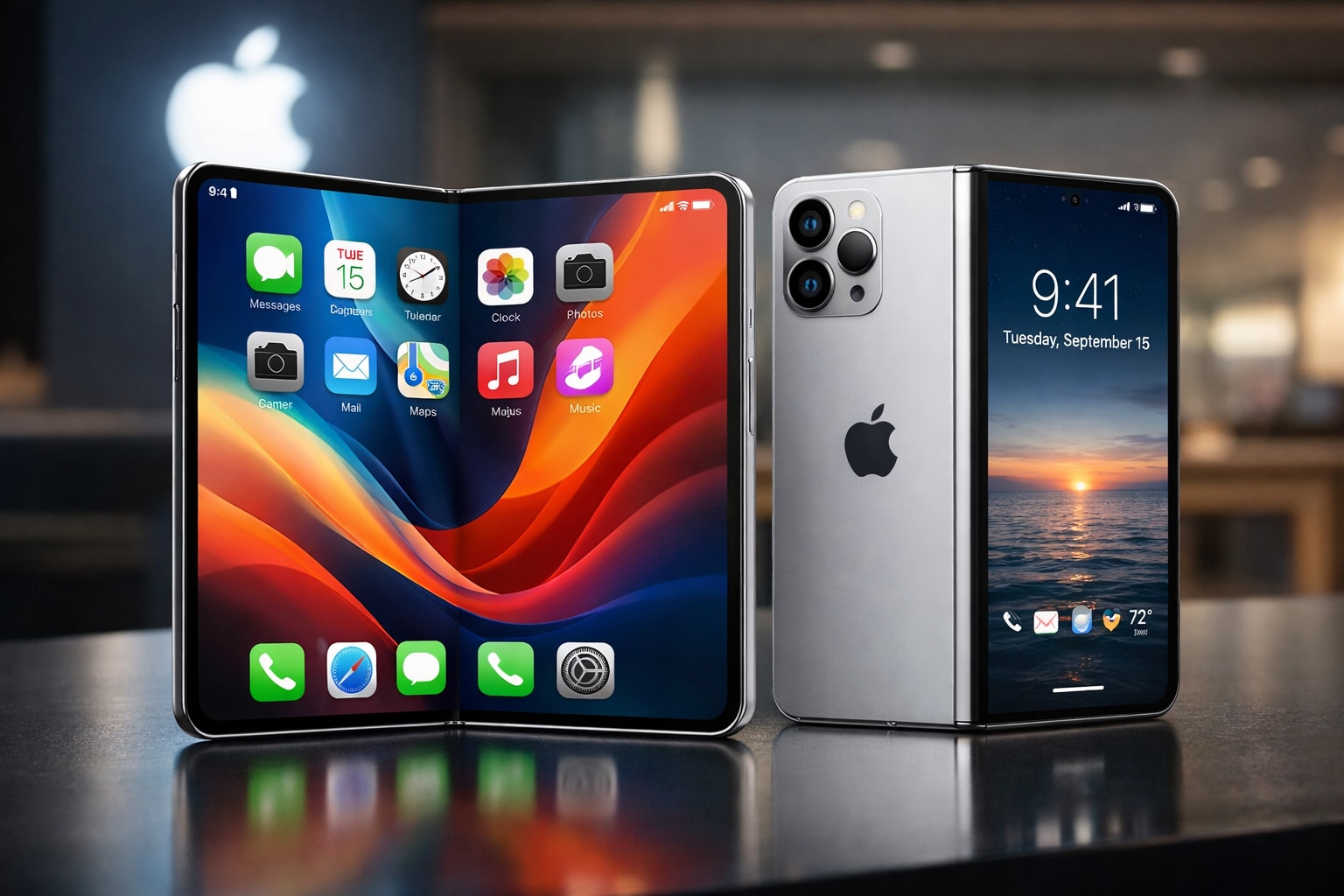
Samsung sells the Galaxy Z Fold and Flip lines, Motorola has the Razr series, and Google offers the Pixel Fold Pro series. However, Apple remains the only major company that still doesn’t offer a foldable smartphone. One may wonder why Apple hasn’t launched a foldable iPhone when its biggest competitor, especially Samsung, has been offering foldable phones for years. If conspiracy theories floating on the internet are to be believed, Apple may finally launch an iPhone Fold in late 2026. In fact, Cupertino has been testing a foldable phone internally for years but has been holding off until it irons out the issues that existing foldable phones have faced.
Sure, foldables are still expensive and niche, and Apple’s entry likely won’t change that, keeping the average price of foldable phones on the higher side. That being said, competition is healthy, and the launch of the iPhone Fold could shake up the market. The question is: would you buy an iPhone Fold at over $2,000, or would you wait for a cheaper Android foldable?
Apple is developing a book-style foldable like the Galaxy Z Fold 7. (Image credit: Anuj Bhatia/Indian Express)
It is very likely that Apple’s first foldable iPhone may not look much different from the Galaxy Z Fold 7, Samsung’s flagship foldable phone. That would mean the device would feature two screens: one on the front and a large inner display, and open like a book. This is the standard foldable form factor that most companies have settled on, and Apple is unlikely to be any different. However, recently, companies like Huawei and Samsung have started launching tri-fold smartphones.
Reliable Apple analyst Ming-Chi Kuo has previously predicted that the iPhone Fold could feature a 5.5-inch outer screen and a 7.8-inch inner display. When folded, the device is expected to be 9–9.5 mm thick and 4.5–4.8 mm thick when unfolded.
It would be great to see whether Apple is able to achieve the slimness of the Galaxy Z Fold 7, which is impressively thin at 8.9 millimeters (0.35 inches) when closed and just 4.2 millimeters when open. The phone weighs only 215 grams.
Durability is another area where Apple could make a difference. Typically, foldables are less durable than standard smartphones; however, Google has shown that it is possible to build a more durable foldable with the Pixel 10 Pro Fold. The device is just 1 gram heavier than the 9 Pro Fold, weighing 258 grams, yet it is considered the most durable foldable phone on the market today with the IP68 rating, addressing many of the IP shortcomings that foldable phones have faced.
Apple needs to uplift the user interface on foldables phone, and the iPhone Fold could change that for a good. (Image credit: Anuj Bhatia/Indian Express)
That being said, Apple has spent years working on a foldable iPhone, and when it finally arrives, it may feature a better design that feels far more usable. With the iPhone Air, Apple has proven that it is possible to make ultra-thin smartphones, and clearly, the learnings that went into Air-like devices will also be incorporated into the company’s first foldable phone.
Previous reports have suggested that Apple is working on a crease-free display for the iPhone Fold and may collaborate with Corning, which has been developing a bendable display. It is expected that Apple would likely need a bendable version of its Ceramic Shield glass.
Another area where Apple could have an advantage is the camera department. While both the Galaxy Z Fold 7 and the Pixel 10 Pro Fold are excellent foldable phones, they still don’t come close to mainline flagships in terms of camera performance. Apple makes some of the best camera phones on the market, and it would be a mistake for the company to treat the Galaxy Z Fold 7 and Pixel 10 Pro Fold as benchmark devices. Instead, Apple should aim to build an uncompromised flagship foldable with cameras that match those found on traditional smartphones.
If Apple is able to achieve this, other manufacturers are likely to follow suit and start including flagship-grade cameras in premium foldables that already cost more than the Galaxy S series and the iPhone Pro series smartphones.
Battery longevity and performance are other areas that could act as a litmus test for Apple. Undoubtedly, Apple will use its most powerful A-series chip to power the foldable, along with enough RAM to handle two or even three displays. As Kuo has predicted, the device is expected to use the same high-density battery cells found in the iPhone Air. However, that slim profile could mean the foldable may forgo Face ID, instead relying on Touch ID built into a side button like other foldables.
A flip-style foldable iPhone may come later sometime in 2027 (Express photo)
Perhaps one way Apple could stand out from the competition is through a user interface specifically tailored for a foldable form factor. Most current foldables suffer from a clunky UI, and at times it feels just like what you get on a regular smartphone. That needs to change, because consumers are already paying a premium for foldables, and the interface should reflect this new type of form factor. Apple has literally reinvented interfaces with its products, whether it’s the iPod, Mac, or iPhone. Expect Apple to take the best elements from iPadOS and iOS and reimagine the user interface specifically for a foldable phone.
Huawei’s tri-fold smartphone looks glorious. (Image credit: Anuj Bhatia/Indian Express)
It remains to be seen at what price Apple will launch the iPhone Fold, but industry insiders expect the retail price to be north of $2,400, higher than what Samsung and Google charge for their foldables. We wouldn’t expect a foldable iPhone to be cheaper than the competition. However, even if the iPhone Fold is priced around $2,400, Apple will need to be strategic in how it positions the device. The company has years of experience in getting products right – both in hardware and software but the failure of the Vision Pro does raise some doubts. How Apple positions the iPhone Fold and what it is ultimately trying to solve will determine the device’s fate.