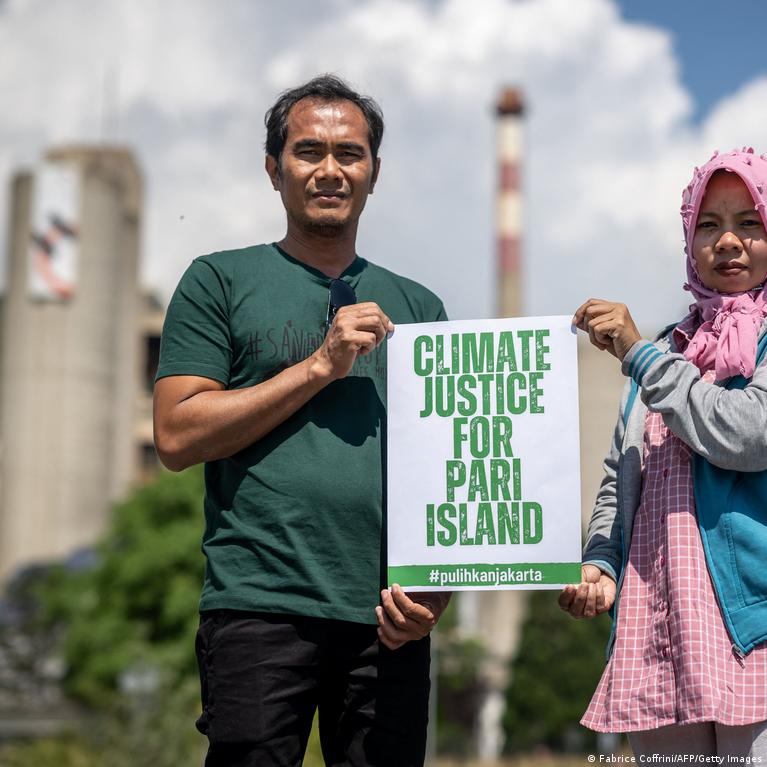
A Swiss court is set to hear a climate case against cement giant Holcim after admitting a complaint filed by four residents of the low-lying Indonesian island of Pari.
The residents say rising sea levels are swallowing their home and accuse Holcim of failing to cut carbon emissions.
The Cantonal Court of Zug admitted the complaint in full, marking the first time climate litigation against a corporation will proceed in Switzerland, according to Swiss Church Aid (HEKS/EPER), one of the NGOs assisting the islanders.
The case is part of a global effort to hold major companies accountable for climate damage that threatens millions, especially in poorer countries.
The case was brought in 2023 by four residents of Pari Island, Ibu Asmania, Pak Arif, Pak Edi, and Pak Bobby, to the court in Zug, where Holcim is headquartered. Rising waters linked to climate change could submerge most of the island by 2050. Pari sits just 1.5 meters (5 feet) above sea level.
The plaintiffs, supported by international NGOs including Swiss Church Aid (HEKS/EPER), the European Center for Constitutional and Human Rights, and The Indonesian Forum for Living Environment (WALHI), say Holcim is one of the world's largest emitters of greenhouse gases. They are demanding rapid cuts in CO2 emissions — 43% by 2030 and 69% by 2040 — as well as compensation for damage and funding for flood protection.
Ibu Asmania said he and the other plaintiffs were "very pleased" by the court's decision.
"This decision gives us the strength to continue our fight," he said. "This is good news for us and our families."
Holcim, which has not operated cement plants in Indonesia since 2019, plans to appeal the court's decision to allow the case to move ahead. The company has repeatedly stressed it is committed to reaching net zero by 2050 but argues lawmakers should decide how those goals are met.
"Holcim remains convinced that the courtroom is not the appropriate forum to address the global challenge of climate change," the company said.
Cement production accounts for about 7% of global carbon dioxide (CO2) emissions, according to the Global Cement and Concrete Association.