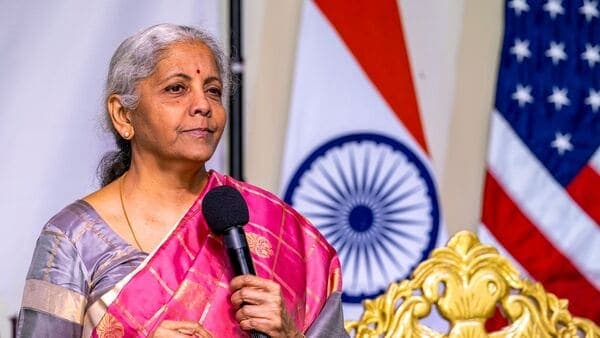
New Delhi: India’s economy has moved from a state of fragility in 2013 to become the fastest growing major economy for multiple years now, showing its transition from external vulnerability to external resilience, finance minister Nirmala Sitharaman told the Parliament on Monday.
Replying to the debate on the first supplementary demands for grants in the Lok Sabha, the minister also said that collective work was needed to reduce debt at central and state levels.
Sitharaman told the House that India’s current account deficit was only 0.6% of its gross domestic product (GDP) in FY25 and that foreign exchange reserves are not dependent on volatile capital flows.
The minister said that in 2013, CAD was at a crisis level of 4.8% of GDP, which was the maximum India had seen since 1970. In 2013, India had foreign exchange reserves sufficient to cover only seven months of imports but by June 2025, this had increased significantly to cover 11.4 months of imports, Sitharaman said.
Sitharaman told the House that the central government’s fiscal deficit, which had increased due to covid-19, has been brought down, but there was concern regarding the debt levels in some states.
Without naming any state, Sitharaman said that it was true that debt to gross state domestic product (GSDP) of many states was shooting up. The minister said that the central government, which committed to Parliament to lower its fiscal deficit, has been lowering it without failure since 2020-21.
“Equally, there should be concern about debt to GSDP of many states,” Sitharaman said, while highlighting the need for collective concern. “And therefore, collectively, we have to work to bring down the debt to GDP number and the debt to GSDP number."
Sitharaman said that in the past one decade, economic growth has become quite broad-based and that people from the bottom rung are acquiring assets now.
The minister also told the House that supplementary demands are “absolutely necessary” for a responsive government to address critical funding needs from departments and states. But the government has reduced the number of supplementary demands in a year to maximum two.
Sitharaman justified the government’s outlays for fertilizers, defence, education, research and development.
During the debate, Congress MP K.C. Venugopal flagged that the rupee has depreciated to 90 against the US dollar and is still sliding. “It means higher oil prices, costlier imports, and rising price pressure on the common man. It is very unfortunate,” he said.
Venugopal said that even more worrying was the GDP data, “which is totally questionable. IMF has flagged serious deficiency in data in India’s GDP”.
Sitharaman explained that the base year for GDP computation will be updated next year.
The minister highlighted a shift in India's consumption trends, emphasizing that growth has become broad-based and asset acquisition is increasing among lower-income groups.
Growth has become quite broad-based, with people from the bottom rung acquiring assets. Inequality in asset ownership has massively declined, particularly in urban areas, for key assets like motor vehicles and refrigerators, Sitharaman explained. The rural poor have experienced significant growth in purchasing power.

