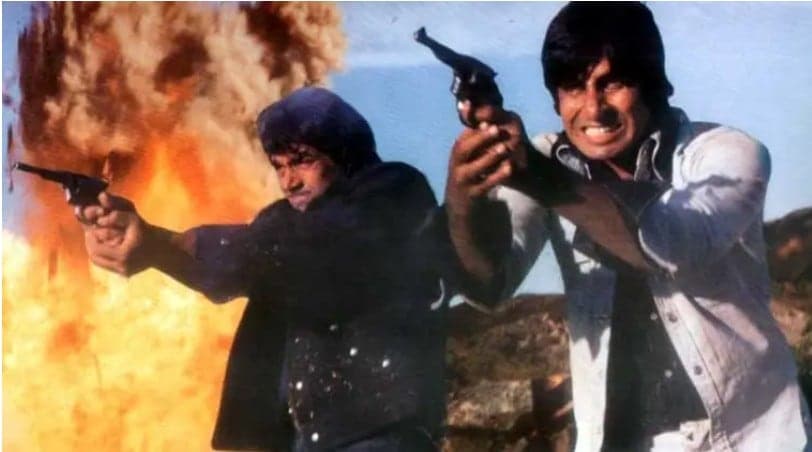
That this story landed so powerfully in 1975 is no accident. Sholay was released at the height of the Emergency, when order was prized over dissent and authority over democracy
Ramesh Sippy’s Sholay (1975) is back on the big screen, complete with its original, censor-forbidden ending where Thakur Baldev Singh crushes the bandit Gabbar Singh with his spiked boots. For decades, we have revered this film as our cinematic Mahabharata, a foundational epic of good versus evil, friendship, and sacrifice. Its dialogues are our secular liturgy, its characters our archetypes. To question its moral compass feels like sacrilege. But 50 years on, as the restored flames flicker anew, we must gently ask: Upon whose altar was this sacrifice made? Whose justice does it truly serve?
The genius of Salim–Javed was to graft the DNA of the American Western onto the Indian badlands. Sholay is, famously, a “Curry Western.” In this transplanted template, the moral geography is preordained. The lone lawman or settler protects a fragile community from marauding outsiders. Sholay faithfully casts Sanjeev Kumar’s Thakur in this mould. The retired police inspector, the benevolent patriarch of Ramgarh, the man who hires mercenaries Jai and Veeru to excise the “disease” named Gabbar Singh. The film asks us not merely to root for him, but to accept his moral authority as natural, inevitable, and beyond question.
But the Western, as a genre, has long been morally dismantled. The civilised cowboy versus the savage Native American is now widely understood as a colonial myth, designed to justify displacement, conquest, and land theft. Sholay, perhaps unconsciously, replicates this same ideological structure. Gabbar is not shaped by hunger, dispossession, or injustice, the traditional roots of the Indian dacoit in cinema and folklore. He is presented instead as an abstraction: An emblem of pure evil. Sippy famously stripped him of a sympathetic backstory, even dressing him in army fatigues rather than a dhoti to mark him as an aberration, a mutation, something almost un-Indian. He is not a rebel; he is a virus.
What the film never interrogates is the soil that produces men like Gabbar. In much of Indian history, and in the dacoit films that preceded Sholay, banditry was not random savagery but a social outcome. Dacoits emerged from the fractures of feudal India; land alienation, caste violence, and the brutal extraction by landlords who owned both earth and law. This later articulated with devastating clarity in Paan Singh Tomar (2012), whose bitter line encapsulates this truth: “Beehad mein toh baaghi rehte hain, dakait toh Parliament mein hain.” The ravines house rebels; the real bandits sit in power.
Sholay inverts this idea completely. Ramgarh’s order is feudal, presided over by Thakur, a title that literally means “lord” or “master”. Yet, the film frames him as the village’s moral spine rather than its historical oppressor. The villagers are infantilised into silence, a passive chorus of fear and gratitude. They display no collective resistance, no political consciousness, no memory of exploitation. Their salvation must arrive from above, through hired guns and inherited authority. Justice, in Sholay, is not structural; it is personal. And rebellion is criminality.
By severing dacoity from land injustice, Sholay converts a social conflict into a moral fairy tale. The rebel is demonised so the landlord can be sanctified. The behaad, the ravines, become a metaphorical hellscape, rather than a consequence of systemic neglect. In doing so, the film aligns itself not with the oppressed but with the preservation of hierarchy. The outlaw must die so that feudal calm can be restored.
The restored ending, where Thakur kills Gabbar himself, strips away the illusion entirely. What remains is not justice but revenge, raw, intimate, and feudal to the core. Thakur’s mission was never to emancipate Ramgarh, only to reclaim honour and avenge his family. Jai and Veeru, lovable small-time crooks, die not for a revolution but for a landlord’s wounded pride. We cheer because the film is engineered to make us cheer. Craft does that.
To recognise this is not to diminish Sholay’s artistry, or its seismic cultural impact. It remains, by any measure, one of the most influential films Indian cinema has produced. But true reverence for a classic lies not in repetition, but in re-examination. Fifty years later, the restored print asks us to see what was always there. A masterpiece that also canonised a feudal worldview. The embers of Sholay still burn. Perhaps now, finally, we are ready to ask who they were meant to consume.

