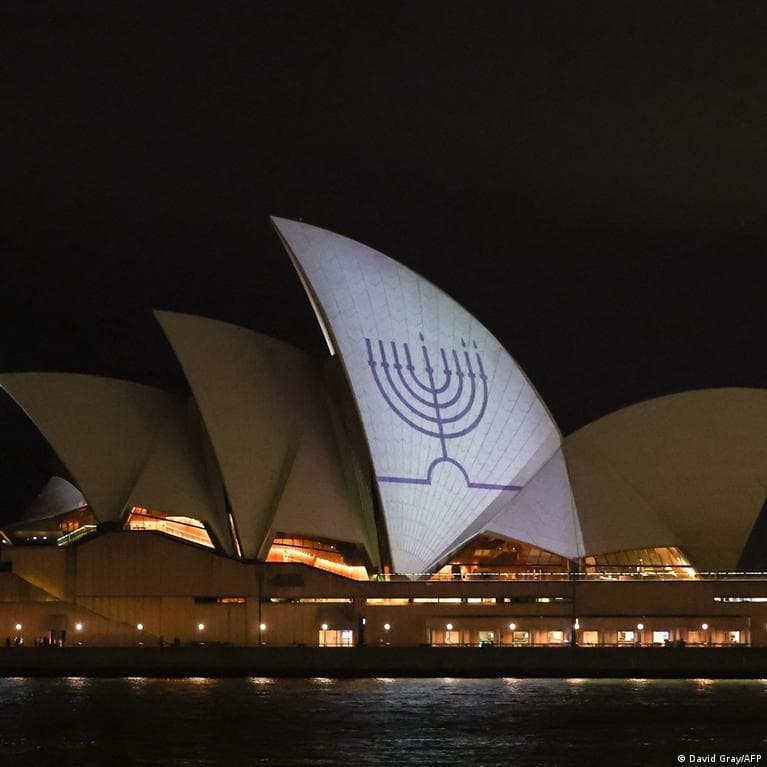
Sixteen people have now been declared dead in the attack, where two gunmen opened fire at the so-called Chanukah by the Sea celebration, an annual event to mark Hanukkah held at Bondi Beach in the eastern suburbs of Sydney, capital of the state of New South Wales.
The area is home to a large Jewish community.
Investigations are now ongoing under the NSW Joint Counter Terrorism Team, and includes members of the state's police, Australian Federal Police, NSW Crime Commission and Australia's domestic intelligence service ASIO.
As of December 15, sixteen people had been confirmed dead and 40 were injured.
Two shooters were involved in the incident. One, a 50-year-old man, was shot dead by New South Wales police. The other, a 24-year-old man, suffered critical injuries and is in hospital under police guard. The two suspects were a father and son, according to officials.
To view this video please enable JavaScript, and consider upgrading to a web browser that supports HTML5 video
More than 116,000 people indicated they belonged to the Jewish faith in Australia's most recent census. It is the eighth largest population of Jews in the world.
The largest Jewish communities are found in Sydney and Melbourne, Australia's two most populous cities.
Sydney's eastern suburbs are home to a particularly large Jewish community. Around 1 in 8 residents of Bondi Beach, where Sunday's attack occurred, are Jewish.
Nearly two dozen major cases of vandalism, antisemitic graffiti, arson attacks and assaults on Jewish people, property and gatherings have occurred since May 2024.
Key incidents have included attacks on Jewish schools, childcare centers, vehicle arson attacks and firebombing buildings across Sydney's eastern suburbs.
Multiple attacks have occurred on synagogues in Sydney and Melbourne.
A bomb plot in January 2025 was found to be an attempt by organized crime to masquerade an antisemitic attack and divert police resources.
Australia had recently begun reforming laws to address antisemitic rhetoric.
In February 2025, the federal parliament passed an anti-hate law prohibiting threatening force and violence on the basis of race, religion, disability, sexual orientation and gender identity. Convictions under the law carry a mandatory minimum sentence of at least 12 months imprisonment. Use of hate symbols like the swastika were also banned.
One report from Tel Aviv University found Australia had seen an increase in incidents between 2023 and 2024.
Special Envoy to Combat Antisemitism Jillian Segal, who was appointed to the position by Australian Prime Minister Anthony Albanese earlier this year, said antisemitic attacks had tripled since the outbreak of war between Israel and Hamas in Gaza.
The Jewish community in Australia has expressed its grief at the attacks.
Among the dead are a 10-year-old girl, a Ukrainian survivor of the Holocaust, and two local Rabbis. France and Israel have confirmed nationals among the victims.
Jewish representative bodies have expressed their grief and sympathies in the hours following the attacks.
"We need decisive leadership and action now to eradicate the scourge of antisemitism from Australia’s public life, for which the Jewish community has long been advocating. Government’s first duty is to keep its citizens safe," said the Executive Council of Australian Jewry, in a statement.
"To be confronted with this horrific act of antisemitic violence during the Jewish festival of light and hope is shattering. In moments like this, we hold each other close," said Sarah Scwartz, executive officer of the Jewish Council of Australia.
Local charity, the Jewish Communal Appeal, said its "thoughts and prayers are with everyone at this time, particularly those who have lost family members, friends, and loved ones in this devastating attack. We stand in solidarity with all who are grieving, traumatized, or struggling to process the events at Bondi Beach."
"This is not just a terrible day for the Jewish community, for Bondi, and for Sydney but for all of Australia, and for the values we hold dear, that are the bedrock of what for so long has been our inclusive, harmonious society," said Colin Rubenstein, executive director of the Australia/Israel and Jewish Affairs Council.
Albanese said existing funding of physical security measures for Jewish community groups would be extended, following the attack. Previously around $25 million (€14.1 million, $US 16.6 million) had been pledged to community protection. He has also flagged overhauling already restrictive national and state gun laws.
Other countries, such as France, have signaled security will also be increased to protect their local Jewish communities. London, Berlin, Warsaw, and New York among other cities have all confirmed increased security for Hanukkah related events.
A father-son duo aged 50 and 24 were named in local press as Sajid and Naveed Akram.
At a press conference in Sydney on Monday, Albanese and his Home Affairs Minister Tony Burke confirmed the father had migrated to Australia, originally on a student visa in 1998, then a partner (spouse) visa, and most recently on a resident return visa. Burke did not give details of the father's nationality.
Albanese said the son, who was born in Australia, had been examined by authorities in 2019. The ABC, Australia's public broadcaster, said this related to connections to an Islamic State terrorist cell. Two IS-related flags were reportedly found in the suspect's car.
Albanese has also flagged further tightening gun ownership regulations in Australia.
Australia is considered to have some of the strictest gun ownership laws. They which were overhauled following the nation's biggest mass shooting in 1996, when 25-year-old Martin Bryant opened fire upon and killed 35 people and injured 23 others in the town of Port Arthur, Tasmania.
The massacre led the center-right government of then-Prime Minister John Howard to establish a National Firearms Agreement that aligned federal and state laws. It included mandatory licensing, background checks, and rules for firearm storage and use.
It saw the voluntary surrender of more than 650,000 firearms, and around $304 million (around $237 million US) in compensation.
Crime data shows that between July 2023 and June 2024, 33 people died from gunshot wounds in Australia. Around four million firearms are legally owned in the country.
Albanese, of the center-left Labor Party, has said an overhaul of gun laws could include an end to open-ended licenses, limits to the number of weapons a person can hold, classifying legal firearms types, and restricting permits to Australian citizens.
A national firearms register has been previously delayed. Maya Arguello, a criminology and law specialist at Swinburne University of Technology, said policing gun ownership in Australia would be aided by a comprehensive system.
"Without a national register to support real-time information-sharing, police and other agencies remain dependent on separate state and territory systems, resulting in gaps in life-cycle monitoring, tracing, and national oversight of registered firearms," Arguello said.
"Although development has commenced, the system is not expected to be operational until 2028."

