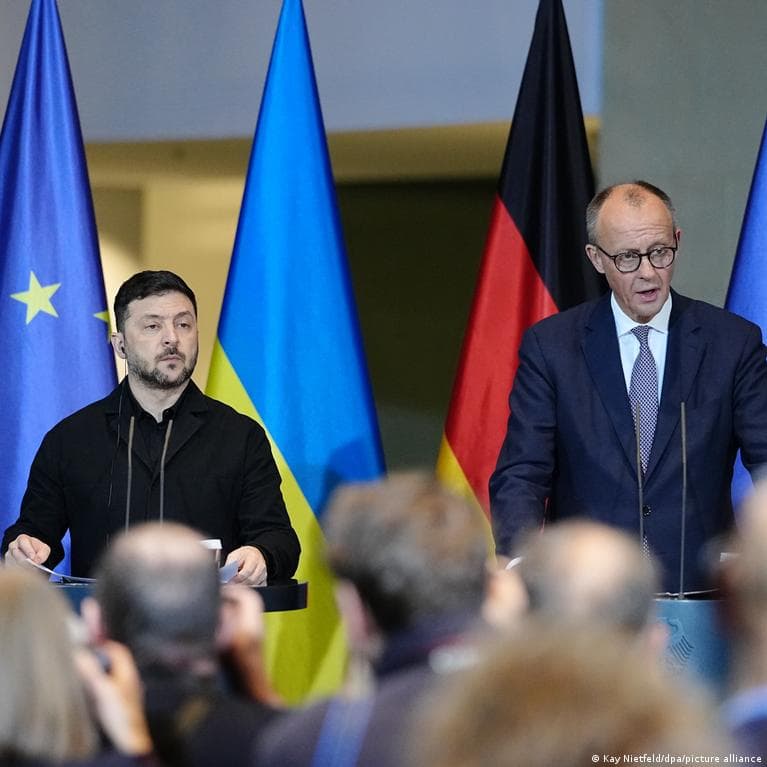
Talks on ending Russia's war against Ukraine are continuing in Berlin and have not concluded with the joint press conference with German Chancellor Friedrich Merz and Ukrainian President Volodymyr Zelenskyy.
Afterwards, both men are set to attend a dinner with several European leaders.
Participants include British Prime Minister Keir Starmer, French President Emmanuel Macron, Italian Prime Minister Giorgia Meloni, Polish Prime Minister Donald Tusk, Finnish President Alexander Stubb, NATO Secretary-General Mark Rutte, and European Commission President Ursula von der Leyen.
Ukrainian President Volodymyr Zelenskyy has said Kyiv and Washington remain divided over territorial issues after two days of talks in Berlin on ending Russia’s war.
Speaking to reporters after the talks in Berlin, Zelenskyy said, "There has been sufficient dialogue on the territory, and I think that, frankly speaking, we still have different positions, but I believe that my colleagues have heard my personal position."
He said the issue of territory remains painful but added he believes the United States will help Ukraine find a compromise. Zelenskyy said Ukraine is ready for fair work toward a strong peace agreement and that talks with US counterparts will continue.
Zelenskyy also said the United States is not making its own territorial demands on Ukraine. He said the US delegation had conveyed Russian demands and he stressed that Ukraine needs clear security guarantees before any decisions are made about front lines.
Earlier, Zelenskyy said negotiations with the US delegation would continue and repeated that while positions differ on territory, Ukraine remains committed to achieving a fair and lasting peace deal.
Chancellor Friedrich Merz has said diplomatic momentum on Ukraine has intensified, calling it possibly the strongest since Russia launched its full-scale invasion in February 2022.
Speaking after talks in Berlin, Merz said there was now a real chance for a peace process, adding, "This plant is still small, but the chance is real."
Merz thanked US President Donald Trump, saying the progress would not have been possible without his engagement. He said he was satisfied with talks in Berlin between US and Ukrainian representatives on ending Russia’s war.
At a joint news conference with Ukrainian President Volodymyr Zelenskyy, Merz said any ceasefire must be backed by strong guarantees.
"This ceasefire must be secured by substantial legal and material security guarantees from the USA and the Europeans," he said.
Merz added that proposals presented by the United States in Berlin marked significant progress.
"What the USA has put on the table here in Berlin in terms of legal and material guarantees is really remarkable. That is a very important step forward, which I very much welcome," he said.
"Negotiators from President Trump played a key role, and I want to make this clear: without their tireless efforts and without President Trump’s commitment, we would not have the positive momentum we are experiencing here at this very moment," Merz said.
Ukraine talks in Berlin have been really positive, with broad consensus emerging on a number of issues, a US official has told the Reuters news agency.
The official said discussions had produced agreement in several areas, while some issues had been delegated to working groups for further talks.
The official praised European participants, saying European representatives had been outstanding, and added that President Trump was pleased with the current state of negotiations.
The official said there was hope the process was on a path to peace.
Security guarantees have made significant progress, according to the official, including work on Article 5-like guarantees.
The official said these guarantees would not remain on the table indefinitely and added that Trump was focused on stopping Russian forces from moving west.
AP news agency reported, also citing the US side, that Russia indicated it is open to Ukraine joining the EU as part of a peace deal.
To view this video please enable JavaScript, and consider upgrading to a web browser that supports HTML5 video
Ukraine's security service has carried out what it calls a unique special operation in the port of Novorossiysk, using underwater drones to strike a Russian submarine.
The SBU said in a statement on Telegram that underwater drones known as "Sub Sea Baby" hit a Project 636.3 submarine, known as the Varshavyanka class, or Kilo class in NATO terminology.
"For the first time in history, underwater drones 'Sub Sea Baby' blew up a Russian Project 636.3 Varshavyanka-class submarine," the SBU said.
"As a result of the explosion, the submarine sustained critical damage and has effectively been put out of action."
The SBU said the submarine was carrying four Kalibr cruise missile launchers, which Russia has used to strike targets in Ukraine.
The latest round of talks between Ukrainian and US officials in Berlin has ended, Ukrainian media have reported.
The top Ukrainian negotiator with the United States has said two days of discussions in Berlin had been "constructive and productive, with real progress achieved."
Rustem Umerov, secretary of Ukraine's National Security and Defense Council, in a post on X, also thanked US President Trump and praised the US team led by special envoy Steve Witkoff and Jared Kushner for " working extremely constructively to help Ukraine find a way to a peace agreement that lasts."
Germany will deepen its commitment to Ukraine's defense through joint ventures, market integration and possible investment guarantees under a 10-point plan unveiled on Monday during Zelenskyy's visit to Berlin.
"A strong Ukrainian defense industry is crucial for defense against Russia's war of aggression and is an important element of security guarantees to deter future Russian aggression," said the document.
Both countries' defense ministries will hold regular, high-level consultations and will cooperate more closely on defense-related research, joint ventures and procurement, with Germany, Ukraine's largest supporter in Europe, looking into the use of federal investment guarantees, according to a statement.
Berlin and Kyiv would also take measures to prevent corruption, the document said, acknowledging concerns about Kyiv's biggest graft scandal of the war that prompted the resignation of two ministers and Zelenskyy's chief of staff.
German President Frank-Walter Steinmeier received Ukrainian President Volodymyr Zelenskyy while the Ukrainian leader is in Berlin for talks with US envoys and European leaders.
Steinmeier welcomed Zelensky at Bellevue Palace, where the two leaders embraced on the steps upon Zelensky's arrival.
Police cordoned off the area around Bellevue Palace, the president's official residence, while snipers were positioned on the building's roof, and a helicopter circled overhead.
As the head of state, Steinmeier has mainly ceremonial duties while Chancellor Friedrich Merz is responsible for the day-to-day running of the country. Merz is scheduled to host Zelenskyy at an economic forum and talks with other European leaders later on Monday (see entry below for Zelenskyy's schedule in Berlin).
Ukrainian President Zelenskyy took part in talks with US special envoy Steve Wikoff and US President Donald Trump's son-in-law Jared Kushner in Berlin.
There were no immediate public statements on the talks, which lasted roughly 90 minutes after a five-hour session on Sunday.
An official briefed on the discussions told the AFP news agency the US is continuing to push Ukraine to withdraw from the eastern Donbas region as a condition of peace talks with Russia. Zelenskyy has earlier made clear that such a step is a non-starter for Kyiv.
"Putin wants territory," the official told AFP, adding that Ukraine was "not agreeing" to the demand.
"It's a bit striking that the Americans are taking the Russians' position on this issue," the official added.
The most recent uptick in international negotiations for an end to Russia's invasion of Ukraine began when Witkoff presented a plan drafted with Russian counterpart Kirill Dmitriev that was widely regarded as favorable to Russia.
That plan was later revised by Zelenskyy and European leaders and presented to the US.
Russia declared the anti-Kremlin feminist protest punk band Pussy Riot "extremist" — a label often used in Russia to outlaw critics of President Vladimir Putin. The label makes any interaction with the band, even posts on social media, illegal in Russia
A Moscow court upheld prosecution submissions "to recognize the punk band Pussy Riot as an extremist organization and ban its activities on the territory of the Russian Federation."
The ruling makes it easier for authorities to go after the band's supporters inside Russia or people who have worked with them in the past.
Pussy Riot's exiled members have repeatedly spoken out against the Russian war in Ukraine, and the band's songs and videos have been banned in Russia since 2012.
A court in September issued them jail sentences in absentia of up to 13 years after convicting them of telling lies about the Russian army. Pussy Riot gained international notoriety in 2012 after performing an anti-Putin protest in a church.
Leonid Solovyov, the band's lawyer, told the independent outlet SOTAvision that the ruling was "another action that shuts up those who speak out of turn."
Band members, long-time opponents of the Kremlin, were expecting the decision.
"The law is designed to erase Pussy Riot from the minds of Russian citizens" they said on social media last week.
Founding member Nadya Tolokonnikova, who has recently been performing in the United States and whose arrest the Russian authorities are seeking even after having spent two years in jail for the church protest song, shrugged off the move to designate the group as extremist.
"Extremism is invading other countries and committing war crimes. Punks, artists, tricksters, blissful people — they are the voice of common sense in the country," she wrote on X late last month.
It also found a steep drop in trust of the United States, and that most Ukrainians were committed to endure a longer war in exchange for a better peace deal and a wide majority is against withdrawing from the Donbas region.
The results were based on telephone interviews of 547 randomly sampled Ukrainians over the age of 18 in territory controlled by the government in Kyiv.
Russian presidential spokesperson Dmitry Peskov said Putin was "open to peace" in Ukraine but was against a temporary ceasefire.
"[Putin] is open to peace, to serious peace, to serious decisions," Peskov said Monday, according to the state-owned TASS news agency. "He is absolutely not open to aand creating artificial respites."
Peskov added that Ukraine refraining from joining the NATO alliance was fundamental to a potential settlement of the war.
"Naturally this issue is one of the cornerstones and, of course, it is subject to special discussion," he said.
Putin has repeatedly demanded that Ukraine renounce its NATO ambitions and withdraw troops from about 10% of the Donbas region that Kyiv still controls. The Russian leader has also said Ukraine must be a neutral country and that no NATO troops can be stationed in Ukraine.
Many of the peace terms Putin has sought to dictate have been rejected by Ukrainian officials and have complicated international efforts to ensure Ukraine's security following the Russian invasion.
Peskov said he expected Russia to be updated on the state of talks among Ukrainian and European leaders on Monday in Berlin by the US envoys also in the German capital.
Nearly four years into Russia's full-scale invasion of Ukraine, fighting continued Monday. Russian forces captured the town of Pishchane in Ukraine's eastern Dnipropetrovsk region.
Meanwhile, Ukraine's energy minister said on Monday that Russian strikes on Ukrainian energy infrastructure have left over 430,000 people without power in the Odesa Oblast in southern Ukraine following massive weekend attacks.
Russian forces have repeatedly targeted Ukrainian electricity production with drone and missile strikes as winter temperatures leave people in the cold.
Too old for combat, some Ukrainians in their mid-60s have formed the volunteer unit "Steppe Wolves." Driven by personal loss and a sense of duty, the men do the tasks that regular soldiers can't close to the front line in southern Ukraine.
As Russian advances stretch Ukraine's military thin in the Zaporizhzhia region, the group helps fill critical gaps.

