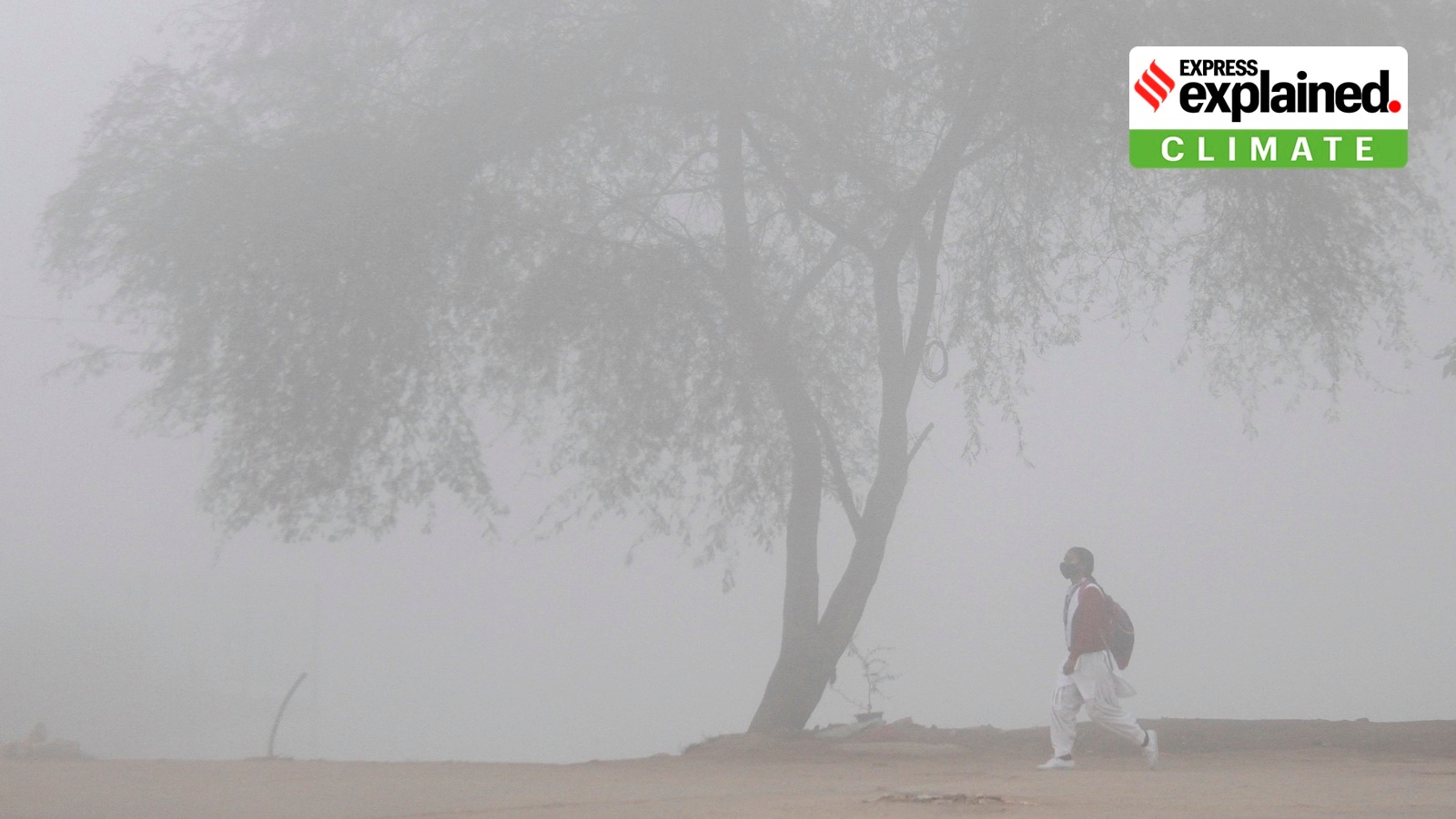
Large parts of Punjab, Haryana and Chandigarh have remained under the grip of dense to very dense fog for several consecutive days, with visibility dropping sharply at several places, at times even during daytime hours.
The India Meteorological Department (IMD) has issued a yellow alert for dense to very dense fog over Punjab, Chandigarh and Haryana. According to the IMD, foggy conditions are likely to persist across the region till at least December 27, also triggering ‘cold day’ conditions in some areas. A ‘cold day’ is when the minimum temperature of a station is less than 10°C for plains and less than 0°C for hilly regions.
Here is why fog has lingered for so long and why it is refusing to clear even during the day.
Weather conditions have remained dry across Punjab. Dense to very dense fog was reported at isolated places on Sunday, along with cold day conditions in some parts of the state. The average maximum temperature rose by 1.5°C from the previous day but continues to remain 2.1°C below normal. The highest maximum temperature in Punjab was 21°C, recorded at Samarala (AWS).
The IMD has issued a dense fog warning for isolated places in Amritsar, Tarn Taran, Kapurthala, Jalandhar, Ferozepur, Fazilka, Faridkot, Muktsar, Bathinda, Ludhiana and Mansa districts. Cold day conditions are likely at isolated places in Gurdaspur, Amritsar, Nawanshahar, Kapurthala, Jalandhar, Bathinda, Ludhiana and Mansa districts. Light rain is also likely at isolated places in Amritsar, Gurdaspur, Pathankot, Tarn Taran, Kapurthala and Hoshiarpur districts.
In Haryana, the weather remained dry. Dense fog was observed at isolated places, while cold day conditions prevailed in some areas. The average maximum temperature recorded a slight fall of 0.1°C from the previous day and continues to remain 2.7°C below normal. The highest maximum temperature in the state was 20.8°C, recorded at Panchkula (AWS).
According to the IMD, a combination of stable atmospheric conditions, weak solar heating and high moisture levels is responsible for the persistence of fog across the Indo-Gangetic plains. The absence of strong western disturbances has resulted in calm to very light winds, which are crucial for dispersing fog.
“Cold surface temperatures, high moisture availability and almost no wind are creating ideal conditions for fog formation and its persistence. Since there is no significant change in the synoptic weather pattern, fog continues to linger for long durations,” said Surinder Paul, Director, IMD Chandigarh.
Why is fog continuing for several days without improvement?
IMD officials say weather conditions across north-west India remain largely stagnant. With no significant change in the synoptic pattern, fog that forms during night hours remains trapped near the surface. The lack of wind prevents vertical mixing of air, which is essential to lift and disperse fog layers.
Additionally, cold surface temperatures maintain high relative humidity levels near the ground, allowing fog to regenerate night after night.
The IMD attributes daytime fog persistence to a combination of low winter sun angle, weak solar radiation and the presence of low-level cloud cover. These factors significantly limit surface heating, which is required for fog droplets to evaporate after sunrise.
Fog is classified as moderate when visibility ranges between 500 and 200 metres, dense when visibility is between 50 and 200 metres, and very dense when visibility drops below 50 metres. In several areas across the region, visibility has frequently fallen into the dense and very dense categories even during daytime hours.
What role is pollution playing?
Pollution has further worsened the situation, reducing the ability of sunlight to penetrate and warm the surface.
“High pollution levels over the region’s plains are worsening fog conditions. Pollutants act as condensation nuclei, allowing moisture to condense more easily and form thicker fog layers. This interaction between moisture and pollution is leading to very dense fog at several locations,” said Paul.
The high concentration of particulate matter traps moisture close to the surface, increasing fog density and duration.
Why is fog more intense at some locations?
Fog intensity varies due to local geographical and environmental factors. Areas close to canals and irrigated agricultural fields experience higher moisture levels. Low-lying terrain allows cold air to settle, while urban pollution pockets contribute to denser fog formation.
As a result, isolated places often witness sudden and sharp drops in visibility, while nearby locations may record relatively better conditions.
Experts say fog conditions are likely to ease only with an increase in wind speed, the arrival of a fresh western disturbance, or a noticeable rise in daytime temperatures. Until then, dense to very dense fog is expected to continue during night and early morning hours, with isolated spells extending into the daytime as temperatures fall further, said the IMD.