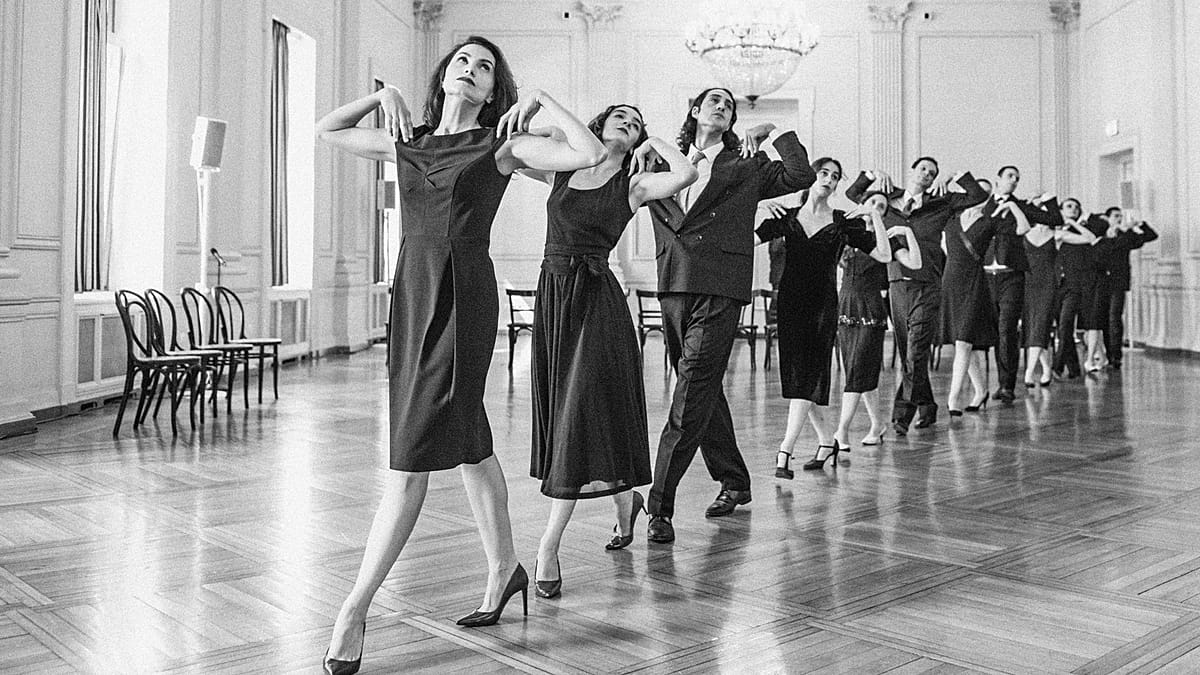
"Kontakthof", one of the emblematic works of Pina Bausch, the German choreographer who had a decisive influence on the form and content of contemporary dance, will be presented from Wednesday 17 December at the National Theatre, in collaboration with the Pina Bausch Foundation.
37 years after its first performance in Greece, at the Herodeion in September 1988, by Tanztheater Wuppertal, the landmark work is now hosted on the main stage of the Schiller Building, in a production featuring exclusively Greek performers aged 21 to 55.
This stage revival is under the artistic direction of Josephine Ann Endicott and Daphne Kokkinou . Both have danced in dozens of the great artist's works and were the ones who selected the Greek cast, in collaboration with Ann Martin, also a member of the original cast, and Scott Jennings, rehearsal directors of the Pina Bausch Foundation. All of them know "Kontakthof" very well.
Josephine Ann Endicott, 75, danced in the first performance in 1978 and was the choreographer's assistant for many years. She remembers the whole course of the group from the beginning: "I participated mostly in Pina Bausch's early works. I joined the dance company in 1973, so by the time we got to the Kontakthof in 1978, we had already done many revolutionary works and many operas in dance form. We had already had tomatoes thrown at us, there were spectators leaving during the performance and banging on the doors. I was a member of the group at the time. Slowly, when we arrived at the "Kontakthof", people were no longer leaving. Pina Bausch had become quite well known, a cult figure with a new way of working that didn't have dancing. There was something about this woman, something so unique and special to me personally, that made me stay there for so many years. I only took a few breaks to have my children.
She herself as a woman was very beautiful. First of all, when she was younger, she could influence people. Her ideas were unique. She had this way of working with questions and answers. All the time I felt I could be myself in her group. That was what she was looking for and it was also what I was looking for. Jo was able to be herself under Pina's eyes because of her guidance. All the things I could do, I could offer her. We were able to create some works that had to do with people's everyday lives. Her work was always interesting to me and I liked all the musical pieces she put in her works. She was a genius. I didn't know it at the time. I wasn't there just because she was a genius. I was there because I loved her."
Daphne Kokkinou's life and dance career also changed radically when she saw performances by Pina Bausch in Athens in the 1980s. So he decided to continue his journey in Wuppertal, Germany, after completing his studies at the KST. He joined the German Dance Theatre in 1993 and in 2002 he became Pina Bausch's assistant. What does he remember from "Kontakthof" at the Herodion in 1988?
"I saw this play for the first time at the Herodeion when I was a student in 1988, before I left for Germany. I was impressed. I remember very well, very vividly the smile the dancers had towards the audience during the cycle. It's amazing that I remember it after all these years. Then when I joined her chorus, I started learning the piece with Jo's help. I love dancing it so much. I danced it last year and will dance it again this summer.
With the work we did at the National Theatre, teaching every move, every scene, everything in the piece, I have a much better understanding of what I do on stage. Before, maybe I only knew things from my own perspective, through my own role. But now all of a sudden, when I was under the stage, I learned so many things, in terms of what my colleagues do on stage, all the preparation, all the steps. It's amazing the work we did for this show in Athens. It's not just the teaching, it's the whole experience. It's really wonderful to dance this particular piece, because you become a co-creator of it, part of its universe."
Josephine Ann Endicott has done several stage revivals of Kontakthof. How did you work with the 23 Greek performers and performers? How did they go about selecting the cast for the Greek production?
"I thought it was a great idea to do this particular play with Greek performers, because in Kontakthof, there is more acting than dancing. Of course we never pretend in the play, we are ourselves on stage. Anyone who came to the audition and pretended, we didn't take them, because we were looking for real people who can speak, stand, have rhythm, present themselves, show who they really are. We chose performers we liked and who said something with their eyes, with their faces, with their aura. Every person has an aura.
Many of the actors took a little time to get into the spirit of the show. You can't get into the world of Pina Bausch that quickly and easily. That's why we had to motivate them to unlock, to find their own identity in the play. Just be themselves and show us who they are. It sounds very simple, but simple things are often the hardest. But we are very happy with the ones we chose. It was a real pleasure to produce this production. I have to admit that I love the humour of the Greeks. I love the way they use their hands when they talk all the time."
"Kontakthof" was first performed in 1978 at the Wuppertal Opera House and is a landmark of Pina Bausch's early period and a pivotal example of her collaboration with set and costume designer Rolf Borzik, who shaped the visual language of the company in those pivotal years. The play continues to tour to this day, often with different generations: in 2000 with Ladies and Gentlemen Over 65 and in 2008 with teenagers aged 14 to 18.
At the heart of the play are human relationships. Love, desire, conflict, the need to communicate, tenderness, violence and loneliness. Men and women meet in a dance hall, reveal aspects of themselves, with the aim of connecting. The way these relationships are portrayed is sometimes humorous and sometimes cruel. A struggle of emotions, repetitive actions and gestures unfolds on stage, inviting the viewer to take part.
"Kontakthof for me is a meeting place for twenty-three people, who meet in a dance hall in search of human contact. They are nuggets of our whole life and our whole being through the eyes of Pina Bausch, in a completely poetic way. But it is a place where we can all find ourselves. That is, we performers come with ourselves to lose ourselves and to find ourselves. I think that's what happens to the person watching the play. For me it is a place of freedom, a place where I can be me, with all my good and all my bad.
The biggest challenge for me is that it's an absolute combination of acting and dance. And for me that's a great happiness, because it's what I am and what I've done, which is an actor and a dancer. The way Pina Bausch has combined these two arts is a challenge in itself for me. What has it taken for me to do? I am very committed to this project. I have given everything I have and haven't physically and mentally. It took a lot of physical work and a lot of study. I've spent a lot of time finding my own story within this project, because it's not clear. This play doesn't have a clear story, so we each have our own journey. And I have spent a lot of time looking for that journey," says Melina Kontis.
Alexandros Vardaxoglou has also studied acting and dance. It was his dream to participate in this performance. We see all these small and big relationships that arise between them, their eroticism, their love affairs, their friendships, their rivalries, jealousies, the need to stand out, to be loved, to be noticed.
The play has so much great variety of relationships and emotions. It constantly transitions to different things. I think it's like seeing a miniature of a society in a way. I feel a lot of times like I'm in a village with all the good and bad of a closed world,which over here goes from the smallest to the biggest. There are big transitions. It's a poetic work, a poetic world.
I treat this material with awe but also with a lot of love, because from a young age, when I was in dance school, I watched her works. Sometimes when I do her material, it feels like a lie. I can't believe I've suddenly entered this world. I feel very happy that I've been lucky enough to enter her world and feel something of what the people who met her felt. You often feel like you're meeting her because you're in her work."
Daphnis Kokkinos has been a permanent member of the Wuppertal Dance Theatre since 1993. He became the German choreographer's assistant in 2002. What makes her work special?
"What makes Pina and her work special is the way she presented the dance. It's also what she wanted to say with the dance and how she used her dancers to touch a little bit of what was in her mind and soul. What she had was something very, very real. That's why it touches us all. It's something that belongs to everyone, something we all have in common. She was able to make it dance, make it move and bring it out on stage. It's stuff that touches all of us. It's stuff that burns us and engages us. These are the things we live with every day.
These everyday things, Pina Bausch was able to make them so that they are truly art. When we were working together and we were doing something very small, we said this is just stupid. But she would make it like that and put it somewhere else and suddenly this trivial thing became important. We had a lot of freedom when we worked with her on the projects. It was wonderful, the freedom it gave you to explore, to express yourself. So I think what makes her special is how she made little everyday things into art on stage."